
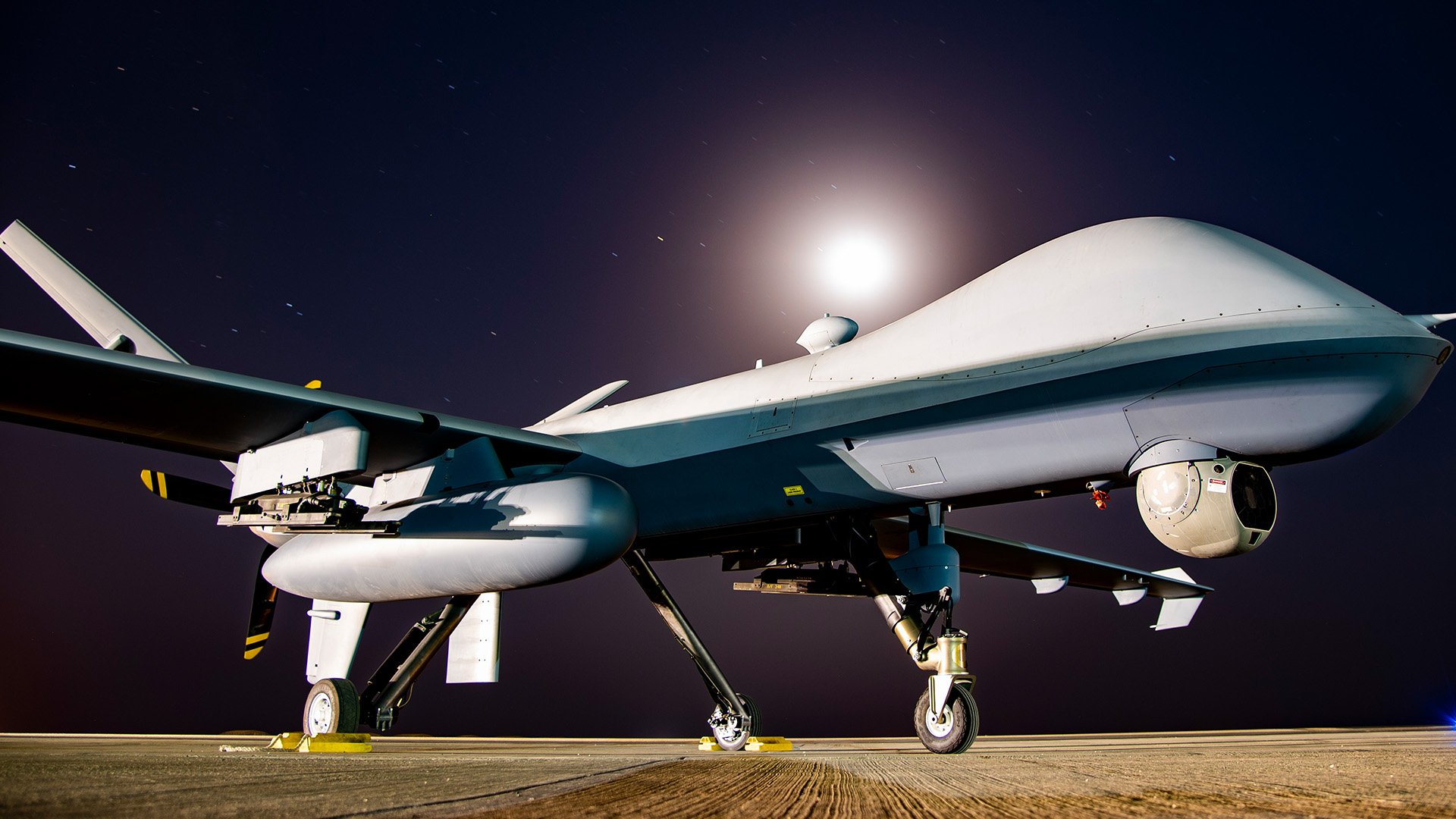
The crew of a malfunctioning MQ-9A drone worked for more than 7 minutes last August to keep their stricken aircraft aloft, but a damaged wire in the fuel system had irreversibly killed its newly installed engine, dooming the $23 million drone after a day-long mission in the Middle East.
Flying from a base in South Dakota, the Reaper’s pilot guided the powerless drone for nearly 10 minutes before making a “forced landing” that buckled the landing gear. Rather than recover the drone inside the undisclosed country in which it landed, U.S. forces destroyed it.
Details of the previously unreported crash were released Wednesday by the Air Force in a final report of a crash investigation board. The board found that a damaged wire in the fuel system was likely at fault for the crash, and that the crew — flying remotely from Ellsworth Air Force Base, South Dakota — had no hope of saving the drone once the fuel system shut down, despite making two attempts to restart the engine as it descended.
The report did not specify where the Reaper crashed or its operational home base, saying only that the mishap occurred in the region under U.S. Central Command, which includes all of the Middle East. Notably, the report noted that the aircraft was not recovered, but “based on the circumstances and the location of its landing, sensitive equipment was recovered from the [Reaper] and its remaining wreckage was demolished on site.” The report added no details on the recovery operation or the drone’s destruction, but U.S. forces commonly drop bombs on disabled aircraft to prevent them falling into enemy hands, including two MC-130 special ops planes lost in April during the rescue of an F-15 weapons officer inside Iran.
The report speculated that the bad wire in the fuel system developed a short by rubbing or “chaffing.” It’s failure caused the fuel system to shut down. The report also noted that the 19-hour mission was the first the MQ-9A had flown after a new engine was installed in the drone as part of a scheduled 3,000-hour maintenance overhaul.
Top Stories This Week
At least some of the drone’s maintenance, the report said, was done by Amentum, a private contractor, which the Air Force employs to do “Comprehensive Engine Management System support; Aerospace Ground Equipment (AGE) and Ground Support Equipment (GSE) maintenance” for MQ-9As. The report did not specify if private or Air Force crews handled the engine swap.
The report noted that crews did not put the MQ-9A through a post-engine swap shakedown flight, known as a Functional Check Flight or Operational Check Flight. Air Force rules, the report said, require a shakedown flight after engine swaps for most manned aircraft, but not for MQ-9s.
But the board said there was no evidence that the engine swap damaged the wire that caused the crash.
“No evidence indicates that maintenance procedures executed were a factor in this mishap,” wrote Col. Brian Desautels, who served as the president of the investigation board. Desautels, according to an online biography, is a career C-130 rescue pilot who now commands an Air Force rescue group at Moody Air Force Base, Georgia.
Over 40 MQ-9s lost since 2024
Another detail in the report hints at how much action MQ-9As have seen in the last two years in the Middle East, as the U.S. prepared and launched its ongoing war with Iran. The two operators of the drone — a pilot and a sensor system operator — had flown almost 60 flights in the previous 90 days, a number far higher than most Air Force pilots fly in manned aircraft. In the 30 days before the crash, the report said, the pilot had flown 19 times and the sensor operator 23 times.
Though the Air Force has over 200 MQ-9s in its inventory, according to the Aviation Safety Network, which tracks both military and civilian aviation mishaps around the world, roughly 40 MQ-9As have crashed since the U.S. increased hostilities with Iran in 2025, most of which have been shot down over Iran or Africa.
Correction 8/21/2026: An earlier version of this story referred to the MQ-9A as a Predator. The correct designation is a Reaper.
Loading comments…
Comments couldn’t be loaded. Please refresh the page.