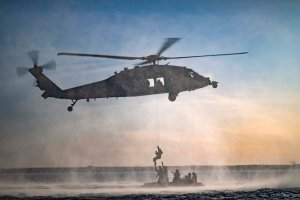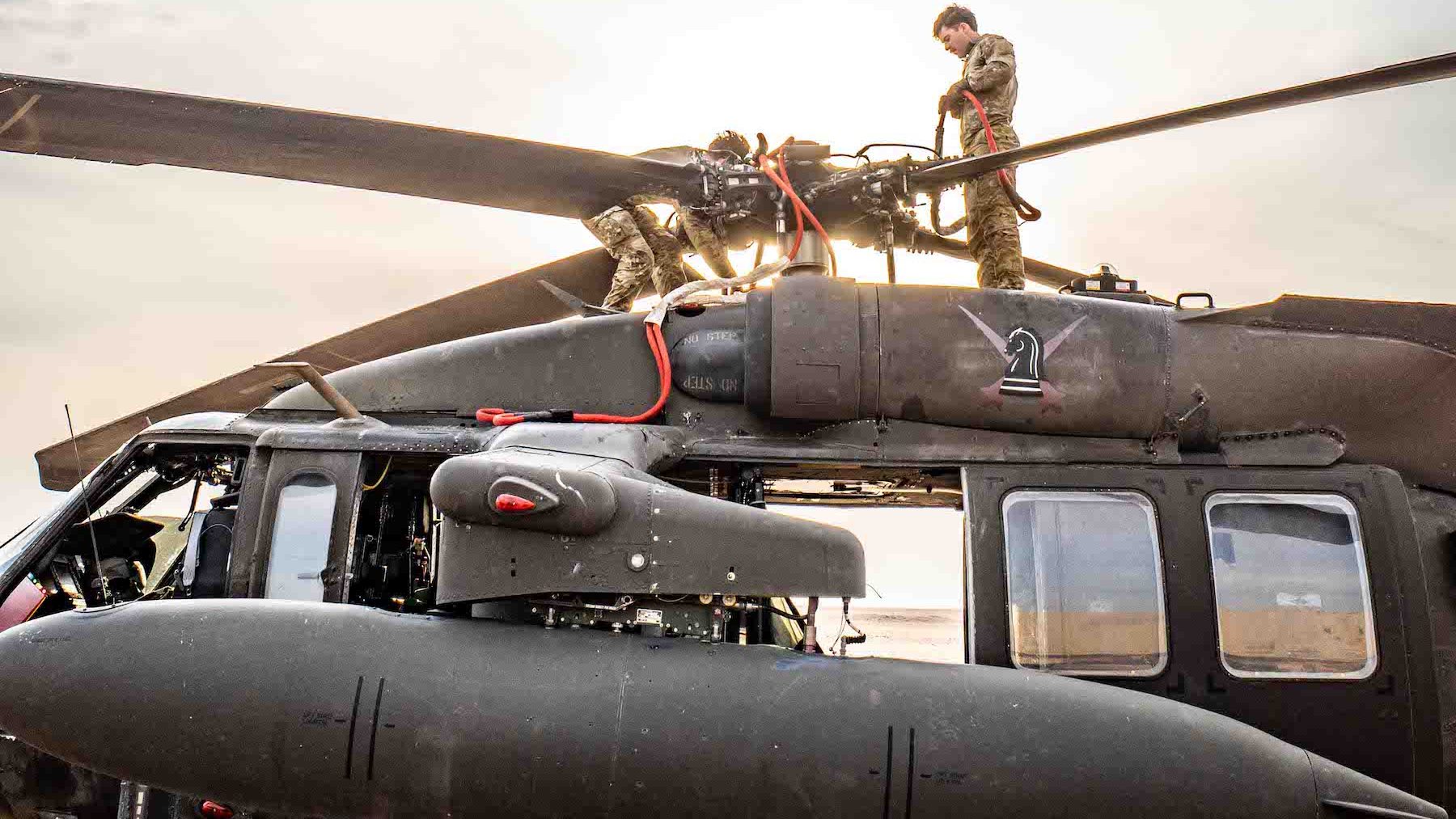
Col. Tyler Partridge began his career as a finance officer. During his first deployment to Iraq in 2003, he rode in ground convoys as Army helicopters buzzed overhead.
This year, he is again deployed to Iraq, this time as the commander of the 101st Combat Aviation Brigade.
Now a commander tasked with sending his own soldiers out on missions, Partridge said he recalls his time as a young officer on the ground in much more tumultuous Iraq. Though he knew nothing about aviation units, he remembered the reassurance that he felt when Army helicopters flew overhead for protection.
“It hit different when you had helicopters supporting you on the ground,” Partridge said. “Fast forward, 22-plus years later, I’m back over here in a far different capacity, in a different job, actually as an aviator and in charge of an aviation brigade and it dawned on me the opportunities for young officers and [non-commissioned officers] and soldiers trying to get to see that and learn that firsthand are fewer and far between.”
And so what Partridge calls the Air-to-Ground Initiative was born. Working with Col. Daniel Kearney, commanding officer of 10th Mountain Division’s 1st Brigade Combat Team, the two commanders agreed to exchange one soldier from each unit with the other for a week. One of Partridge’s pilots spent a week with a 10th Mountain infantry unit while a 10th Mountain mechanic shadowed along with 101st aviators, finding a newfound respect for the others’ job, and even culture shock.
“It’s oftentimes hard to understand how the ground force lives, communicates, plans, whatever it may be. The same thing for our formation,” Partridge said.
Top Stories This Week
From the aviation side, Partridge sent Warrant Officer Colton Francis, an Apache helicopter pilot who originally enlisted as an infantryman. Francis said the exchange was a way for soldiers from both worlds to ask each other questions and understand what exactly it is they do — a rare occurrence even when soldiers share a base or division.
“When I was in the infantry, I’d look up and I’d see Apaches or Black Hawks or any other aircraft, and I would have zero clue of what they’re doing. I just know that they have a helicopter that flies around the sky and they’re there for me,” Francis said. “We don’t ever train with the conventional infantry guys. Even back home, it’s rare that we ever train with them besides, when we do, like a monthly operation called Operation Lethal Eagle back at [Fort Campbell, Kentucky].”
Partridge said it’s a very common situation where units with both aviation and ground elements don’t have the time to do these exchanges “unless it’s very deliberate” or a directive from higher up.
For a week in June, Francis joined a platoon in the 10th Mountain’s 32nd Infantry Regiment and provided security for ground convoys traveling more than 1,000 miles throughout Syria. While traveling with the convoys, Francis said he fielded infantry soldiers’ questions on the weapon systems, tactics and lifestyle of Army aviation.
“They think they’re talking to a pilot up in the sky and they get all nervous on the radio to talk to a dude and not know what to say. I can totally understand that. I came from the same exact world,” he said. “At the end of the day, we’re all human beings. You tell me your location, where you’re at and then where the bad guys you want us to take care of are at, and we’ll take care of the rest up in the air. That’s just kind of what I overstated to them. It’s not rocket science, just speak in plain English and we’ll work out the rest.”
From the 10th Mountain side, Staff Sgt. Shaquille Wisdom volunteered to switch jobs for a week.
A wheeled vehicle mechanic, Wisdom enlisted right after immigrating from Jamaica at 16 and finishing high school in the U.S. He became a mechanic because of his love of cars but has been considering moving to aviation. In May, Wisdom was assigned to the 101st Aviation Regiment, where he went on Black Hawk and Chinook training flights and shadowed their mechanics.
Wisdom was previously assigned to aviation units at Fort Drum, New York and Wheeler Army Airfield, Hawaii, but he never got to interact with the pilots and see what they did. This opportunity gave him that — and a bit of culture shock.
“Their job is more dangerous than ours because they’re flying helicopters,” he said. “When they’re on mission, they’re more relaxed because they want everybody to be comfortable… [If] you’re in the air and somebody’s not comfortable, then it can lead to problems.”
Going from a regimented infantry unit with “Yes, sir. No, sir. Yes, ma’am. No, ma’am,” he said, to an aviation unit where soldiers call each other by their last names.
“They can talk to each other without using rank. Everybody knows your rank already. We know who the higher rank is, we’re not gonna disrespect you,” Wisdom said. “They’re completely fine with it because they’re all on the same page.”
But while Wisdom’s appreciation grew for the dangers of aviation roles, Francis’ time with an infantry platoon deepened his respect for soldiers in his old infantry lifestyle.
“The most thankless job in the military, I believe, is the infantry. They don’t get the credit they deserve. Those guys are going outside the wire more than anybody out here at [U.S. Central Command]. They’re getting little sleep. They’re having the longest days, driving the longest distances,” Francis said. “It was really a reminder for me of where I started and my foundation to really appreciate where I’m at now.”
Partridge said they’re looking to continue swapping soldiers during the rest of this deployment and continue once back home.
“I think that the Army is better off when our ground soldiers understand the perspective of aviators, and then our aviation element has a walk a mile in the boots of the ground forces they’re supporting,” he said.