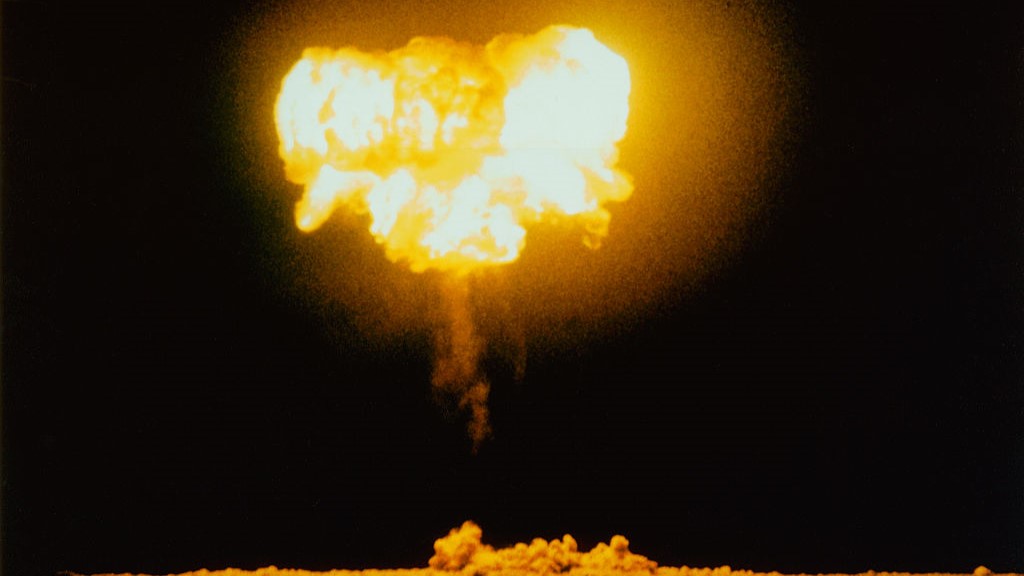
Imagine if you will, a low-cost, small weapons system. It could fly stealthily into enemy territory, not being mistaken for a bomber or any kind of missile. And then it could detonate a nuclear weapon onboard, hitting a desired target. That system? A balloon.
Back in the 1950s military researchers seriously explored using free floating balloons as a way to launch nuclear bombs at enemies.
The idea was taken seriously enough by the United States government that nuclear researchers did a formal study on it. The report from the Sandia Corporation, which oversaw the Sandia National Laboratories, one of the nation’s top nuclear research centers, came out in 1957 and determined that there was some merit to using balloons, but a lot of risks.
The military had been testing nuclear weapons regularly, and had some idea of what a balloon could carry. A large, identified as being 100 feet in diameter, balloon could carry a nuclear weapon into enemy territory. And weaponized balloons were not a new idea. During World War II, Japan built and fielded thousands of Fu-Go fire balloons, small and cheap inventions meant to float over the Pacific Ocean, reach the West Coast of the United States, and set much of it on fire. They were incredibly unsuccessful, failing largely before they reached their targets. They also struggled with the reality of nature — winds flew them off course and if they did reach the Pacific Northwest, wet and damp conditions left the fire bomb part of their nature ineffective. But they set a recent metric for how balloons could be used for stealthy and cheap weapons.
Those were all factors researchers looked at. Nuclear-armed bombers were a powerful force of the American strategic arsenal, but they were costly, high-tech and a known entity to the Soviets. Balloons were a smaller, stealthier approach.
“[…]it appears that under certain conditions the free-balloon delivery system may compete with other systems requiring multiple weapons,” the report noted.
Top Stories This Week
Those advantages included the fact that the balloons were both cheap to make and relatively simple in nature. Several could be deployed at once, increasingly the chances of success. If concerns over enemy response were serious, the U.S. could also launch nuclear-armed balloons alongside a flood of dummy balloons, hiding the strike weapon amid duds. Then there were the downsides, of which there were several. Mainly, weather was the big concern. Launching the balloons required good conditions. Since these were specifically free balloons, there was no way to guide them or adjust for altitude. They also were, like the Fu-Go balloons, susceptible to the wind.
Other concerns included the risk to allies. A large balloon could make a trek to enemy territory without risk to allies. But there were size and weight limits to the bomb carried. The radioactive fallout of a nuclear weapon also meant that if and when a nuclear weapon detonated, the balloon would need to be well within enemy territory to avoid endangering allies downwind.
And, well, they were slow and easily shot down, by air or by ground forces.
A few months later, the U.S. military launched Operation Plumbob, a series of nuclear tests. The operation was a test for different nuclear detonation methods — using ground-based towers, high-altitude detonations and, yes, balloons — and how troops would react on the nuclear battlefield. It was one of many exercises done as the U.S. military experimented with how personnel could fight in the age of nuclear weapons and what impact they would have on them.
For all of the failures balloons offered, the real downside came months later in the fall of 1957. The Soviet Union launched Sputnik into orbit, showing it was capable of launching intercontinental ballistic missiles. Suddenly ICBMs became the dominant nuclear weapons systems, with both sides of the Cold War pouring resources into research and testing on rocket-delivered nukes. That would lead to its own unique nuclear proposals — such as ideas to nuke the Moon or blanket enemy countries in a nuclear death cloud by taking advantage of magnetic fields — but the speed that ICBMs offered essentially rendered free floating balloons a quickly forgotten idea for the ages.