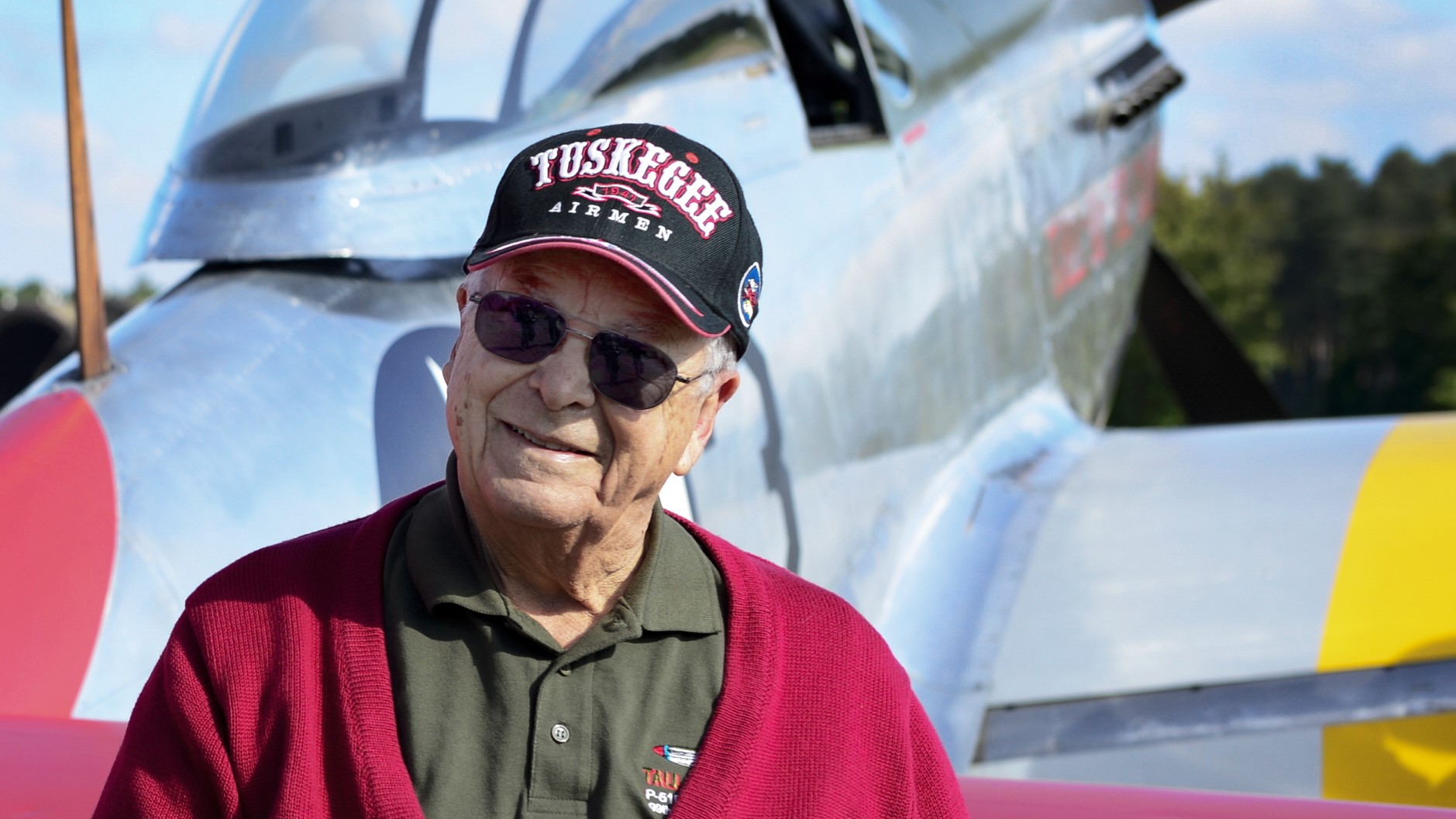
Lt. Col. George Hardy, one of the original members of the Tuskegee Airmen and one of the nation’s first Black fighter pilots, had died. He was 100.
Hardy passed away on Tuesday at his home in Sarasota, Florida, according to Tuskegee Airmen Inc., a nonprofit group focused on honoring the history and impact of the group. Hardy was part of the original group of Tuskegee Airmen and is believed to have been the last of the original group’s combat pilots from World War II.
“His legacy is one of courage, resilience, tremendous skill and dogged perseverance against racism, prejudice and other evils,” the group said in its announcement on Friday of Hardy’s passing. “We are forever grateful for his sacrifice and will hold dear to his memory.”
According to Tuskegee Airmen Inc., only 13 of the original group of Tuskegee Airmen remain.
Hardy was born on June 8, 1925 in Philadelphia, PA. When World War II broke out, his brother joined the Navy. Hardy wanted to follow in his brother’s footsteps but was dissuaded after his father refused, citing racism in the military, according to the National World War II Museum. Eventually, just after turning 18, Hardy joined the U.S. Army Air Forces. He, like other African-American pilots and aircraft crewmen, trained at Tuskegee Army Air Field. This was where the segregated military sent Black soldiers to train as fighter and bomber pilots, navigators and mechanics.
Then-2nd. Lt. Hardy was sent off to Italy with the 99th Fighter Squadron, 332nd Fighter Group, the all-Black fighter group nicknamed the “Red Tails.” He and the others in the squadron were tasked with escorting American bombers for missions over Axis territory. The Tuskegee Airmen became widely known across the Army Air Forces in Europe; bombers suffered some of their lowest losses in the war — when they had high casualties overall — when they had Red Tails providing cover. When he was piloting his P-51 Mustang, Hardy was only 19, the youngest Tuskegee Airman in combat.
After the war he studied engineering, first at New York University before he was recalled to active duty, then at the U.S. Air Force Institute of Technology for his graduate degree. He was sent back into combat during the Korean War, this time piloting a B-29. He flew 45 combat missions during the war and again stayed in the military after hostilities ceased. He would see action once again during the Vietnam War. There, Hardy flew 70 combat missions, more than he had in the previous two wars combined, piloting a C-119 gunship, often during nighttime missions. He finally retired in 1971, after nearly three decades of service.
Top Stories This Week
Hardy’s military service ran parallel with the integration of the armed forces. When he was fighting in Korea, segregation in the military was over. He would later recall a time during the Korean War where a racist officer blocked him from joining a mission, leaving his crew that he had worked with to face danger without him. By the time he was in Vietnam, he was a lieutenant colonel, overseeing a large number of white officers.
After leaving the military, Hardy remained active in veterans circles and served as a representative for the legacy of the Tuskegee Airmen. He spoke regularly about the airmen and his own experiences well into the 2010s.
During his service, Lt. Col. George Hardy was awarded the Distinguished Flying Cross with Valor, the Air Medal with 11 Oak Leaf Clusters and the Commendation Medal with one Oak Leaf Cluster. He and the rest of the Tuskegee Airmen would receive the Congressional Gold Medal in 2007 for their actions.