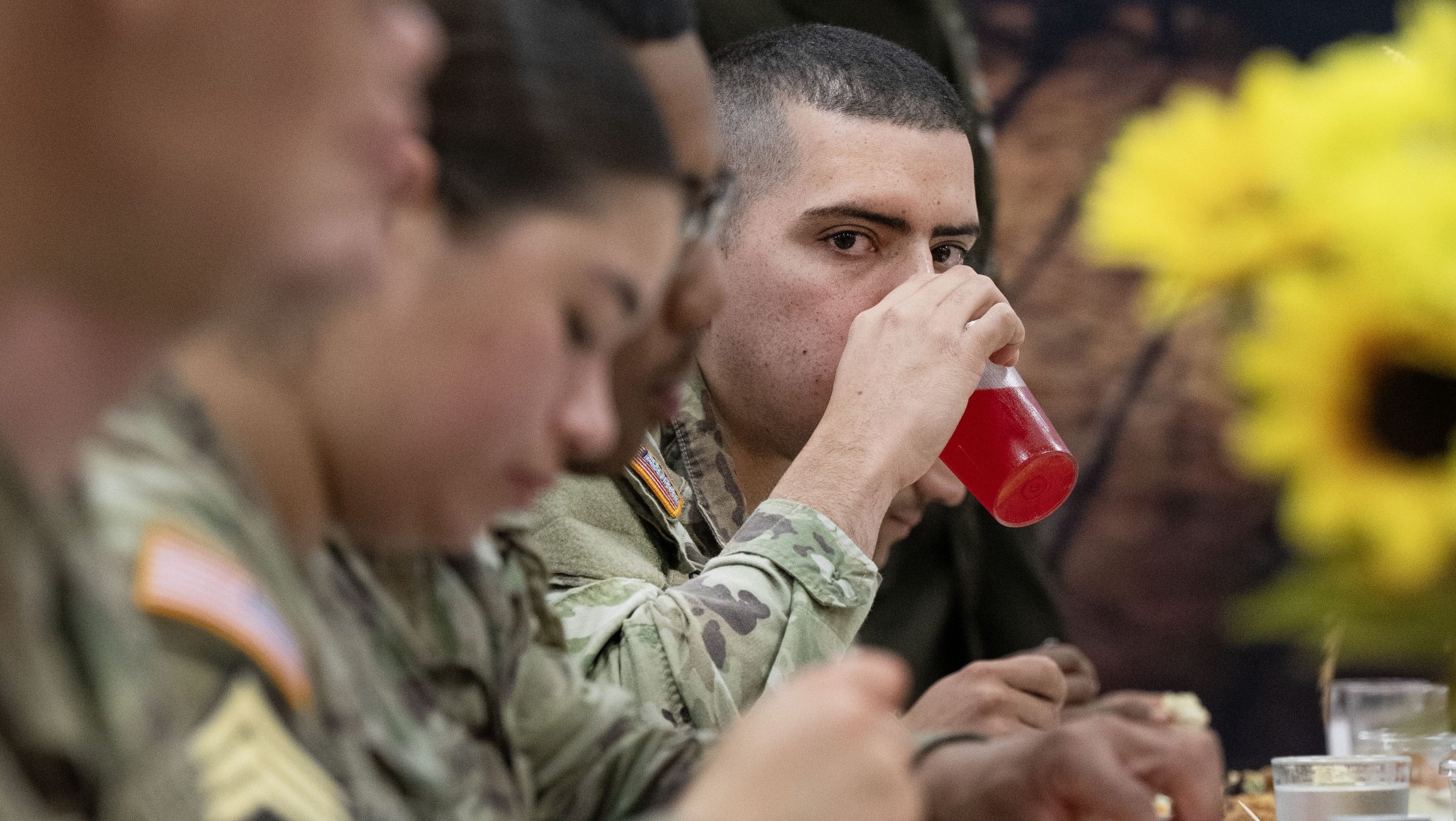
Starting this month, the Army has begun closing some dining facilities at major bases to begin renovations that will overhaul and privatize how soldiers eat on base. But according to documents posted on a federal contracting site, the Army’s next major dining makeover may be the chow halls that feed brand new soldiers as recruits at basic training and when they move on to advanced individual training schools.
An Army official made clear to Task & Purpose that these changes are in the early planning stages but will differ from the overhauls and “campus-style” remodels underway and planned at regular bases. Boot camp and AIT dining will continue to conform to the training the soldiers are in, where they “follow fixed schedules, have specific nutritional needs, and must use assigned dining facilities, resulting in higher rates of usage,” Col. Nichole Downs, a spokesperson for Army Materiel Command, told Task & Purpose in an email.
In contracting documents posted by the Army this month, the service is “seeking innovative, flexible solutions” to upgrade the dining halls at bases run by the Army Transformation and Training Command, or T2COM, where soldiers attend Basic Combat Training and Advanced Individual Training.
Anyone who has been through basic training in the last few decades will remember vividly how the process has long worked: three and sometimes four times a day, recruits file into a dining hall “utilizing a straight-line feeding layout designed to rapidly flow trainees through the facility,” according to the documents posted to Sam.gov, the federal government’s website for contracting opportunities.
Bases and facilities run by T2COM, which recently absorbed Training and Doctrine Command to run all formal Army training, average more than 55 million meals each year and feed soldiers seven days a week.
The culture of moving soldiers through breakfast, lunch, and dinner in an assembly-like fashion doesn’t seem to be changing, but the Army wants vendors and tech companies to address “efficiencies in staffing, scheduling, menu management, maintenance, supply chain integration, training, or service delivery models,” Downs said.
“This will be a change in the food service model. Soldiers will still follow fixed schedules, etc,” said Samantha Tyler Hill, an Army Materiel Command spokesperson.
Under what the service is calling the Army Dining Excellence Initiative, private-sector pitches will be tested at Fort Lee, Virginia and Fort Rucker, Alabama, dining facilities, DFACs, according to the documents.
The chosen commercial dining projects or innovations may be expanded to other T2COM bases that host formal entry-level training, including the Presidio of Monterey, California; Fort Huachuca, Arizona; Fort Leonard Wood, Missouri; Fort Sill, Oklahoma; Fort Knox, Kentucky; Fort Gordon, Georgia; Fort Benning, Georgia; and Fort Jackson, South Carolina.
The overhaul is separate from the service’s announced plans to remodel DFACs at five of its largest bases to resemble campus-style dining halls at colleges and universities, to get soldiers to eat at underutilized base cafeterias. In October, Army officials said the campus-style dining model would be expanded to eight to ten installations.
The campus-style dining format is planned for bases like Fort Bragg, North Carolina, and Fort Hood, Texas, where soldiers are consistently based and eat on their own schedule. The documents describe “the new millennium soldier” seeking “a more open, inviting facility atmosphere” where they have more menu options and “station style feeding concepts,” with greater choices over their meals.
Despite this language, the documents make clear that basic training chow halls are still very much basic training.
“The needs of T2COM garrisons are distinct: operations must align with fixed training
schedules and concentrated dining flow rates,” according to the documents.
Correction, 12/17/2025: An earlier version of this story incorrectly identified a base that may eventually be included in the dining program. The base is Fort Knox, Kentucky.