

Finn is a squared-away Marine: fit, disciplined, proud. Like many Marines, he takes supplements to train harder and stay in the fight longer. The label on the container the supplements came in, which he didn’t read, listed ipamorelin, CJC-1295, and enclomiphene — alphabet-soup chemicals he couldn’t pronounce.
They are also on a Department of Defense “prohibited ingredients” list that he didn’t know existed.
Weeks after a superior discovered the supplements in his room, Finn was facing separation for “drug abuse.” No hearing, no real chance to explain, allowed only to submit a written statement, pleading that some official he would never meet might let him keep the budding career that already meant everything to him.
Finn, whose name I’ve changed here, is one of hundreds of service members whose cases I’ve become familiar with in my years as a Marine Corps lawyer. The stories echo one another: their careers are ending because of an obscure database of banned “ingredients” called Operation Supplement Safety (OPSS). The site does not contain a full list of “prohibited ingredients and substances” for supplements, but rather provides a search box of a hidden database. The database can’t be searched by brand names, but only for the specific chemical ingredients listed mostly in small print on the back of packaging. The system offers little help or leniency for typos, no matter how long or obscure the word.
OPSS began with good intentions. In 2012, with supplement use on the rise, the DoD launched an educational campaign to help service members make informed decisions about supplements. But somewhere between mission and execution, education became enforcement. A decade later, DoD Instruction 6130.06 flipped that informational campaign into the official program for maintaining the prohibited ingredients list.
Top Stories This Week
Now more than ever, the military wants troops who are in peak shape. In his September 2025 address at Quantico, Virginia, Secretary of Defense Pete Hegseth declared that “it all starts with physical fitness,” mandating twice-yearly PT tests and daily PT for all ranks. He warned that lowered standards “get our sons and daughters killed.”
But as fitness requirements ramp up across all four services, there is no indication that the Department has plans to increase the education troops receive on supplements, banned substances and the severe career consequences of small mistakes.
The result? The service members who will be most committed to meeting these heightened fitness standards — the hard chargers that OPSS was created to protect — are often the ones most likely to be punished for violating rules they never knew existed.
OPSS hosts overlapping lists: a “Prohibited Ingredients List,” a “Performance-Enhancing Substances” list, and an “Ingredient Index” that isn’t exhaustive or authoritative. Even military lawyers struggle to understand which list is authoritative. The site instructs users to enter only one ingredient at a time, never a product name. So a soldier using a supplement with a name like Mega Burn Pro has to manually type and verify each ingredient, letter by letter.
In Finn’s case, if he entered “enclomiphene,” OPSS would immediately tell him “the ingredient as entered is on the Prohibited List,” with a menacing red ‘X.’ But if he instead typed “enlcomiphene,” OPSS would blandly reply: “The ingredient as entered is not on the prohibited list,” with no hint he’d transposed two letters.
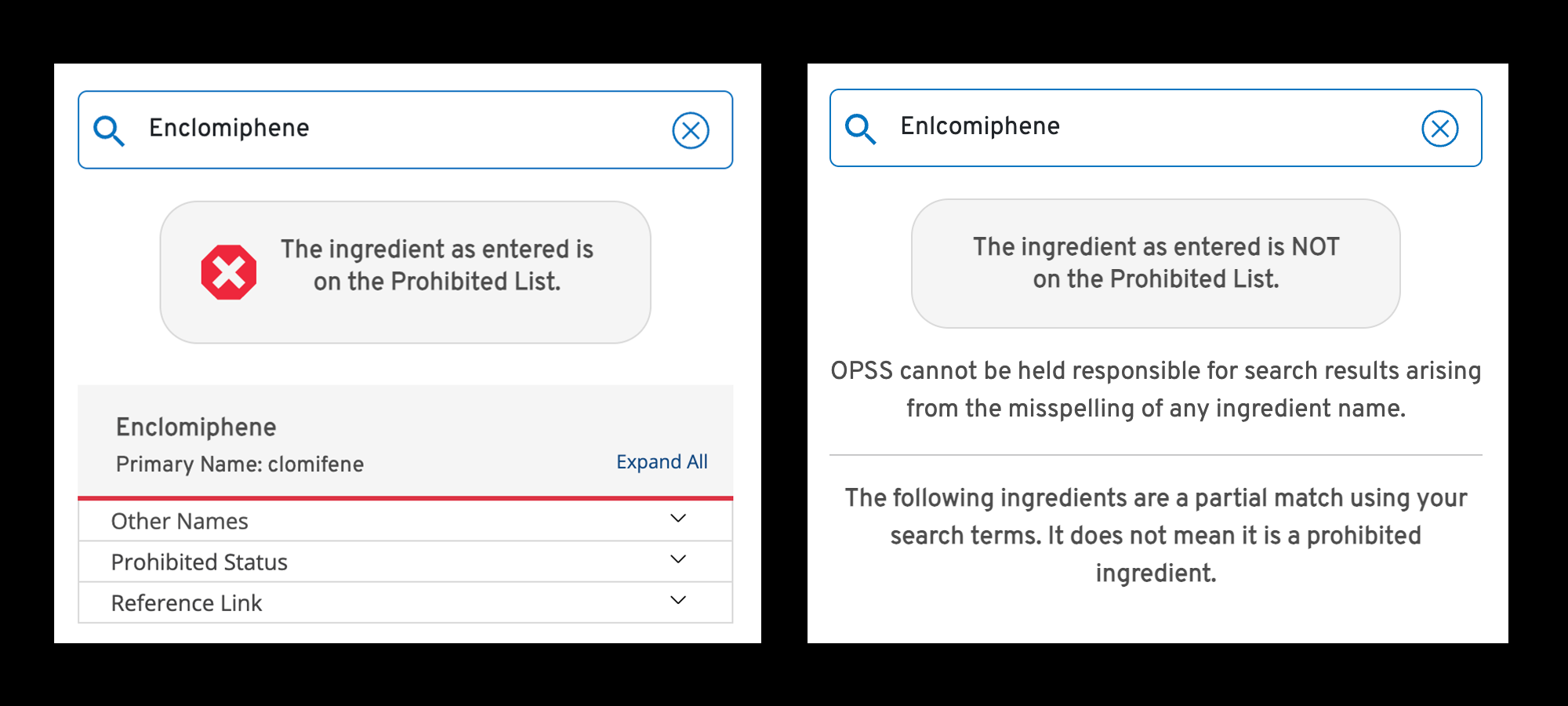
No autocorrect. No warning. Just a spelling bee where the prize for a wrong answer is your career.
Even OPSS acknowledges the problem, warning in fine print that it “cannot be held responsible for search results arising from misspellings.”
Only a handful of the “prohibited” substances are illegal for civilians. The list includes legal compounds that are completely unregulated by civilian law. You can buy many of them pretty much anywhere, yet a single bottle in a barracks room can end a career.
No ‘honest mistakes’
When a sailor or airman is found with a supplement that includes a “prohibited ingredient,” commands rarely treat it as an honest mistake. Instead, they face accusations of “drug abuse.”
On paper, the rules prohibit only knowing or “wrongful” use of these ingredients, but in practice, bureaucracy flattens nuance. The presumption is guilt.
And once the paperwork starts rolling downhill, it is nearly impossible to stop. Once substantiated, separation processing becomes mandatory — commands have no discretion not to finish the process, no matter the circumstances.
Service members with less than six years don’t even have the right to an administrative separation board. Their only option is a written statement. Only if the command seeks an Other Than Honorable discharge do they “earn” a hearing that vaguely resembles due process.
As a military defense counsel, I’ve watched this play out countless times. I’ve written appeal after appeal for good Marines and sailors who never got a hearing and whose only chance at fairness rests on someone reading their final written plea.
To date, not one has been heeded.

The Department has created an impossible bind. On one side, Secretary Hegseth has doubled down on peak physical fitness as the foundation of a “lethal, professional fighting force.” On the other, OPSS maintains a hidden tripwire that destroys careers of those trying hardest to meet that standard. We tell troops that fitness standards must be “uniform, gender-neutral and high” while denying them clear guidance on what they can safely use to achieve it.
All branches use the same lists, the same broken logic. And the casualties aren’t bad troops — they’re the kind we need most: fit, disciplined, motivated. We’re expelling them in the name of discipline while lamenting recruiting shortfalls. Every separation over a hidden ingredient is a self-inflicted wound.
The solution starts with recognizing that supplement mistakes aren’t “drug abuse.” A sailor who takes the wrong pre-workout isn’t a drug offender — yet we’re ruining careers with mandatory separation over substances sold at every GNC. Yes, fixing OPSS would help — especially to add consistent autocorrect and enable product searches — but with thousands of products flooding the market, perfect compliance is impossible. At a minimum, return OPSS to its educational mission: teach supplement safety in boot camp, post warnings in gyms, and give real notice. Treat first violations as health and welfare issues, not misconduct. Education first, separation never.
Right now, the department’s approach isn’t protecting troops — it’s setting them up to fail. Finn isn’t being punished for breaking the rules. He is being punished for not knowing they existed. The Defense Department says it wants fit, resilient service members. Yet we ruin careers for doing exactly what we demand: getting ready for the next fight. Until we give them notice and tools — or stop pretending ignorance of a hidden rule is defiance — we’ll keep losing exceptional young men and women to an arcane list no one ever taught them to read.
The views expressed are those of the author and do not represent the views of the Department of Defense or its components. The story of the service member referenced is published with their permission but their name has been changed to protect confidentiality.