For decades the United States military has dreamed of developing jetpacks to ferry troops around. Personalized flying machines could turn an infantryman into an airborne fighter. But alongside rocket-propelled soldiers, the U.S. military also once gave personal vertical take-off and landing machines a shot.
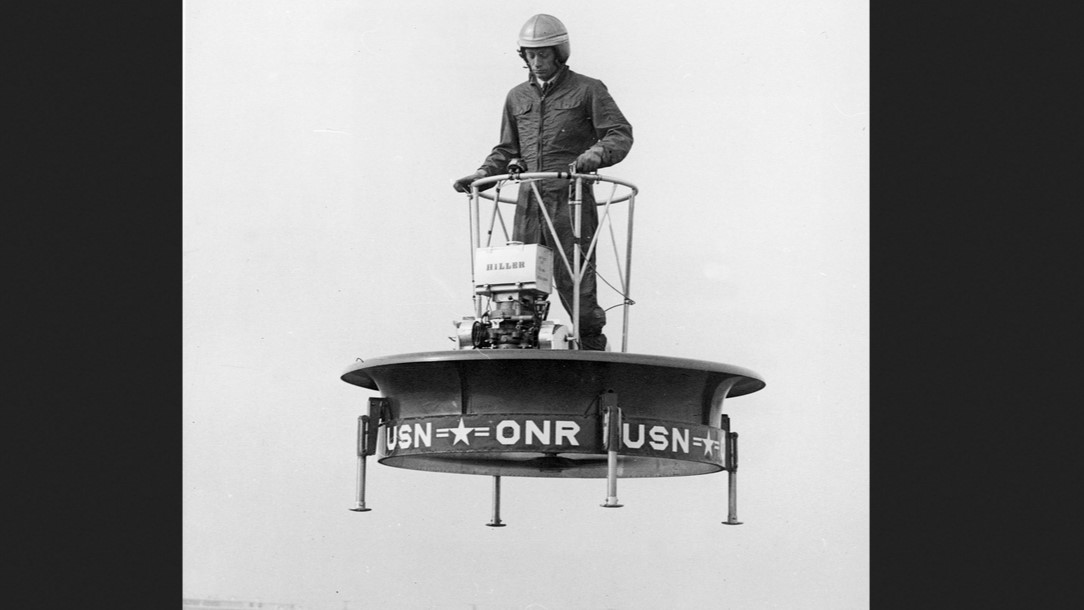
They are better described, and are classified as flying platforms. Soldiers would stand on a small platform, which itself was over a large fan that would generate lift and get troops airborne. Steering itself would actually be simple: soldiers would lean, tilting the platform and directing it where they wanted to go, almost like a surfboard.
In the mid-1950s the Office of Naval Research, in a joint project with the Army, began to see if flying platforms would be both feasible and practical. And it turns out, the personal VTOL machines worked. Troops did fly on them.
Top Stories This Week
According to the Smithsonian’s National Air and Space Museum, the idea for flying platforms started in earnest in the late 1940s. In 1953 the Army began its flying platform projects, contracting with Hiller Aircraft and de Lackner Helicopters. The Office of Naval Research was already working with Hiller, so a joint-service venture started. De Lackner created its DH-4 Aerocycle (designated the HZ-1), which had a smaller platform right above spinning rotors. It worked but was shelved due to the risk.
More success came with the Hiller projects. The Office of Naval Research got Hiller’s first design, the 1031-A-1 flying platform. It stood 7-feet tall, with an 8-foot-in-diameter platform, with the fan almost as wide. With two engines, it could hit a top speed of 16 miles per hour. The flying platforms were meant to be stable enough and easy enough to control that soldiers on them could still aim and fire small arms while airborne. Photos from some of the tests of the 1031-A-1 show service members aiming and firing rifles while in the sky.
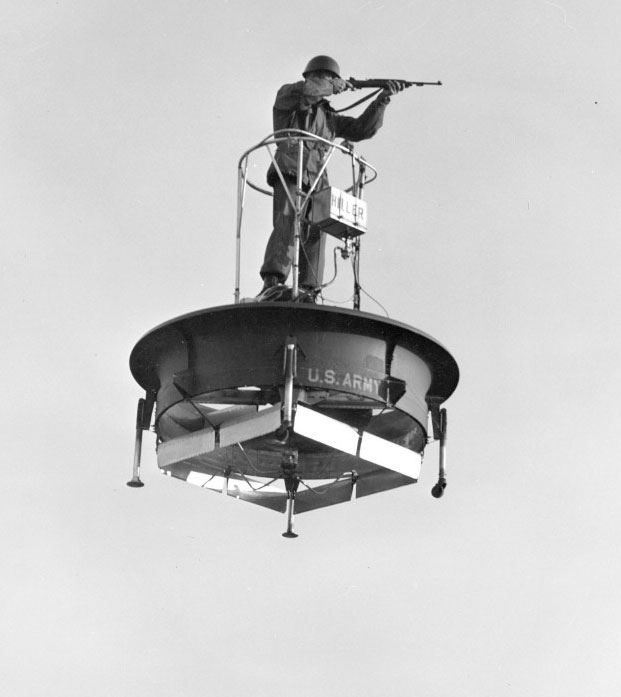
The Army, after giving up on the Aerocycle, turned to Hiller, getting a larger version of the 1031-A-1 with more thrust. The Hiller VZ-1 Pawnee began testing in 1957, with three engines. However the increased size made the idea of kinesthetic control impractical. Soldiers could not easily steer or maneuver on the Pawnee. Attempts to adjust the power and size didn’t resolve the issue.
These personal helicopters seem like science-fiction concepts, but they came out of a major transformation within the military as it tried to deal with changing warfare. The advent of the Cold War and the threat of nuclear conflict led the military to try all sorts of nuclear-inspired weapons and tactics, ranging from creating a nuclear death cloud to attempting to reorganize the Army under “pentomic” divisions. Researchers were also looking for any technological edge that could help create the soldier of the future. Meanwhile, helicopters had proven incredibly useful during the Korean War, for quick transportation and medical evacuation. To a modern eye, flying platforms would function the way the military today uses aerial drones — as relatively small, fast reconnaissance vehicles.
Even though the flying platform did work, the military eventually soured on the idea. They weren’t effective enough, or fast enough, to be practical in the field. The military stuck with larger helicopters, which would become more central to military transport. These 1950s inventions were useful however; the Smithsonian Institute noted they were a major step forward in VTOL research. But much like jetpacks, the military still isn’t fielding personal flying platforms. At least not yet.