The military keeps trying to get rid of both of them, but the A-10 Thunderbolt II and the Littoral Combat Ship keep finding ways to stick around — particularly in the Middle East.
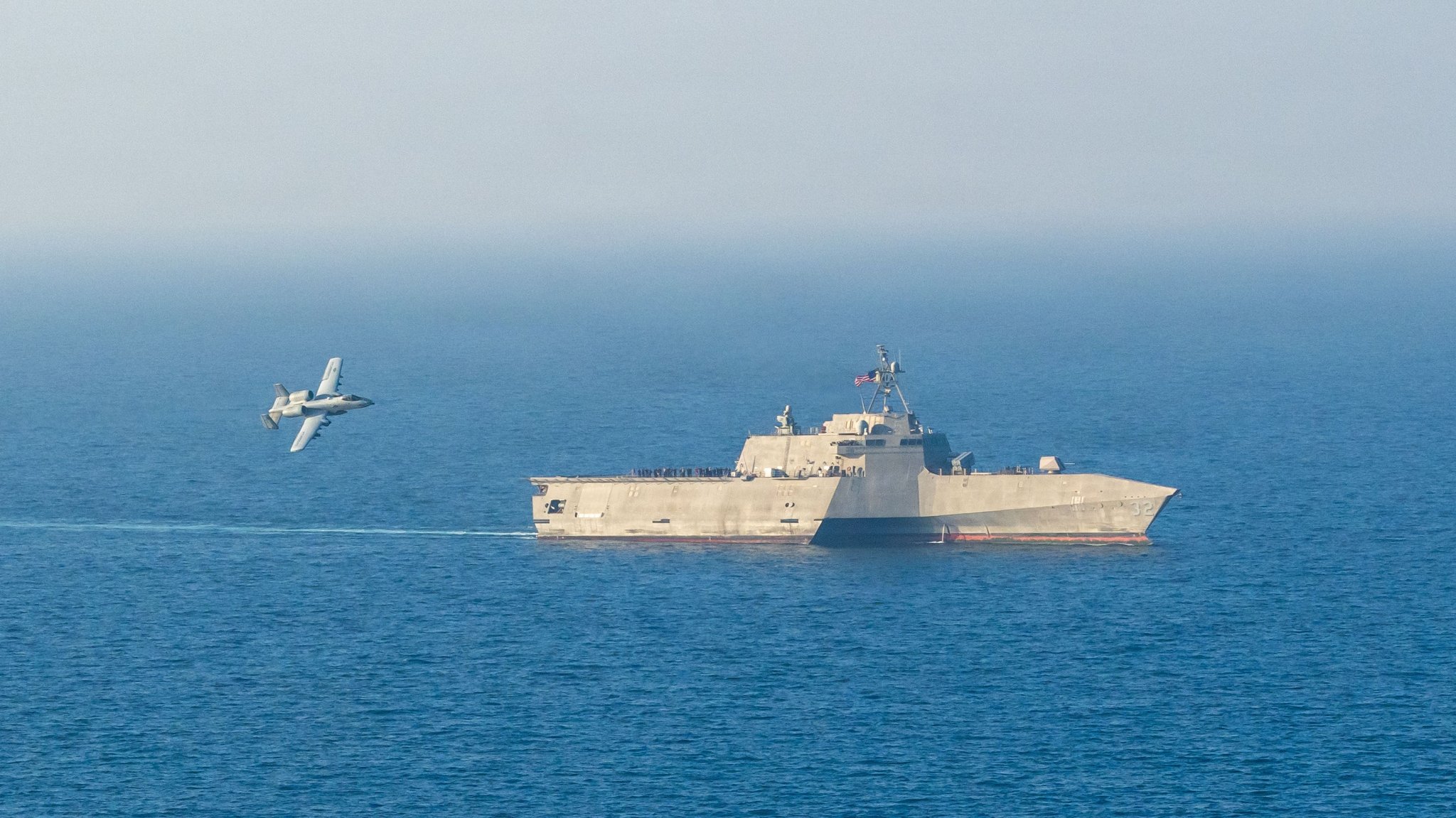
The Navy’s 5th Fleet and U.S. Central Command posted photos of the USS Santa Barbara carrying out a live-fire training exercise in the waters of the Persian Gulf. Circling overhead was a single Air Force A-10 Thunderbolt II, better known as a “Warthog.” The close-air support plane was there for aerial coordination as the sailors on the Santa Barbara took part in a “killer tomato” exercise. These kinds of live-fire exercises are often named “killer tomato” due to the large red inflatable balls put out at sea for troops to fire at.
The Air Force and Navy training highlighted “joint air-maritime integration” according to the Navy’s 5th Fleet, but it also showed that the military is still finding uses for both the planes and ships, even as they have aged or proven to not be as useful for their original purposes.
The Independence-class Littoral Combat Ship, the Santa Barbara, is one of three “little crappy ships” as they’re derisively called, that’s deployed to the Persian Gulf. The ships were meant for, as the name suggests, coastal support and combat. However, as the other name suggests, mechanical failures plus a need for more powerful warships left them without much use, and the Navy is working to retire and sell off some of the vessels.
Top Stories This Week
Despite their fraught origin story, the Navy found a new purpose for them: mine hunters. Late last year, the last of the older Avenger-class mine hunters left the Middle East, leaving the task of finding and taking out mines to the LCS. Three littoral combat ships, the Santa Barbara, the USS Canberra and USS Tulsa are operating near the Strait of Hormuz, which Iran has repeatedly threatened to mine. The Strait is a strategically important waterway where roughly a fifth of the world’s entire commercial oil passes through.
The A-10, meanwhile, is old. The aging airframe, famous during the Global War on Terror, and endlessly popular online, for its distinctive “BRRRRRT” sound, has been in service for decades. The Air Force has been steadily sending the planes to the boneyard, looking to replace them with modern fighter jets or attack helicopters that can fill the same role. Despite that, the Warthog has been a mainstay of CENTCOM’s air forces in recent years, supporting operations against the Islamic State in Iraq and Syria. In the last two months, it has gotten a lot of prominent use as part of Operation Hawkeye Strike, the ongoing series of airstrikes against ISIS following a fatal shooting of U.S. soldiers in Palmyra, Syria, in December.
Both the ships and the planes are operating around the Persian Gulf — also called the Arabian Gulf by the U.S. military — near the Strait of Hormuz, as the U.S. continues to build up its military presence amid tensions with Iran. American and Iranian officials are negotiating in Oman, but the U.S. has repeatedly threatened military action over Iran’s response to internal protests and regional actions. Among other measures, the USS Abraham Lincoln and its carrier strike group were moved to CENTCOM’s area of responsibility. On Monday, the Department of Transportation’s Maritime Administration issued new guidance to U.S.-flagged commercial ships, warning them to avoid Iranian waters out of safety concerns.