
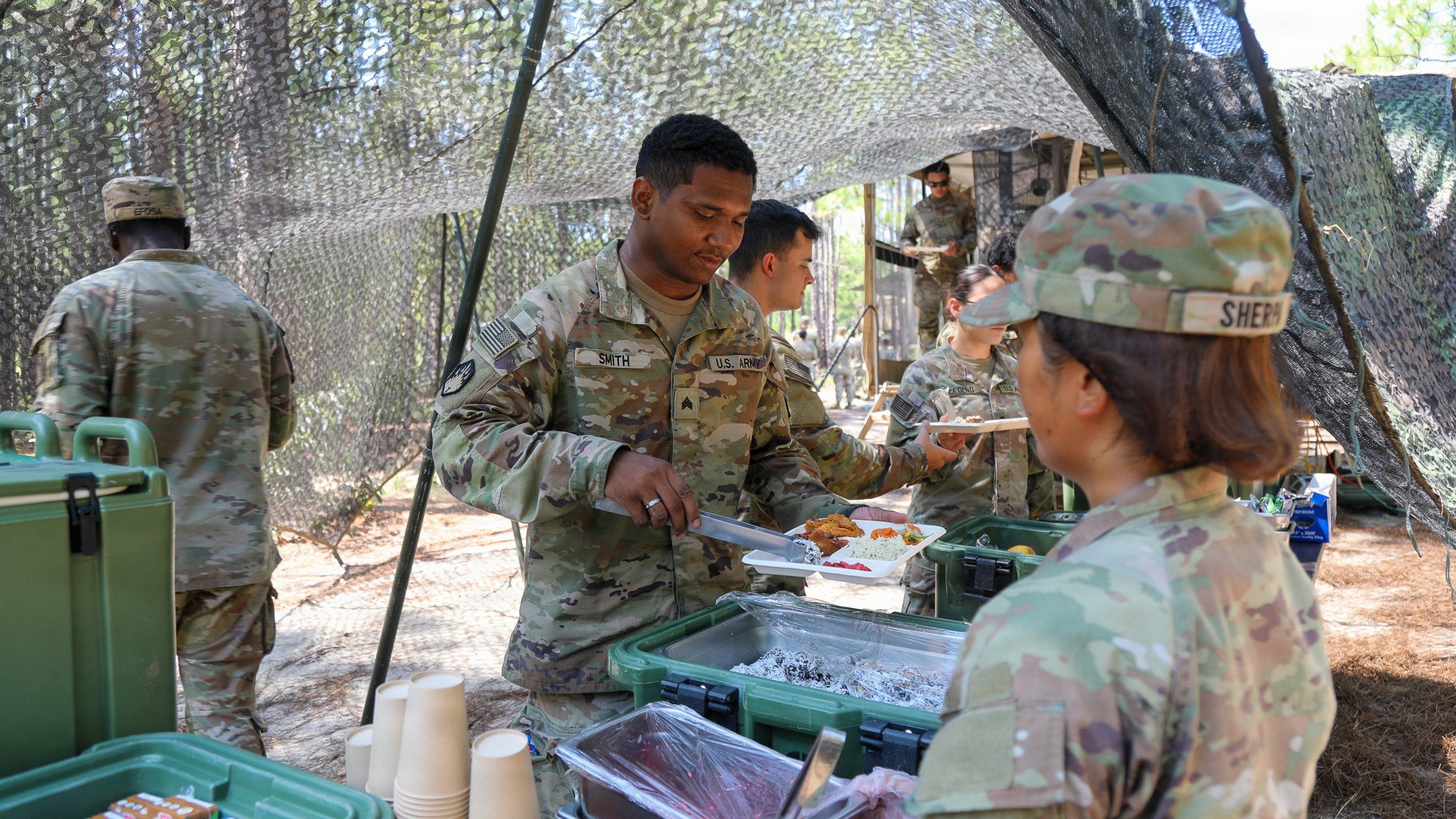
It’s said that an army marches on its stomach. Now, the soldiers responsible for keeping the U.S. Army’s stomachs full at home and abroad have a new name, which is meant to evoke battlefield demands.
Soldiers serving in the 92G military occupational specialty are now known as “tactical field feeding specialists.” Army cooks in that specialty were known as 92G Culinary Specialists.
The new name for the existing job was unveiled by the Army Quartermaster School’s Joint Culinary Training Department on Oct. 30 at an event at the Tactical Field Readiness Training Center. Col. Stacy Moore-Callaway, the Quartermaster commandant, said in the Army’s announcement that the MOS name change isn’t a superficial move, but was done “because the character of war has changed.”
“We formally redesignate our culinary specialists, stepping forward under the title that truly captures the 92G’s operational weight, and that is to turn them into tactical field feeding specialists,” Moore-Callaway said. “When we look at modern battle spaces that are taking shape around the globe, we know that we must shift the mindset of every single Soldier in our formation towards survivability and true lethality.”
Stars and Stripes first reported on the renaming.
The Army previously defined the work as “responsible for preparing and servicing meals both in the field and at home stations, as well as ordering, inspecting food supplies, and keeping the kitchen safe and sanitary.” That mission is largely the same under the renamed role, but the Army said in its announcement that the new tactical field feeding specialists “must understand tactical operations, logistics, and operating in a contested environment.”
The Army made the cook role a formal MOS in the 1960s, eventually designating the job as 92G culinary specialist in the mid-1990s. The Army’s announcement repeatedly pointed to potential large combat operations as a reason to rethink how the job is viewed. Sgt. Maj. Paul Denson, Installation Operations Directorate, Army G-4, said that soldiers in the role are “sustaining warfighters; a tactical field feeding specialist has to understand food production, nutrition, and food safety.”
It’s the latest shift in how the Army is organizing its personnel with an eye towards large-scale peer or near-peer conflicts. Last month, soldiers in North Carolina carried out an exercise involving digging and filling temporary and large graves, in the event of a conflict that could have mass casualties on the battlefield.
On a wider level, the military has been looking at ways to get food, supplies and other essentials to troops in remote areas, or in contested locations. That has ranged from using 3D printing to make some parts, exploring the use of drones to drop supplies into contested areas and testing out a shipping container-like box that uses a robotic system to prepare food.
Loading comments…
Comments couldn’t be loaded. Please refresh the page.