
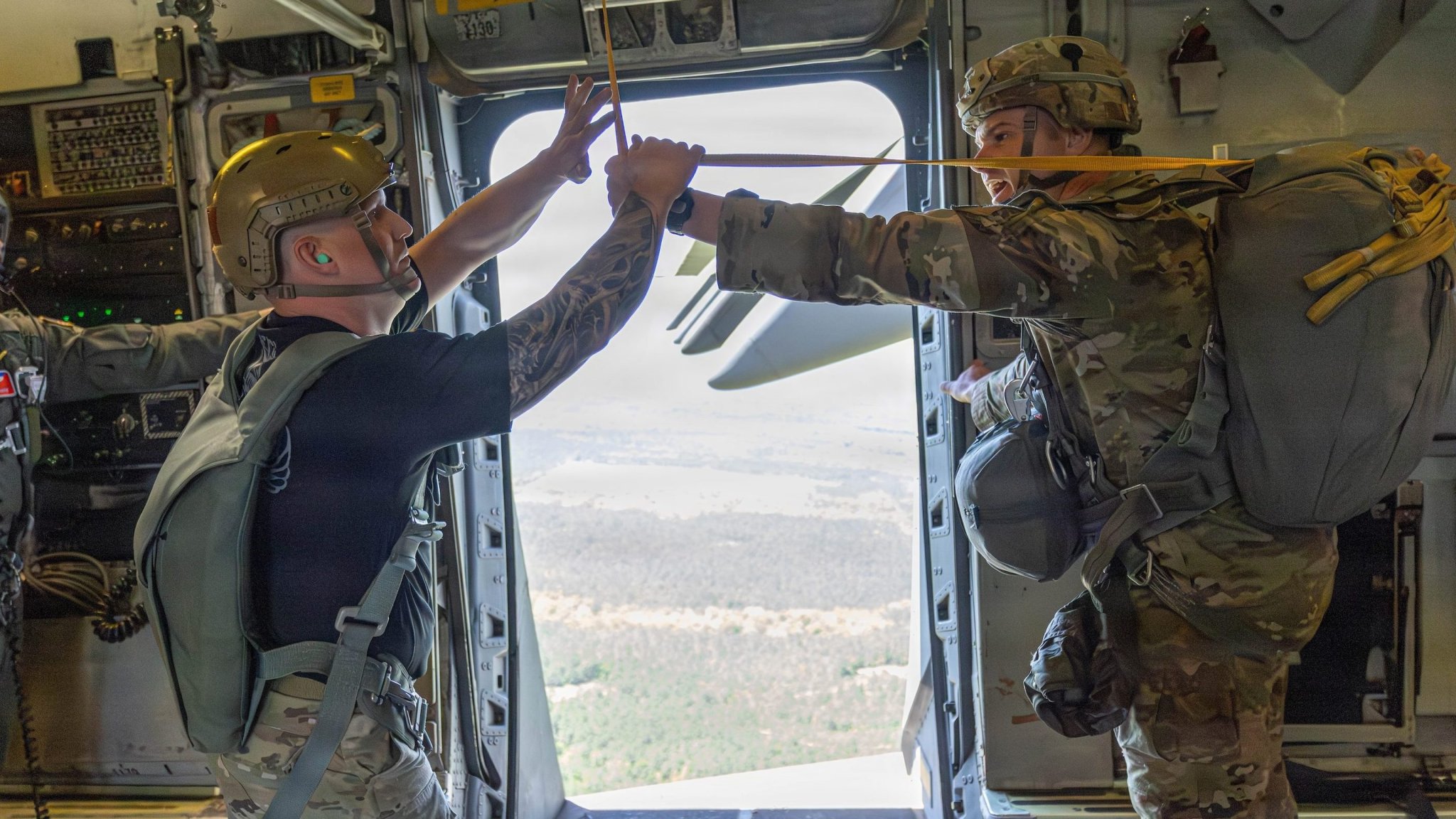
The inaugural Best Jumpmaster competition at Fort Benning, Georgia, began in a similar style as many of the Army’s “Best” competitions: with competitors taking a PT test and starting off on a long ruck march.
But as the 28 competitors made their way over the 13-mile course, they stopped along the way to be graded on a variety of jumpmaster skills. Then over the course of the three-day event, the paratroopers were put through skill tests that ranged from aircraft inspections and crew briefings to packing or “rigging” a parachute.
And of course in the middle of it all, the soldiers had to prove their mastery of the skill at the heart of the job, the Jumpmaster Personnel Inspection, or JMPI.
“A JMPI is a high-speed, systematic dance with a paratrooper’s life,” said 1st Sgt. Gustavo Quintero, who graded paratroopers during the competition, in a release about the event. “You aren’t just looking; you are feeling for the mechanical seat of a canopy release assembly and the specific tension of a static line routed over the shoulder. Your hands verify what your eyes see, tracing every inch of webbing to feel for the slight irregularities — a twisted strap or a frayed edge — that could turn a routine jump into a catastrophe.”
The Army hosts “Best” competitions in a variety of career fields and skills, like Rangers, medics, sappers and even chaplains. But the 28 jumpmaster-qualified soldiers who gathered at Fort Benning — which is home to the Army’s parachute school — were the first to compete for Best Jumpmaster, officials announced.
The competition culminated in a final jump onto a drop zone from a Black Hawk helicopter, as soldiers judged the wind speed and altitude to hit a target on the ground below.
The competition’s winners were a team from Fort Benning’s Airborne and Ranger Training Brigade: Sgt. 1st Class Tedder Bridges, Staff Sgt. Nathan Byrd, Staff Sgt. Riley Fischl and Staff Sgt. Zachary Wiertalla. Seven teams participated, including the 11th Airborne Division and 82nd Airborne Division.
Organizers are planning to host the event each year during the Maneuver Center of Excellence’s Infantry Week in the spring, officials said in the release. Army planners hope future events can draw all types of soldiers in airborne units, like those from heavy drop and special operations units, or anyone who has trained to become a jumpmaster.
Jumpmasters are the experts who lead and watch over paratroopers as they jump out of planes. On board airplanes, jumpmasters direct paratroopers as they approach a drop zone, then point them out of a troop door as if on an assembly line. Jumpmasters watch closely for any deviation that could pose a safety hazard or, in the worst-case scenario, be a fatal mistake.
Jumpmasters are selected from experienced paratroopers who demonstrate a real passion for airborne tactics and safety. To be eligible for the three-week Army Jumpmaster Course at Fort Benning, paratroopers have to complete a minimum of 12 static-line jumps and serve on jump status for at least a year. There, soldiers learn the dozens of tiny details of parachute equipment, procedures, and JMPIs.
In just over a minute, a jumpmaster’s JMPI checks dozens of critical details on every paratrooper’s parachute and equipment before a jump. The checks look for misrouted belts and straps, loose equipment, and even the proper size of a parachute harness. They must pass inspections in which overlooking a “gig” as simple as a missing rubber band can fail a student.
“The sequence ends with a deliberate physical signal,” Quintero said. “You reach back, get a handful of air and issue a seal of approval by tapping the jumper on the buttocks. When you give the command of ‘recover’ and move to the next man, you are signing your name to their safety. In that moment, their life is quite literally in your hands.”
Loading comments…
Comments couldn’t be loaded. Please refresh the page.