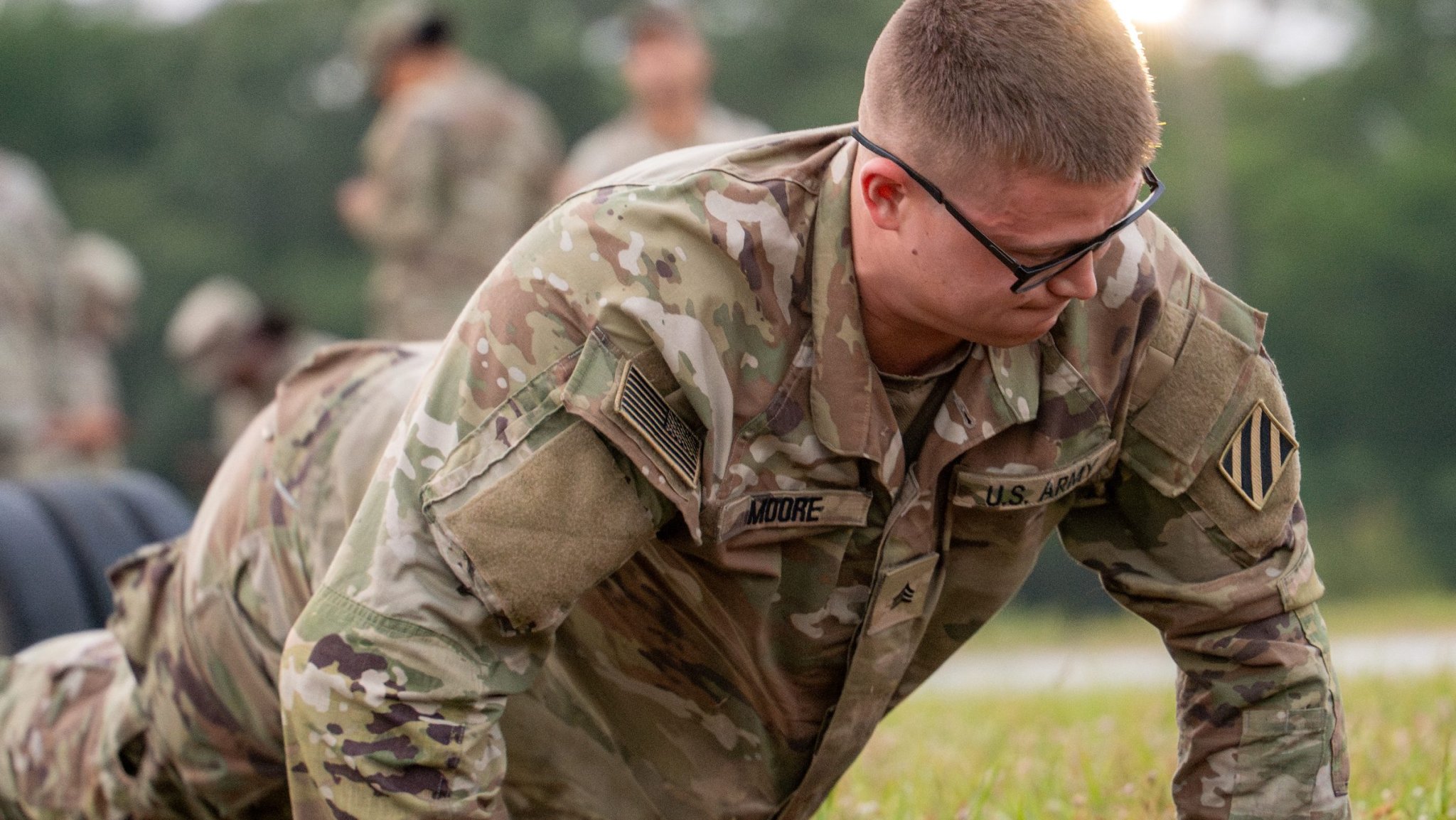
The Army is revamping how it hands out reenlistment bonuses, adding extra dollars for those with top scores in PT tests and job performance.
Under a memo circulated last week on social media and confirmed by Task & Purpose, top bonuses will continue to go to soldiers in hard-to-fill Military Occupational Specialties, or MOSs, with larger payouts to those who agree to serve more years. But for the first time, a soldier’s individual job performance will also be used to compute the size of their check, according to a Jan. 27 military personnel message, or “MILPER,” which announced the new policy.
The memo specifies that the incentive system will “reward top-quality soldiers based on the physical, technical, and tactical proficiency, in addition to their overall command assessment.”
Soldiers will be ranked against peers in the same career field and organization, which will determine the amount of money they are eligible for in their retention bonus, Army officials told Task & Purpose.
But the needs of the Army will still factor into bonuses, with in-demand career fields getting heftier checks. Soldiers in cyber, aircraft repair, paralegal, special forces, and intelligence jobs will get the largest bonuses, particularly if they sign up for more years of service, according to the Army notice.
Bonus ‘step’ rating includes on-the-job factors
Under the new program, soldiers can collect Selective Retention Bonuses with contracts as short as three years for an extra $450, or dedicate at least five more years of service and get extra checks as high as $81,000, according to MILPER. Bonuses only apply to additional years added to their current contract.
To account for individual performance, the new rules introduce the Army Retention Quality Tiered Incentive Program, which the MILPER refers to as QTIP. Under QTIP, bonuses are structured into four levels, or “Steps” 1-4, with high performers graded at Step 4 in line for the highest bonuses.
For instance, an infantry soldier with an 11B MOS who re-enlists for four years can earn a bonus of $2,775 if they are graded at the Step 1 level. But an infantry soldier graded at Step 4 who signs the same four-year contract would be in line for a $3,700 retention bonus.
Top Stories This Week
Soldiers will be ranked against others in the same career field and unit, officials said. As an example, an Army official said infantry soldiers assigned to the 3rd Infantry Division might be scored against one another, but not coworkers from other MOSs.
Company commanders will work with Army career counselors to place soldiers into one of the four Steps.
Soldiers will receive a “quality” score in three components: their Army Fitness Test score, “technical” expertise within their job, and rank on their unit’s Order of Merit List. The technical component considers advanced training and education they have completed for their job as well as additional skills soldiers develop beyond their primary career field, such as graduating from the Army’s Airborne School or becoming a jumpmaster.
“The combined total of these points determines each soldier’s Step value on the Selective Reenlistment Bonus,” officials said.
Dollar figures in the memo vary widely by rank, length of contract, and MOS, but generally follow the same pattern of higher performers in Steps 3 and 4 getting larger bonuses than those in Steps 1 or 2.
“The Army remains committed to building a more lethal force through precision and quality retention,” Brig. Gen. Gregory Johnson, director of military personnel management at the Army’s G-1 said in a statement. “As the program matures, we will refine it further based on field feedback to meet the Army’s evolving needs.”
Special ops, cyber soldiers get larger checks
The Army notice also provides a window into the types of jobs and wartime capabilities that the service is prioritizing for its formations, like cyber, manned and unmanned aircraft, construction and engineering, intelligence, and special operations.
“In response to personnel shortages and the expansion of Army structure, the Army will prioritize critical military occupational specialties (MOSs) within growth career management fields and will use incentives to shape behavior for these specialties in accordance with those stated priorities,” the MILPER states.
Among the more than 100 MOSs covered in the new policy, some of the highest bonus ratings are aimed at special operations soldiers, like those assigned to the 75th Ranger Regiment and 160th Special Operations Aviation Regiment, with soldiers in several support roles in line for particularly high bonuses.
For cyber, the Army is aiming to retain early-career soldiers in the 780th Military Intelligence Brigade who work as exploitation analysts and cyber capability developers. If these cyber soldiers sign one- to three-year contracts, they can earn roughly $5,000 to $15,000, or $43,000 to 58,000 for staying in another five years or more.
Officials said the emphasis on specific units in the new bonuses reflects a need to retain soldiers, rather than an indication that those units expect significant growth.
The Army is also looking to retain soldiers in a variety of intelligence specialties like human intelligence, psychological operations, and signals intelligence voice interceptors, or soldiers who analyze and translate foreign languages using specialized tech.
Some of the highest bonuses offered this year will go to certain ranks of special forces soldiers with certain language proficiency skills, and other enlisted soldiers who work as medical laboratory technicians, occupational therapists, explosive ordnance disposal techs, counterintelligence agents, and geospatial intelligence analysts.
In addition to high-tech gigs, the Army is also trying to keep armor crewmen who operate the Army’s M1 Abrams tank — but the bonus is only offered to privates at Fort Riley, Kansas, and Fort Bliss, Texas.
Correction: 2/4/2026; The article has been corrected to note that the shortest reenlistment contract a soldier can sign is for three years, not one.