
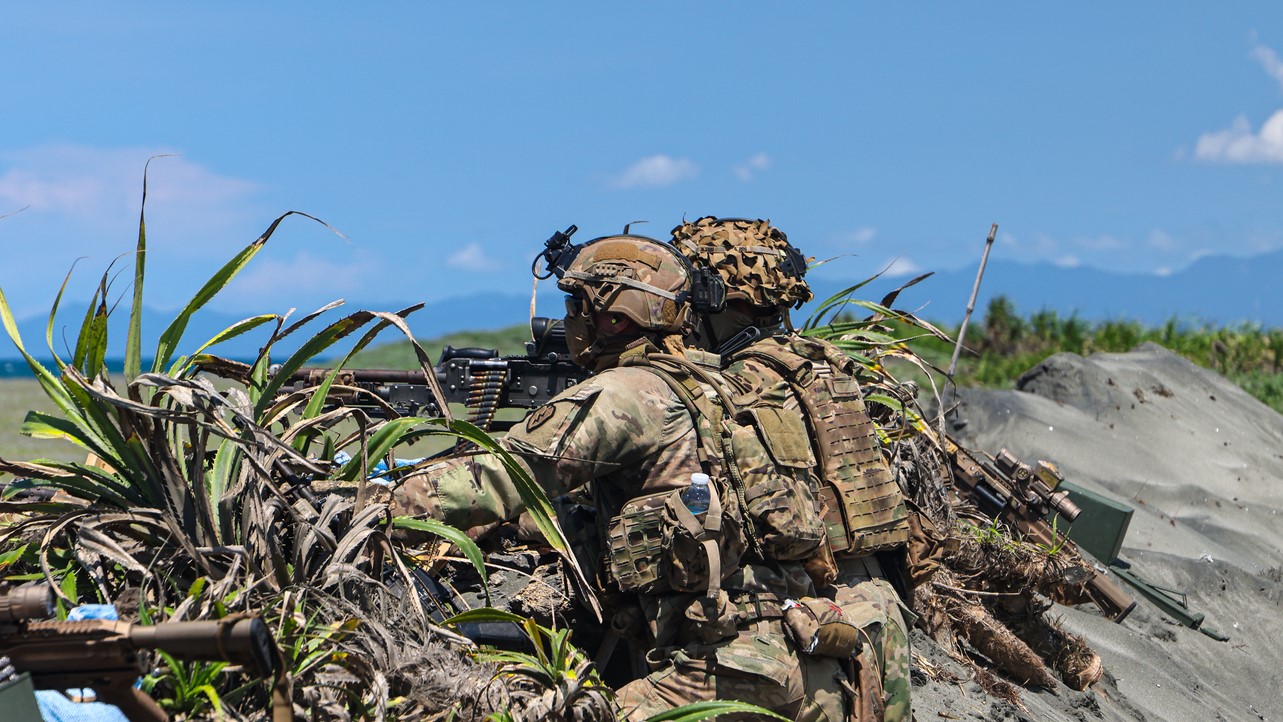
The U.S. Army quietly stood up a new rotational force in the Philippines as part of a “shift” in its expanding cooperation with partners in the western Pacific. But it did not reveal it for months.
The new element, formally named Army Rotational Force-Philippines, stayed in the dark for half a year after being established in July 2025. It was unveiled in a post on the Defense Visual Information Distribution Service, the military’s image and video hosting website. The post, from mid January, focused on Marine Rotational Force-Southeast Asia but showed Marines interacting with the officer in charge of the Army force. USNI News first reported on the new force.
A spokesperson for U.S. Army Pacific said that the rotational force comprises approximately 50 personnel from Army Pacific “with operational coordination with Task Force Philippines.” The statement did not say what units are currently rotated in or how long they will be in the country.
“The force’s mission focuses on strengthening our enduring army-to-army partnerships while improving infrastructure to protect the security, freedom, and prosperity for the U.S., our allies, and partners,” Col. Isaac Taylor, a spokesperson for U.S. Army Pacific said in a statement. “While the rotational force is not permanently assigned, this represents a shift from previous year’s iterative engagement cycle to a more sustained rotational presence, enabling deeper and more consistent collaboration with our Philippine Army counterparts.”
Top Stories This Week
The coordinating task force, Task Force-Philippines, was announced months after the Army rotational force was set up, on Oct. 31, in a press conference between the Philippine and American defense secretaries. That task force only numbers roughly 60 personnel, led by a one-star officer. At the time of the announcement, U.S. Pacific Fleet said that it “does not involve new combat forces or offensive operations, unilateral deployments, or permanent military basing.”
The Philippines is considered part of the “First Island Chain,” a series of island nations in the western Pacific Ocean that include Japan and Taiwan and are considered strategically important as part of a defensive strategy against China. As part of wider overhaul of U.S. strategy in the Pacific, the military has been working to revive old bases, forward deploy more units and build up capabilities on islands such as Guam.
The Army force is small, but the news of its existence points to the extent of the U.S. military’s presence and partnership in the island archipelago. The Army has worked with the Philippines’ military before in joint training exercises, including the annual Balikatan exercise, and deployed new weapons systems such as the Mid-Range Capability missile system, which can fire long-range cruise missiles. However much of the expanding American presence has been from the Navy and Marine Corps rather than the Army.
