An Army unit originally established to train Afghan forces now has a new mission: teaching U.S. troops how to fight in the jungle.
On Tuesday, the 1st Security Forces Assistance Brigade ceased to exist and was reborn as Army Security Cooperation Group – South. Its primary focus will be to operate the Combined Jungle Operations Training Course in Panama.
“We are now charged with holding a different line, no longer as advisors, but as committed jungle warfare experts,” Col. Keith W. Benedict, the unit’s commander, said during a ceremony held Tuesday at Fort Benning, Georgia.“We are charged with and have the opportunity to spearhead combined and combined arms jungle training.”
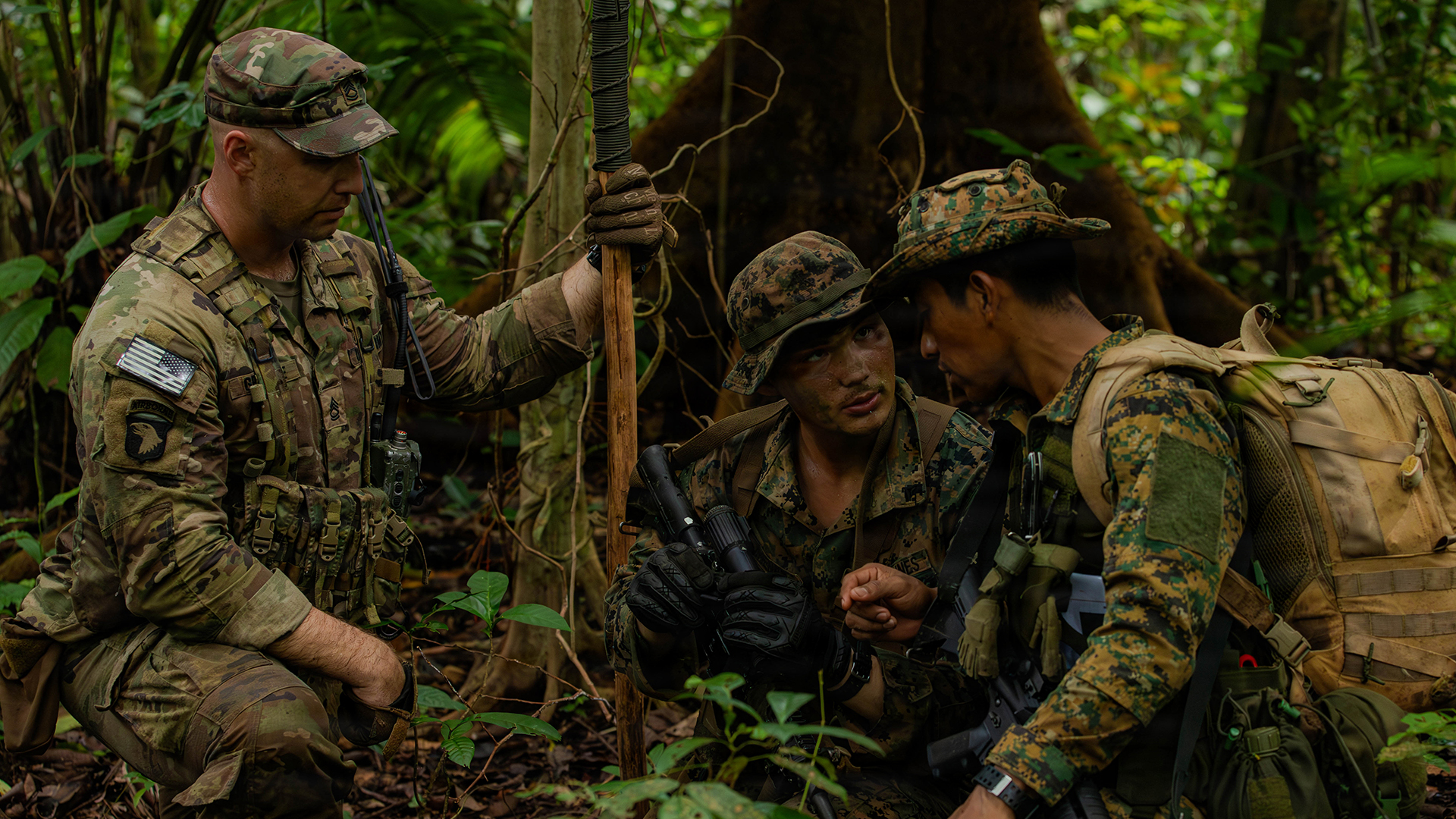
During the Global War on Terrorism, the U.S. military put less of an emphasis on jungle warfare training. But last fall, conventional American troops returned to Panama for the first time in more than two decades to learn jungle survival and combat tactics.
U.S. and Panamanian troops train together during the 21-day jungle warfare course, which is held at Aeronaval Base Cristóbal Colón, a former Army base that was transferred to the Panamanians in 1999.
Top Stories This Week
Since last year, most of the service members who have gone through it have been Marines, who were taught by U.S. Army and Panamanian instructors, an Army official said. The first large influx of soldiers is expected to begin the jungle warfare course in February.
Starting next month, soldiers who complete the course in Panama will receive the Army’s jungle tab for the first time, said Army Col. Mike Burns, a spokesman for U.S. Army Western Hemisphere Command. The tab signifies that soldiers have mastered skills including jungle tactics, survival training, combat tracking, and waterborne operations.
The creation of Army Security Cooperation Group – South comes as the U.S. government has shifted its focus to Latin America. The Defense Department’s recently published National Defense Strategy emphasizes the need to “fearlessly defend America’s interests throughout the Western Hemisphere.”
“We will also deny adversaries’ ability to position forces or other threatening capabilities in our hemisphere,” the strategy says.
Army phasing out SFABs
Between 2017 and 2020, the Army created a total of six Security Force Assistance Brigades, or SFABs: five from the active-duty force and one from the National Guard.
SFABs were the brainchild of Gen. Mark Milley, who was serving as Army chief of staff at the time. Milley wanted the service to create dedicated units of advisers for foreign conventional forces.
The brigades were initially intended to train Afghan, Iraqi, and Peshmerga forces. Soldiers in the units have been issued brown berets since 2018 to avoid any confusion between SFABs and Special Forces. That move followed an uproar after a picture leaked online showing a green beret meant to be worn by 1st SFAB soldiers.
“There is no intent to replace Special Forces, or to compete with Special Forces,” Milley told Army Times in October 2017. “This is a unique mission gap that needs to be filled.”
The 1st SFAB deployed to Afghanistan in 2018, and it later shifted its focus to South America as part of a reorganization that assigned the five active duty brigades to combatant commands.
Of the six SFABs, only one will remain in its original role: the 5th SFAB, which is focused on the Indo-Pacific region, according to Army officials.
Last year, an Army spokesman said that two SFABs were being eliminated so that the service could move experienced noncommissioned officers to traditional line units, including infantry and armor formations.
“That’s where we’re hurting the most,” Col. Dave Butler, spokesperson for the Army chief of staff, told Task & Purpose for a story in May. “We’re trying to fill the ranks up of the operational force and we have a lot of NCOs and junior officers in the SFAB formations.”