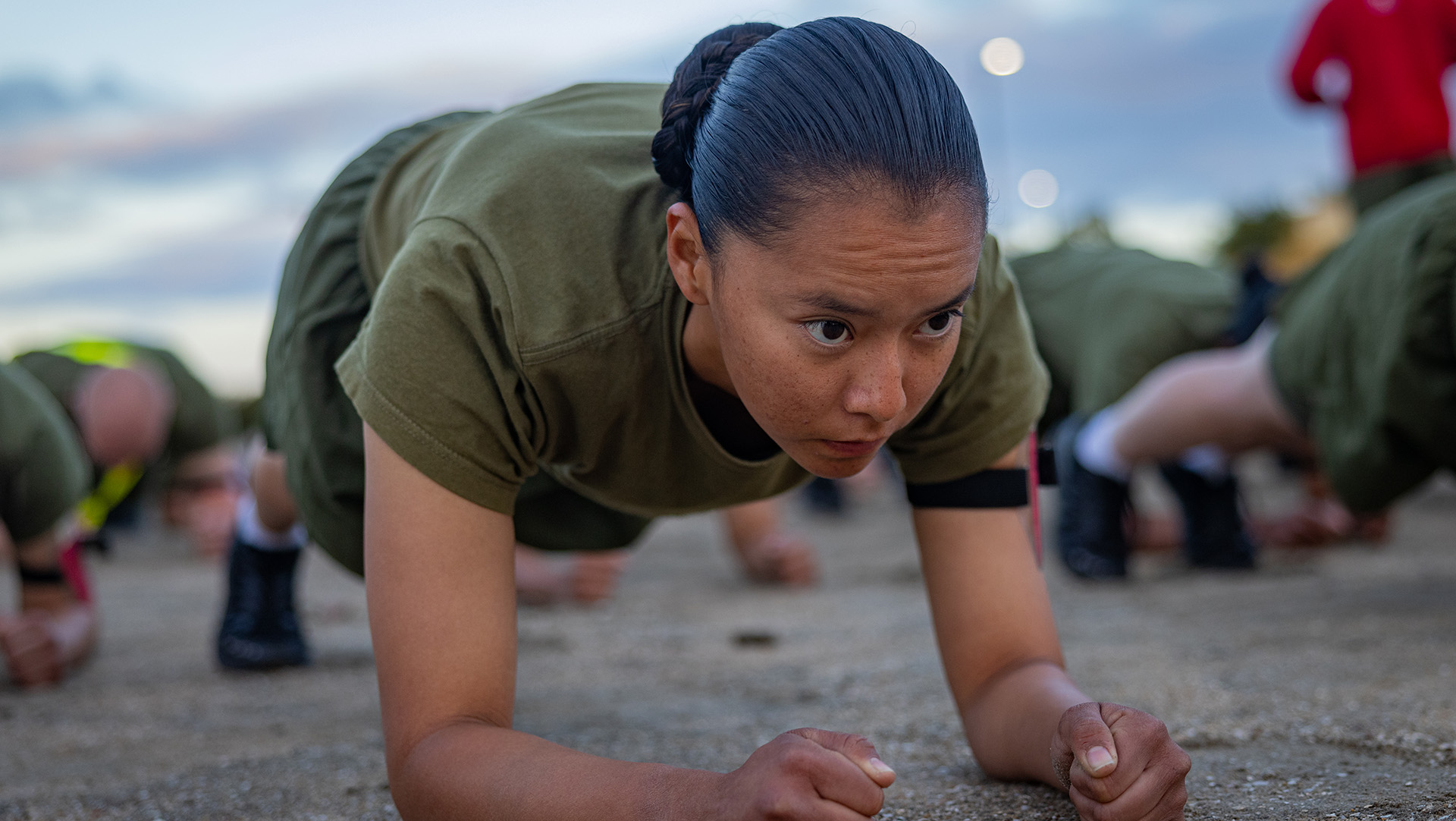
All Marines in combat arms fields will soon have to meet the same standards on their Physical Fitness Test, or PFT, regardless of their gender, under a service-wide policy announced Thursday. The new rules bring Marine PT standards in line with guidelines laid out by Defense Secretary Pete Hegseth in a Sept. 30 mandate that all combat arms troops across the military should be held to gender-neutral fitness standards.
A Marine Administrative Message, or MARADMIN, released on Thursday lists all the primary military occupational specialities, or PMOS, that will take the gender-neutral physical fitness test, including Infantry Riflemen, Field Artillery Cannoneers, Mortarmen, and Raiders.
Though the annual PFT has long been a defining experience among Marines, Marine combat roles have also required gender-neutral physical tests specific to each job since 2015.
Top Stories This Week
Starting on Jan. 1, 2026, all Marines in those specialties will be held to fitness test scores that currently apply only to men, and be required to score at least 210 points on the fitness test, which is 70% of the maximum score, the message says. The test will continue to be scored differently across age groups, with those between 21 and 35 generally held to higher standards than younger or older Marines.
The PFT is a general fitness test taken by all Marines with age- and gender-normed standards, said Maj. Hector Infante, a spokesman for Training and Education Command. The PFT tests basic strength and cardio across three events — push-ups or pull-ups, plank and a 3-mile run. Marines can score up to 100 points in each if they “max” out an event, except in pushups, where the top allowed score is 70 points.
Significant changes in strength and run requirements
The timed-plank event already uses gender-neutral scoring but the new rules will nearly double the pull-up requirements and subtract three minutes from allowed run times for women, fairly major challenges for Marines hoping to keep similar PFT scores from previous tests.
A Marine’s final PFT score is the sum of the scores of the three events, with 300 being the highest possible total, and a minimum of 210 required under the new policy.
“Marines in combat arms PMOSs who pass but do not achieve 210 points on the PFT by the end of the reporting period will be placed on the remedial physical training program and may be subject to PMOS reclassification and/or promotion restriction,” the message says. “Until further guidance is published, no adverse or punitive actions will be administered.”
In pull-ups, men in their 20s or early 30s score 100 points if they complete 23 reps. Women currently get the same score for 11 or 12. A woman in the 21-35 age range who completes 12 pull-ups would score just 63 points. To score 70 points in the event — on pace for the lowest overall passing score — women now must do 5 or 6 pull-ups but under the new rules would need to complete 14.
In the 3-mile run, men’s scores are uniformly set three minutes faster than women’s. To score the maximum 100 points, for example, women 21-35 years old can now run all three miles at a 7-minute pace, but will have to run each mile in 6 minutes under the new rules. That previous “max” time of 7-minute miles will now score in the low 80s.
Other Marines who are not in combat arms specialities will continue to take fitness tests under existing age and gender standards, the message says.
Marine combat jobs already have gender-neutral standards
Starting in 2015, Marines training for combat arms specialties had to pass gender-neutral “MOS-specific physical standards” testing. Those tests vary slightly between jobs, but generally require each Marine to complete several simulated combat events. Infantry Marines must press a grenade launcher over their head and, in timed events, drag a 214-pound “casualty” 25 meters, cross a wall, breach a door, rush 200 or 300 meters to an objective, and march 20 kilometers in full combat gear.
Test for artillery Marines, crews of armored vehicles, and other combat jobs have been similar.
“Since 2015, Marines seeking a combat arms MOS have conducted sex-neutral occupational fitness testing, which is assessed using MOS-specific physical standards (MSPS) evaluations,” Infante said. “The evaluated events and standards are based on physical tasks required by the job and ensure all combat arms Marines meet the same sex-neutral, occupation-specific, and operationally relevant physical standards.”
The Army announced earlier this year that it would require male and female soldiers in combat arms jobs to meet “sex-neutral” fitness standards.
In September, Hegseth told a large crowd of generals and admirals that all troops in combat arms jobs would be held to “the highest male standard only.”
“When it comes to any job that requires physical power to perform in combat, those physical standards must be high and gender neutral,” Hegseth said. “If women can make it, excellent. If not, it is what it is. If that means no women qualify for some combat jobs, so be it. That is not the intent. But it could be the result. So be it.”
Thursday’s MARADMIN also announced upcoming changes to how the Marine Corps’ body composition evaluations, estimates a Marine’s body fat percentage based on height and weight.
“Once additional guidance is received, the current height, weight, and tape test for body
composition assessments will be replaced with a waist-to-height ratio (WHtR) methodology,” the message says.
Current body fat standards will remain in effect until the updated assessment policy is implemented, according to the message.