
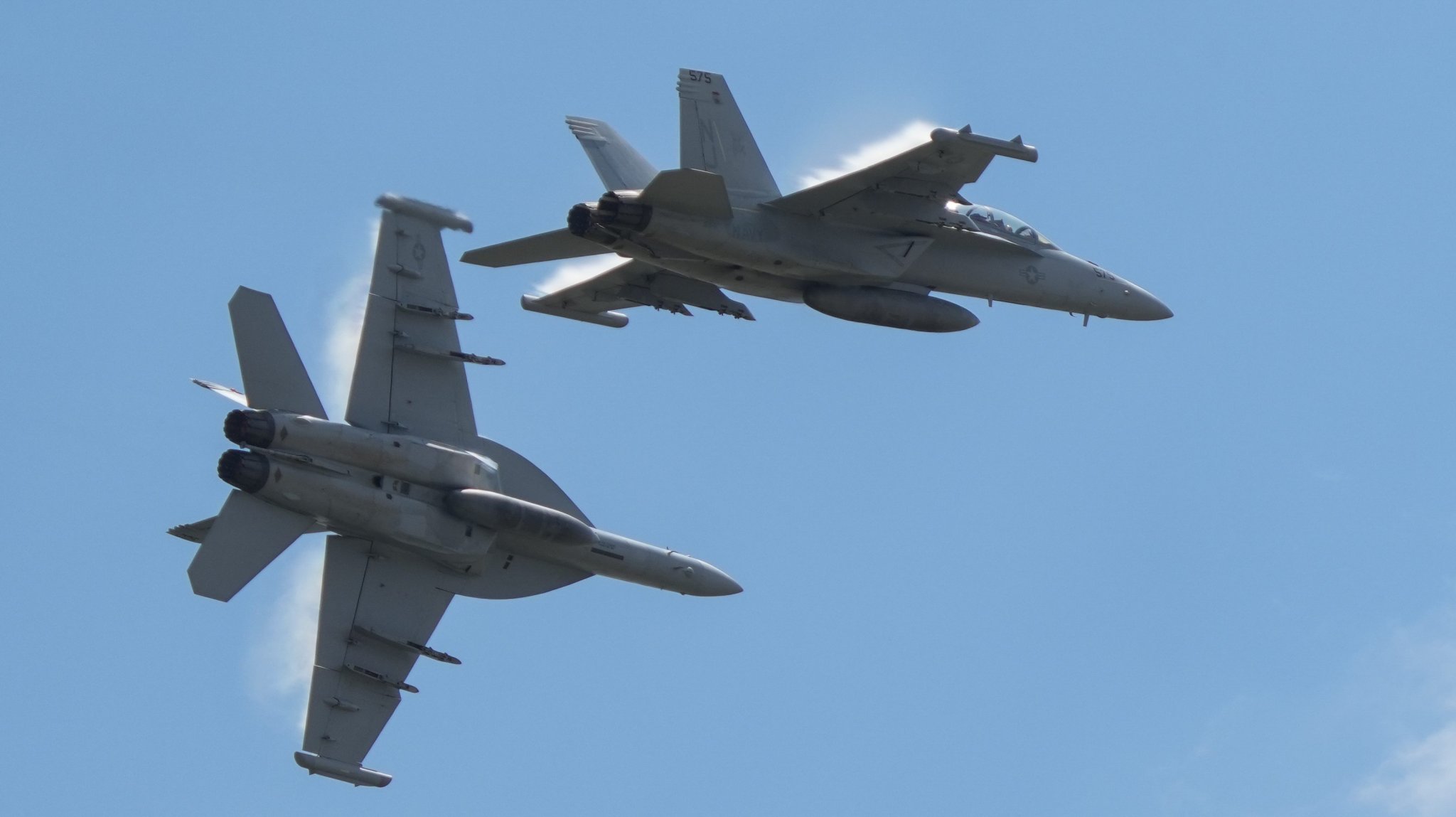
All four Navy aircrew members involved in a midair collision Sunday over an Idaho airshow survived ejecting from their planes, Navy officials confirmed Monday, an outcome that several retired fighter pilots described as extraordinary.
The mishap came when two Navy E/A-18G Growlers appeared to become stuck together in midair during a demonstration flight over Mountain Home Air Force Base. All four crew of the two-person jets ejected almost instantly as the planes stalled, including the two aviators whose jet had become stuck underneath the other plane.
All four landed safely under parachutes as the two jets tumbled into a fiery crash, Navy officials said Monday. Three aviators were unscathed.
“One aircrew is being treated for a non-life-threatening injury at a local hospital,” a Navy spokesperson said in a release.
Video of the crash spread on social media in the hours after the collision and several former fighter pilots told Task & Purpose that the crew’s survival was remarkable. Most notable, they said, was the safe ejection by the crew in the Growler stuck underneath its wing man.
“Ejections are a string of consecutive miracles on a good day,” said retired Navy Capt. Sterling Gilliam, a retired Navy fighter pilot and director of the National Naval Aviation Museum in Pensacola, Florida. “It’s a miracle there were four good parachutes. It’s another miracle that the trajectories of those four ejection seats didn’t cross each other’s path or hit a fuselage.”
The E/A-18G Growler is a derivative of the F/A-18 Super Hornet fighter rebuilt for electronic warfare missions and suppressing air defenses. Unlike the single-seat Hornet, the Growler flies with both a pilot and an Electronic Warfare Officer. The two Growlers at the Mountain Home air show were part of the Navy’s Growler Demonstration Team, of Electronic Attack Squadron 129, which is based at Naval Air Station Whidbey Island, Washington.
Videos and photos of the mishap appear to show one plane lodged so squarely on top of the second that its fuselage nearly covers the lower jet’s cockpit — a position more dire than any fictional scenario the crew likely faced during training, said Guy Snodgrass, who flew F/A-18s during a 20-year Navy career.
“We train to proper ejection procedures: canopy clearance, aircraft orientation, and body position. But, man, all that likely goes out the window in a scenario like this,” Snodgrass said in an email. “If the crew was processing info in real-time, it might have simply been ‘I can see sky/clear air above me’ and punch out. I’d like to think that if they looked up and simply saw a huge aircraft on their canopy that they would’ve possibly held off for better orientation.”
When the planes first connect, they appear to be perfectly in line, a deadly spot for the lower clue. But as they begin to tumble, the jets’ cockpits scissor away from each other briefly. It is then that the lower crew ejects. It’s unclear if that timing was intentional by the crew, but retired Air Force Maj. Gen. Ronald Bath, who survived an unintentional ejection from an F-4 while on a runway in 1988, said the collision will likely become a teaching example in pilot training.
“I’ve watched the video multiple times. Both crews were very fortunate to be able to get a complete successful ejection sequence,” said Bath. “This will be studied and analyzed for a long time.”
Entanglements of planes flying in formation is not unheard of. In both 2019 and 2021, Air Force T-38s with student pilots collided during “formation landing” training, in which two planes land on a runway side-by-side. In both of those cases, one of the planes drifted directly over the top of their wingman before essentially landing on top of them. Three Air Force pilots died in those crashes, prompting the service to halt the maneuver during training.
None of the pilots Task & Purpose spoke with would speculate on the cause of the mishap, pending a formal Navy investigation.
“We don’t know what the aircrew were thinking but it was probably a ‘holy shit’ moment,” said Snodgrass. “The time from collision to the airplanes going out of control was very fast.”
Loading comments…
Comments couldn’t be loaded. Please refresh the page.