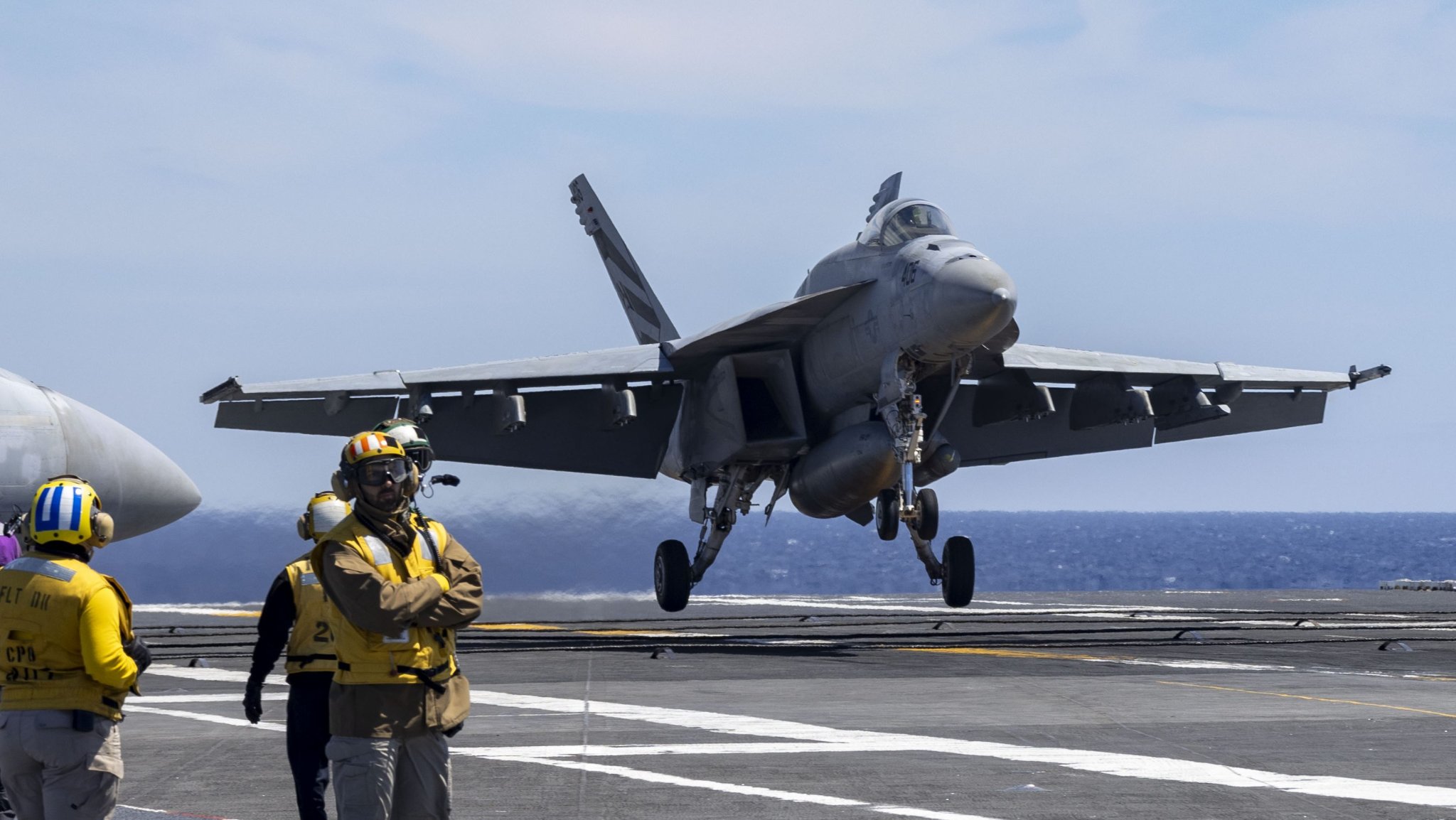
Naval aviators believe they are the best pilots on earth — just ask them — and the primary reason they cite is hard to argue with: they land on aircraft carriers. Whether in calm seas and sunshine or on a deck pitching in a storm at night, the skill to make a carrier landing, or trap, is at the heart of Naval aviation.
But in a major change to how the service trains aviators, the Navy recently revamped their flight training curriculum so that pilots now graduate from flight school and receive their “Wings of Gold” — the Navy’s formal name for flight wings — without actually landing on an aircraft carrier.
“The final strike carrier landing qualification occurred in March of 2025,” a Navy official told Task & Purpose. “Students in the strike pipeline, those training to fly F/A-18s, F-35s, and EA-18Gs, are no longer required to qualify by landing on a carrier prior to graduation.”
According to Sterling Gilliam, a retired Navy captain who is now the director of the National Naval Aviation Museum in Pensacola, Florida, past Navy carrier pilots nearing the end of their initial training pipeline would make at least one flight to a carrier to perform a series of landings and launches. Students recognized the live training, after weeks of simulations on a dry land field, as the final rite of passage for earning their wings.
“It’s what makes naval aviation unique,” Sterling told Task & Purpose. “Audacity has kind of defined Naval Aviation, and the uniqueness of carrier operations, specifically fixed wing launches and recoveries, requires a fair amount of skill and practice and professionalism.”
But the new training pipeline, said Gilliam, makes sense for the Navy and should make little difference to the eventual skill of the pilots produced. As of March, pilots headed for carrier duty will now qualify on carrier landings after they earn their wings, when they move on to learn to fly their assigned fighter jets in units the Navy calls fleet replacement squadrons.
The sea change to the training is based on the switch the Navy will soon make to the planes that pilots train on. For decades, Navy pilots training for fast-moving, carrier-based strike jets spent close to a year flying the T-45 Goshawk trainer, a high-performance jet. Pilots headed to duty in helicopters or larger, land-based planes follow a separate training pipeline that does not include T-45 training or trap landings.
But the Navy has been moving to phase out the aging T-45s for an as-yet unspecified training jet being developed under the Undergraduate Jet Training System (UJTS) program.
While the T-45 has the beefy landing gear required for carrier landings, the Navy has said the UJTS will not, a move that will both make the plane cheaper to buy and, without the abuse of hundreds of traps and catapult launches, cheaper to maintain over its life.
Top Stories This Week
But shouldn’t pilots headed for a career of carrier landings start practicing that skill as early as possible? Not necessarily, the Navy says, because of a major leap forward in technology that its most advanced jets now fly with.
The fighters that strike pilots fly have, for several years, been equipped with a flying system known as Precision Landing Mode (PLM), which was rolled out in 2016 to F-18-based planes as the Maritime Augmented Guidance with Integrated Controls for Carrier Approach and Recovery Precision Enabling Technologies, the abbreviation for which is — check it yourself — MAGIC CARPET.
The system is not a self-landing autopilot but controls much of the plane’s flight controls during carrier landings, coordinating thrust and control surfaces on the wings for a steadier, smoother approach in the crucial seconds before touchdown.
And while the PLM system has made carrier landings simpler, the T-45s don’t have it. So pilots who train for carrier landings on the T-45 spending weeks in potentially dangerous, expensive training on a skill they’ll practice very differently for the rest of their careers.
Still, carrier landings will remain at the heart of Naval Aviation.
“Taking off and recovering back aboard an aircraft carrier, that’s nothing more than a commute to work, right?” Gilliam said. “The real mission is what we do in between the catapult shot and the arrested landing. That really is the value to the United States and our citizens.
“That said, it’s a pretty fun commute,” he said.