
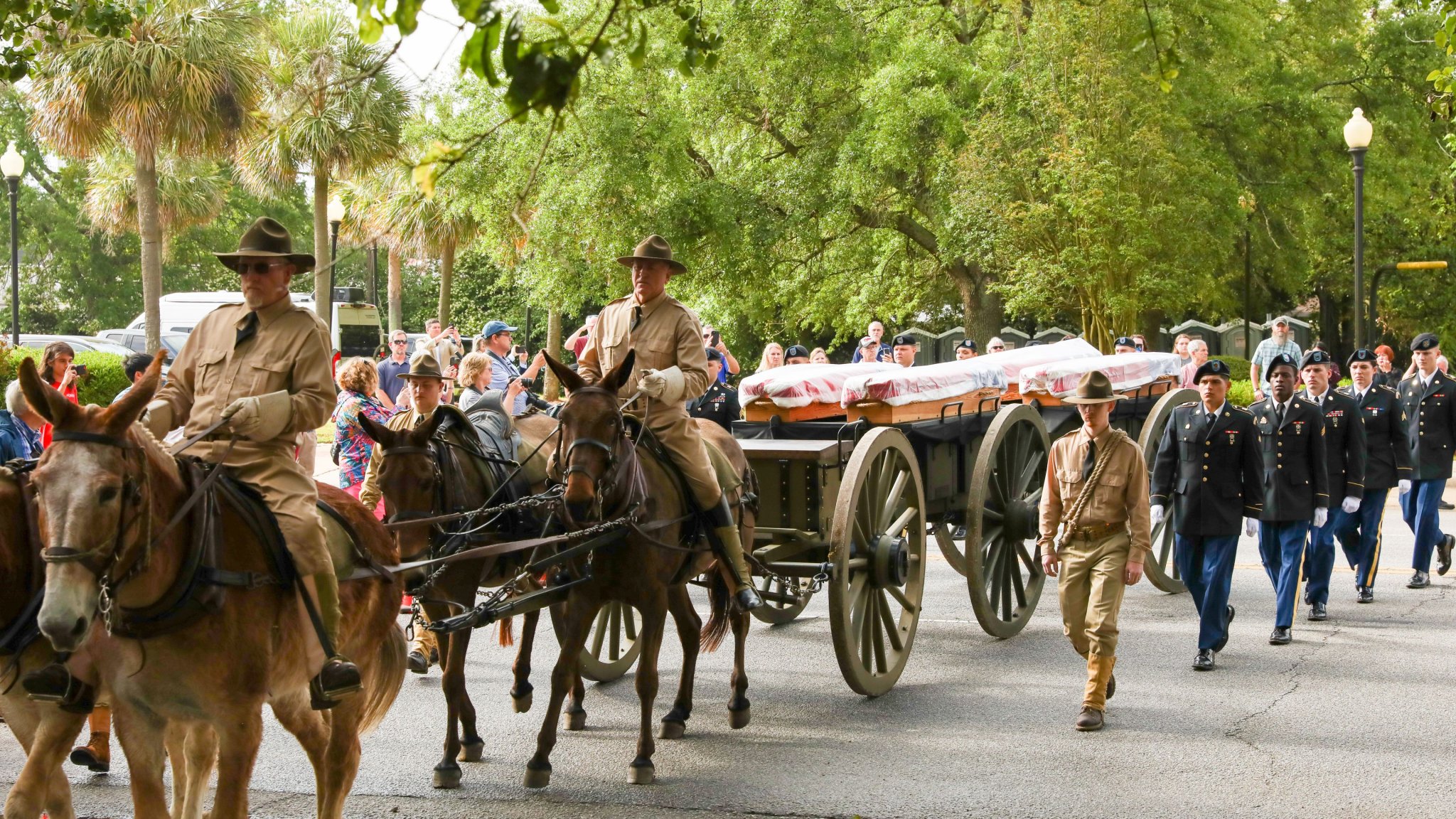
Nearly 250 years after he died in the Battle of Camden, researchers identified Pvt. John Pumphrey as one of more than a dozen Continental Army John Does that were found near the battlefield.
On Thursday, researchers in South Carolina announced that they confirmed the identity of one set of remains. Pumphrey, whose death was not recorded and whose identity was nearly lost to history, had been from a prominent Maryland family who enlisted in the Continental Army in his early teens. Given his service in the 7th Maryland Regiment, he is believed to have taken part in several campaigns in the nearly four years he fought in the Revolutionary War.
Researchers from the South Carolina Institute of Archaeology and Anthropology found the bodies in 2022 after coming across some exposed bones. The Historic Camden museum began studying the site and reached out to FHD Forensics to try and identify the 14 dead. It was determined that 13 were Americans while the 14th was British. According to the Baltimore Sun, a skull fragment — which turned out to belong to Pumphrey — had a strong DNA sample. That, with genealogical databases, gave the researchers leads. Records from the area also helped to narrow the identity of the deceased, leading to Pumphrey. The young private joined the Continental Army at around 14 in 1777.
It took “incredibly complicated research to go all of the way back to the colonial era,” FHD Forensics President Allison Peacock said at the event. Pumphrey himself didn’t have descendants, but researchers were able to trace the corpse back to him via his siblings’ descendants.
Pumphrey came from a well-off family in Anne Arundel County, Maryland, but joined the revolutionaries early. It’s not clear what caused him to join up with the revolution, but he stuck with it. Pumphrey reenlisted on Feb. 28, 1779 “for the war’s duration,” according to Maryland records, for $100. His regiment, part of the Maryland Line, took part in the battles of Brandywine, Germantown and Monmouth before marching south to Camden.
Maj. Gen. Horatio Gates, who had earlier won the Battle of Saratoga, took command of Continental Army force of troops from Delaware and Maryland, to break up British control in South Carolina. Despite having a larger force, Gates was deep in Loyalist territory and the battle was a major defeat for the rebels, with hundreds killed and more captured, Pumphrey among them.
After the bodies were found in 2022, they were given a formal burial a year later. The ceremony included honor guards of American and British troops.
Loading comments…
Comments couldn’t be loaded. Please refresh the page.