
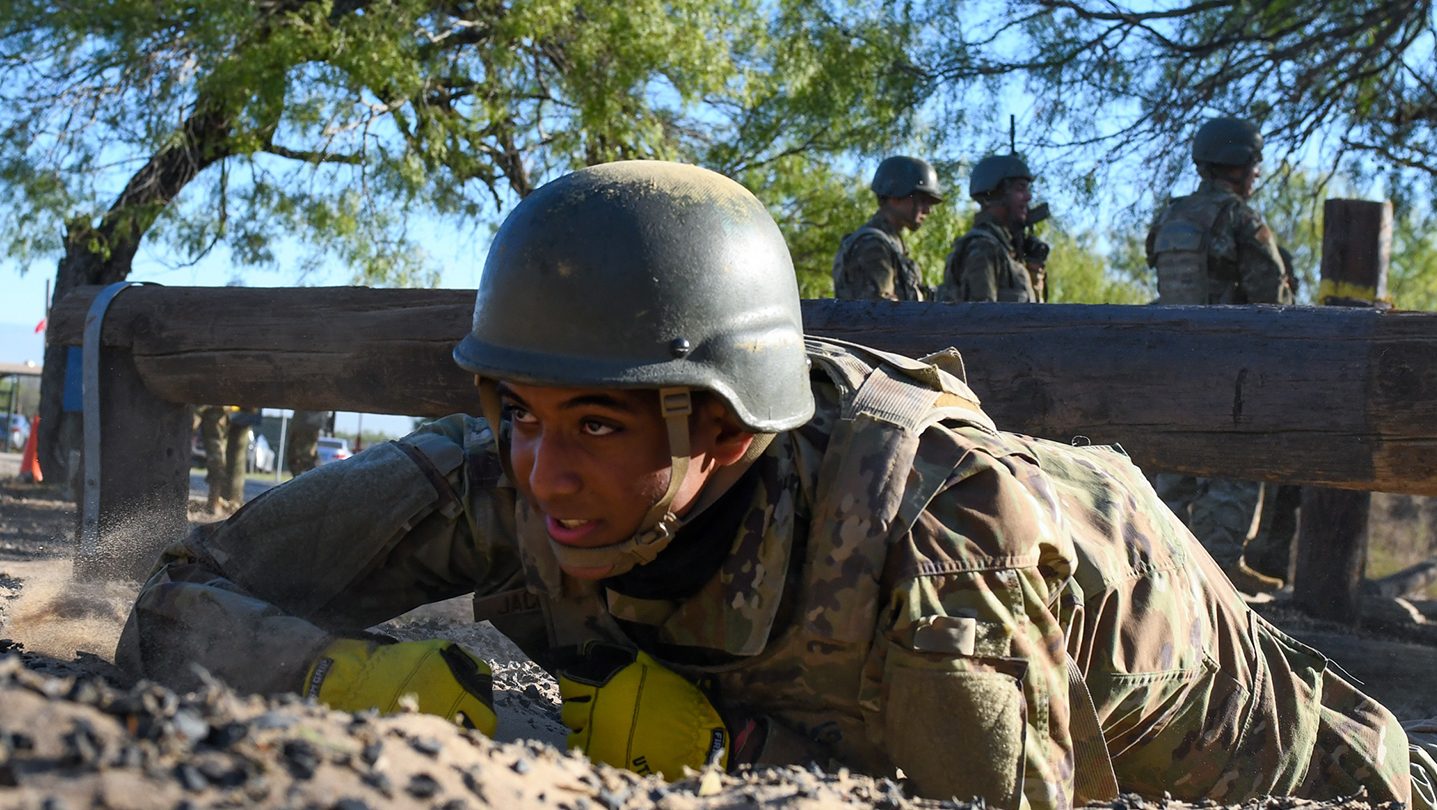
New Air Force recruits reporting to boot camp in October can expect more time spent working out and a new series of field events that simulate deployments to combat zones.
“Physically, it’s going to be tougher,” said Col. Bill Ackman, commander of the 737th Training Group, which oversees Air Force Basic Military Training, or BMT. “That being said, we are also giving them the tools to recover the resiliency piece, both mentally and physically.”
Daily exercise time will increase from 60 minutes to 90 in the new BMT, as recruits prepare for a capstone event that simulates a deployed environment, Ackman told Task & Purpose at the Air & Space Forces Association’s annual conference in National Harbor, Maryland.
The first 848 trainees will begin “BMT 2.0” on Oct. 7 at Lackland Air Force Base in Texas, Ackman said. The overall length of the training will remain seven-and-a-half weeks.
Top Stories This Week
Compared to current BMT physical training, or PT, the new, longer sessions will be “more high-intensity interval training,” Ackman said. “The runs are going to be longer. Increased box jumps. So, more than just pushups, sit-ups, and the run. We really want to make sure that their cardio, their strength, is all improved.”
The recruits will still have access to athletic trainers, whose job it is to teach recruits to exercise more efficiently and prevent injuries, he said.
The changes to BMT are designed to better prepare airmen for the changing character of war, Ackman said.
“You’re seeing it in Ukraine with drones,” Ackman said. “We’re seeing it with AI. Therefore, we need to adapt the way that we’re training both airmen and guardians to be useful in the next generation.”
Recruits will train as small teams
In addition to increasing the amount of time that recruits spend exercising, another change is that the training will focus on smaller teams, he said
“Traditionally, BMT has been set up around a flight of between 40, 50-some trainees,” Ackman said. “We’re now going to be focused on an element, so one quarter of that – so, between 10 and 15. And this is all to get after building competencies that are going to be more applicable to going into combat.”
The new version of BMT is also intended to better prepare trainees for the PACER FORGE event during the sixth week of training that puts recruits through combat scenarios, such as defending an air base against small drones, Ackman said. The Air Force lengthened PACER FORGE from 36 to 57 hours earlier this year to include scenarios including building and defending operating locations.
The format will also change how trainees transition from typical boot camp — marching, inspections, etc. — to the field enviornment. Currently, the abrupt transition to PACER FORGE can be “a shock to the system, if you will, going from marching on a drill pad to defending against small UASs [unmanned aerial systems],” Ackman said.
Those changes include adding progressive training events leading up to PACER FORGE to get trainees ready for the combat scenarios they will have to deal with, such as reacting to a simulated perimeter breach at an airfield, he said.
“The expectation that they have to operate under stressful environments as a small team prior to PACER FORGE will be a little bit tougher,” Ackman said.
Dummy rifles but not live weapons
One aspect about BMT 2.0 that will remain unchanged is trainees carrying inert M4s instead of actual rifles, Ackman said.
The Air Force has long wavered on what weapons, if any, are integrated into daily life at BMT. Weapons were not part of daily boot camp in the Air Force until 2005, when recruits were issued real weapons to carry and maintain. That practice was dropped seven years later. Since 2024, trainees have carried inert M4s through BMT after completing their initial weapon familiarization course in the first week of training.
Chief Master Sgt. of the Air Force David Flosi suggested last year that trainees could eventually be issued fully functioning M4s again “because the threat’s real, the environment is dangerous,” Air & Space Forces Magazine reported.
But Ackman said he does not believe that Air Education and Training Command ever endorsed such a move. Trainees will keep using the practice weapons and only use live M4s at the rifle range, he said.
Training weapons are cheaper than actual M4s, said Ackman, who added that he did not see a “perceived value” in having trainees carry weapons that can be fired.
“I don’t believe that the intent of what we’re trying to achieve with the trainer weapons, as far as muscle memory, getting comfortable carrying a weapon, being mindful of where you put it for tasks and making sure that it is part of your check list; that any time you go somewhere, you make sure – oh, where’s my weapon, carry it with me – carrying it safely, muzzle discipline – all of those things can be achieved using a trainer weapon,” Ackman said. “There’s no real value of having a live M4 versus the training substitute.”
