
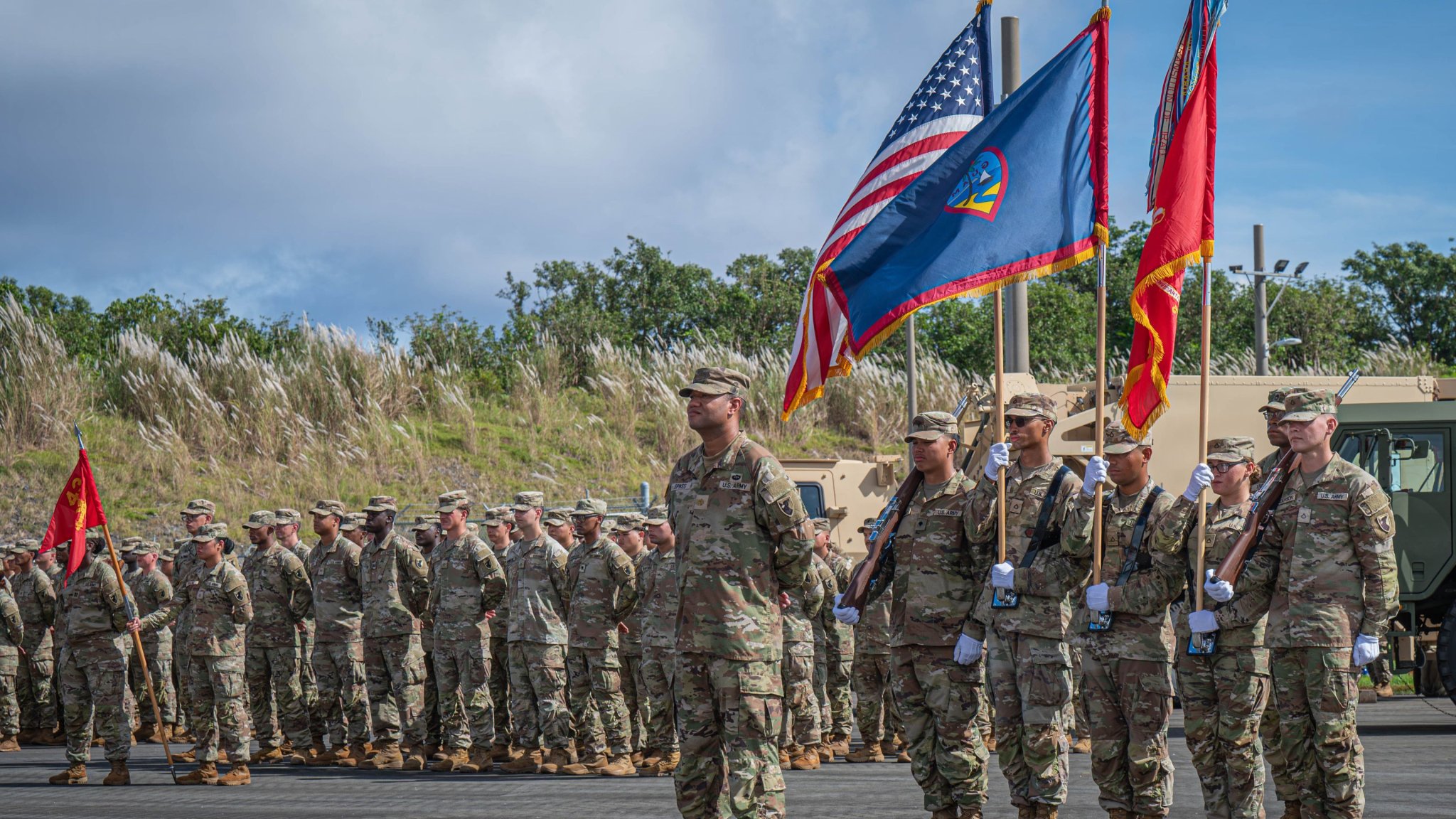
As part of its ongoing effort to fortify the U.S.’s westernmost territory, the Army activated a new air defense battalion on Guam this month.
On Oct. 16, the Army formally stood up the 3rd Battalion, 43rd Air Defense Artillery Regiment, 38th Air Defense Artillery Brigade, 94th Army Air and Missile Defense Command on the island.
The new battalion replaces Task Force Talon in overseeing the Army’s air defense role. That task force, set up in 2013 and made up of rotating groups of soldiers rather than a fixed unit, deactivated this summer. It was the Army’s first forward deployed air defense force in the Pacific and operated the Army’s powerful Terminal High Altitude Area Defense or THAAD missile interceptor system.
The Army called the activation of the new battalion a kind of institutionalization of the air defense mission, establishing permanent capabilities in the region.
“This battalion helped transform an ambitious concept toward operational capabilities,” Lt. Col. Joshua Urness, the battalion’s commander, said in the Army’s announcement. “The soldiers developed new procedures, relationships, and integration required to connect sensors, command and control systems, launchers, and interceptors to promote a unified defensive architecture.”
Along with the THAAD system, the battalion will operate a range of Army air defense weapons. Those include Patriot missile batteries and drones, according to a report from Stars & Stripes this summer.
Guam, strategically located in the Pacific, is a major U.S. military site, not just for its bases and airfields but also as a logistics hub for any major military operation in the region. It has large fuel storage sites and munition stockpiles. It also makes it an important target for any U.S. adversary in the event of a war. The military is working on a wider network of sensors, missile launchers and infrastructure for the island, called the Enhanced Integrated Air and Missile Defense System. That network would coordinate various Army, Navy and other air defenses to protect the island from enemy ballistic missiles and drones, although that remains in development.
The Army noted that importance in its announcement, saying that Guam is “an important part of U.S. military operations throughout the region by supporting joint force operations while making air and missile defense a critical part of protecting the forces and infrastructure needed to support those missions.
Loading comments…
Comments couldn’t be loaded. Please refresh the page.