
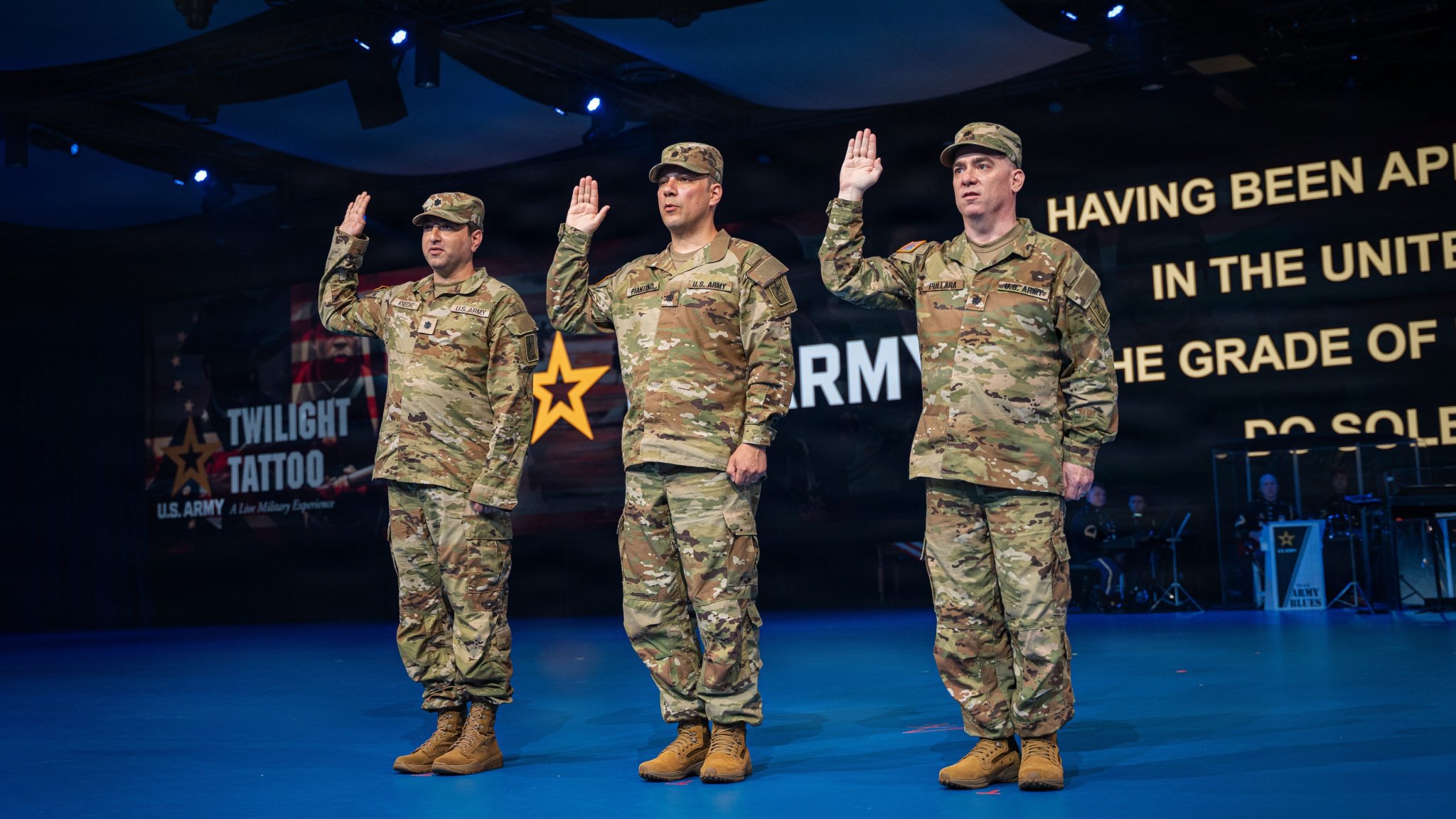
The Army recently commissioned a batch of executives from tech and venture capital firms with deep ties to Silicon Valley under a recruitment program launched last year.
The three officers were commissioned as lieutenant colonels and are the second cohort of soldiers to join an Army Reserve unit called Detachment 201. The program brings in professionals from major tech companies to serve as advisors. In June 2025, the first four came from day jobs at companies like Palantir, Meta, and OpenAI, before pinning on the rank of lieutenant colonel.
The June 10 commissioning ceremony at Joint Base Myer-Henderson Hall, Virginia, was part of the Army’s build-up of its officer pipeline of tech professionals, and it occurred as the Navy launched its own direct commissioning program focused on civilian experts in similar fields.
The newest batch of Army officers includes Sam Pullara, chief technology officer of Sutter Hill Ventures, a California-based venture capital firm; Serkan Piantino, who co-founded Facebook AI Research and was a former vice president of products at Reddit; and Dane Knecht, chief technology officer of Cloudflare, a company that sells a cloud platform that acts as an intermediary between a website and its visitors.
Lt. Col. Orlandon Howard, an Army spokesperson, said the officers were commissioned into the Army’s cyber field. The officers signed an eight-year Reserve contract as Individual Mobilization Augmentees and are required to complete at least 112 hours of service each year. Given that these officers are coming into the service straight from the private sector, they will also undergo legal reviews, receive ethics training, and submit financial disclosure forms to avoid any conflicts of interest. Disclosure forms for the three most recently commissioned officers are currently under review, so the Army has not assigned them to specific projects yet, Howard said.
Top Stories This Week
The officers are required to meet all the requirements laid out in the Army’s Direct Commission Course, Howard said. That includes passing annual fitness tests, completing weapons qualifications, and receiving medical and Chemical, Biological, Radiological, and Nuclear training. However, instead of attending the standard six-week course, they are being allowed to participate in a hybrid format with virtual and in-person training at Fort Benning, Georgia.
The Army’s plan, as laid out in news releases and during past roundtables with the press, is to use Detachment 201 to bring in tech professionals who have experience at the “C-suite level” — which refers to companies’ senior executive positions — who can advise the Army leaders on tech, cyber and related fields.
Howard said candidates for the program also need to have at least 10 years of experience and be able to show “a track record of growing organizations” from start-ups to larger private sector enterprises.
Army officials said in last week’s release that over the last year, the first cohort of tech execs have helped the service build supply chain data analysis tools for munitions and strategies for how to implement autonomous systems and counter-drone tech.
More tech talent
Beyond Detachment 201, the Army has also been opening up its direct commission options to younger officers with several years of private sector experience who can help build the service’s expertise in areas like AI, robotics, and networks. These would be professionals with three to five years in tech jobs who can come in as captains and lieutenants and serve in operational formations or in command staff jobs.
In a similar fashion, Navy officials recently put out a call that was akin to a private sector job posting for the Reserve’s Navy Innovation Unit. In the announcement last week, Navy officials said the service is looking for tech professionals with skills like network engineering, cybersecurity, and software development and management to join the ranks.
“The program is designed specifically for technical leaders, architects, and builders. The Navy is seeking professionals who have served as early-stage startup employees or have a proven track record of delivering high-impact products at scale,” officials said in the release.
According to the Navy, “candidates must have demonstrated the ability to work effectively in fast-paced, agile, and geographically distributed team environments,” and they will be assessed on their contributions to “significant” open-source projects, patent applications and published academic research.
Loading comments…
Comments couldn’t be loaded. Please refresh the page.