
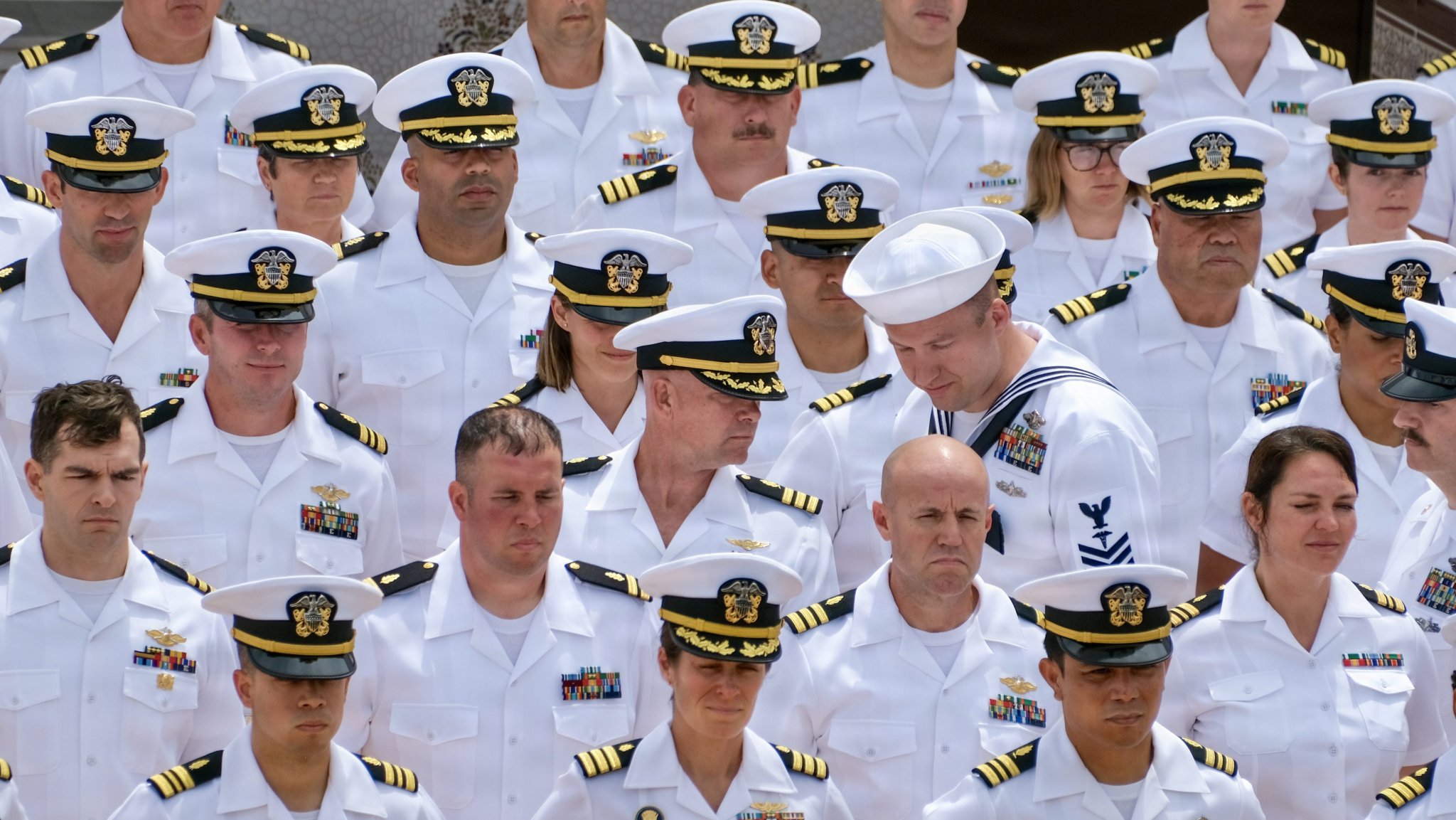
The Navy wants to find civilians who work in artificial intelligence and other fast-changing tech fields and fast-track them into service as Reserve officers, some with ranks as high as commander.
Once commissioned, the officers will maintain their day jobs in the tech world while working remotely and part-time for the Reserve’s new Navy Innovation Unit. The officers will be commissioned at ranks ranging from ensign (O-1) to commander (O-5), an official told Task & Purpose, as determined by a Navy board. Current Navy officers could be assigned to the unit in ranks as high as captain (O-6).
“The Navy Reserve Executive Innovation Pilot Program recruits accomplished industry professionals with expertise in fields such as cybersecurity, artificial intelligence, and human-machine teaming for direct commission into the Reserve Component,” the Navy official said.
Though direct commissions are not uncommon for junior officers, bringing a civilian into the Navy as a commander would be unusual. Commanders in the regular Navy typically have between 15 and 20 years in service and typically serve as senior officers, and occasionally commanders, on warships or with units with many hundreds or even thousands of sailors.
The officers will not attend a traditional commissioning program, like Officer Candidate School, but after being directly commissioned, will have to attend Officer Development School in Newport, Rhode Island. That program’s five-week course includes a curriculum focused on leadership skills, how the service operates, Naval strategy, and military law and ethics. The school trains other direct commission officers, like doctors and lawyers who join the service.
The Navy plans to begin commissioning new officers in fiscal year 2027, which begins on Oct. 1, 2026.
The Navy’s plan to bring in direct commission officers at mid and upper-level pay grades comes as the Army has set up a similar program. The Army’s new Detachment 201 had three Silicon Valley tech executives commissioned as lieutenant colonels last week and four others who joined last year.
Top Stories This Week
Navy Innovation Unit officers will work remotely and be assigned to a “nationally distributed team,” according to a Navy fact sheet reviewed by Task & Purpose. Their drill schedule will be “flexible” and based on the projects that they are assigned to, in order to “accommodate” their civilian careers. They must also hold or be eligible for a Top Secret/SCI clearance.
“This is not a typical Reserve billet. This is your chance to serve as a hands-on expert on a distributed, elite team. You will be asked to consult, build, and deliver solutions on the Navy’s toughest problems. You will be valued for your civilian skills first and foremost,” reads the fact sheet.
The officers’ mission objectives fall into three categories: acting as subject matter experts on technology applications; working in small teams to test rapid prototypes and solutions; and serving as a “translator” and advisor for senior leaders on tech trends.
The program will be looking for candidates with either technical or business experience in high-tech. The program will seek technical recruits with skills in artificial intelligence, data science, robotics, software engineering, cloud architecture, cybersecurity and other high-tech areas. Business and investment experience can be in venture capital or defense acquisition.
The Navy pilot program follows similar efforts by the Army to direct commission full-time tech professionals into the service, including tech executives who serve as lieutenant colonels, and lower-level officers with several years of tech sector experience.
So far, the Army officers have come from companies that contract with the Department of Defense, like Palantir and OpenAI. Others had backgrounds working for Reddit, Cloudflare, and Sutter Hill Ventures, a venture capital firm that was an early investor in NVIDIA. The officers are required to submit financial disclosures and complete ethics training, officials have said.
The Navy did not respond to Task & Purpose’s questions about whether the new officers would have to follow similar requirements.
CORRECTION: (6/24/26); This post has been updated to clarify that the highest rank at which civilians can be commissioned into the Navy Reserve to join the Navy Innovation Unit. That rank is commander. A previous version incorrectly stated civilians could join as captains. Current Navy officers who join the unit can do so at ranks up to captain.
Loading comments…
Comments couldn’t be loaded. Please refresh the page.