
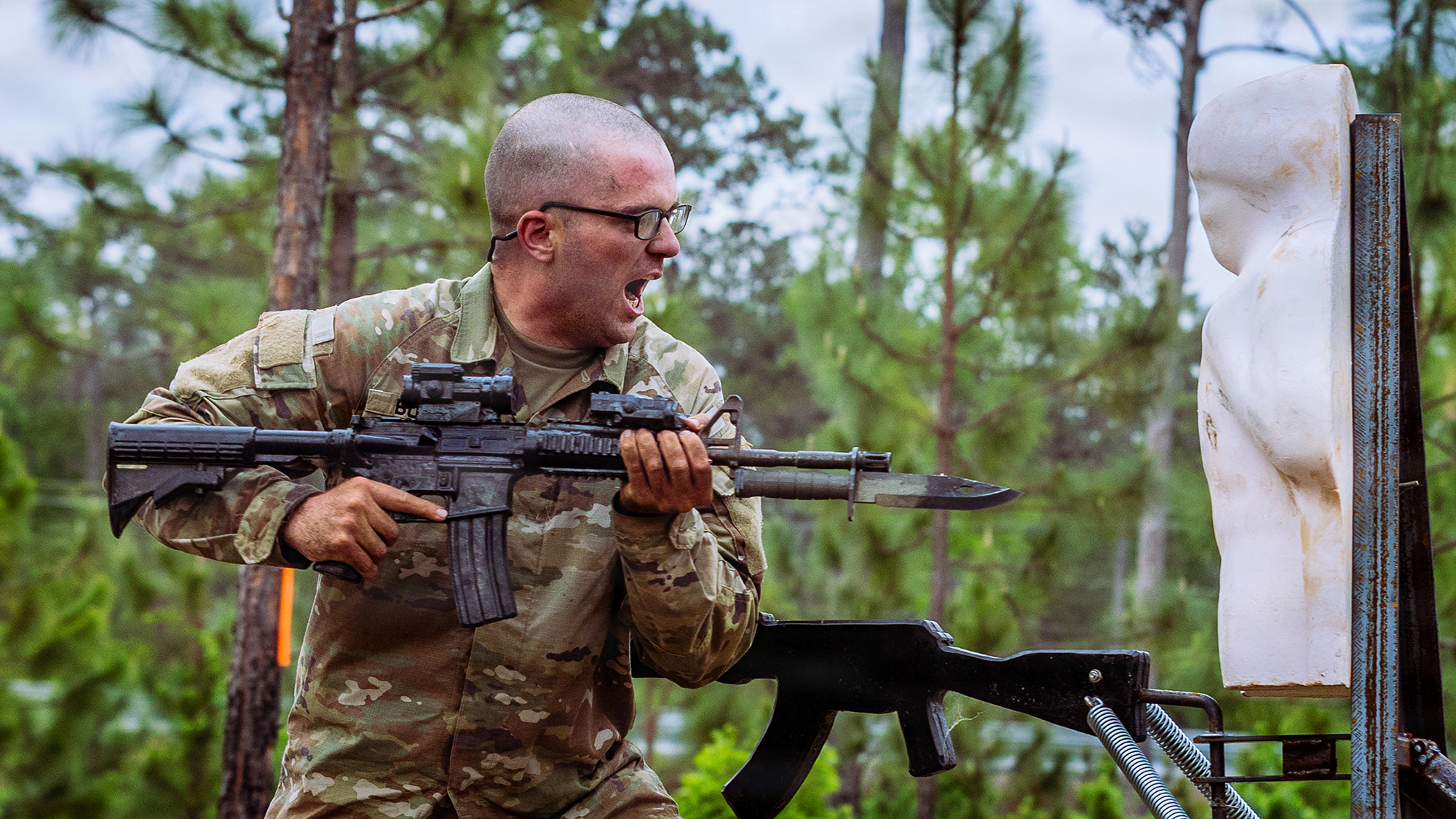
Those looking to take on the Army’s infamously difficult Ranger School will have to start by fixing bayonets, then run through smoke, razor wire, and machine gun bursts, hop in a trench, and stab the enemy with cold steel.
In April, Ranger Class 06-26 became the first to, well, take a stab at the school’s new bayonet course, a quarter-mile event in which students crawl through tunnels, sprint over open fields, and negotiate barbed wire fence lines. Along the way, students must drive their bayonets into silicone foes toting rubber Kalashnikovs and manning sand-bag machine gun nests.
For students embarking on the months-long Ranger School, the bayonet course is the chance to demonstrate to instructors that they are ready “to close the last 100 yards and destroy the enemy,” a course spokesperson told Task & Purpose.
“The Bayonet Assault Course allows us to introduce a level of grit, a level of violence of action, very rapidly,” said Command Sgt. Maj. Patrick Hartung, the senior enlisted soldier at the brigade that runs Ranger School, in a video the Army released.
Fixing blades to the end of students’ carbines isn’t necessarily about preparing for real-world bayonet charges, though those tactics aren’t completely unheard of in modern warfare.
Rather, the new bayonet training will let Ranger School instructors assess their students’ mental toughness when faced with the brutal, up-close reality of taking and holding terrain in battle.
Similar reasons undergird the Marine Corps’ reasoning for keeping bayonet instruction in boot camp — to foster a combat mindset. Army Basic Combat Training at Fort Benning also does a day of bayonet familiarization and pugil stick training, but not to this extent.
In April’s first class with bayonets, Ranger students ran through the obstacles during the course’s initial assessment portion on Fort Benning, Georgia, before beginning “Darby Phase,” where they are drilled on squad-size ambush tactics, demolitions, and graded patrols.
Less than half the class will typically proceed to the “Mountain Phase” in the more rugged northern part of Georgia and the “Swamp Phase” in Florida, according to the schoolhouse.
Graduates earn the Ranger Tab — not to be confused with the scroll worn by soldiers in the 75th Ranger Regiment, a light infantry unit composed of three battalions that specialize in high-stakes raids. When “Batt Boys,” as they’re commonly called, practice close quarters battle, they usually focus on advanced pistol transitions, rifle butt strikes, and other forms of hand-to-hand combat.
That’s not to say bayonets have no role on today’s battlefields.
The last major U.S. Army bayonet charge occurred during the Korean War. And while the practice may appear anachronistic in an era of fiber optic kamikaze drones and precision guided missiles, anyone who’s fumbled with fancy military-grade gizmos knows malfunctions should be expected.
Marines fixed bayonets at various points in the brutal house-to-house combat that became known as the Second Battle of Fallujah in 2004. In 2012, a British soldier led three others across 80 yards of open ground in Helmand, Afghanistan, with bayonets fixed to break out of a Taliban ambush. And during the Battle of Danny Boy in 2004, British troops near Amarah, Iraq, fought off dozens of insurgents with close-quarter rifle fire and bayonets.
“If all technology fails, (Ranger students) will have the fundamentals,” said Hartung, the command sergeant major of the Airborne and Ranger Training Brigade. “This is why we have them navigate terrain, close with and destroy the enemy with a bayonet.”
Loading comments…
Comments couldn’t be loaded. Please refresh the page.