
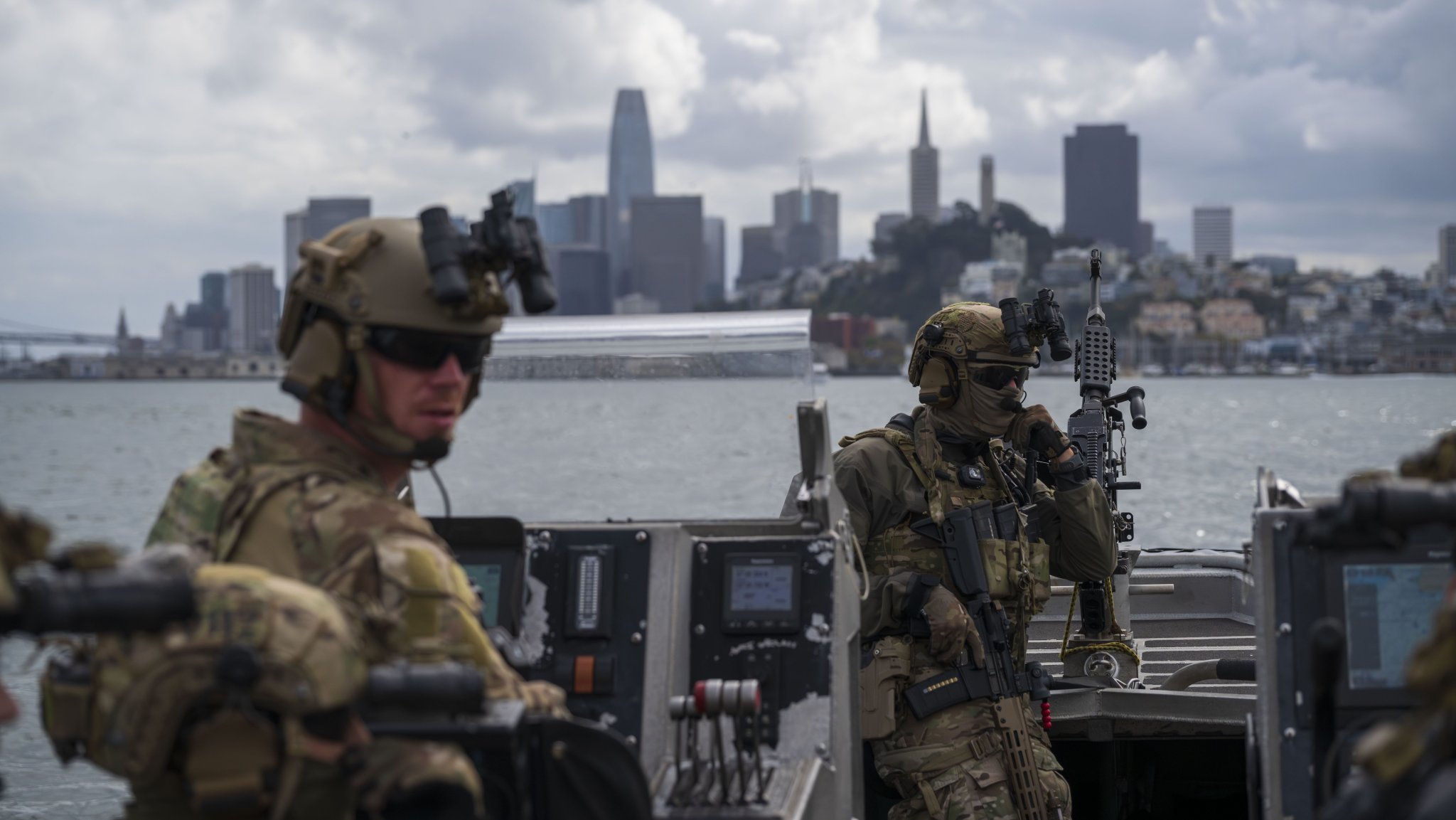
The Coast Guard plans to grow its specialized interdiction teams who hop onto fast-moving cocaine submarines and fast-rope down to oil tankers to make mid-ocean seizures, according to service officials and a fiscal 2027 budget proposal.
In all, the Coast Guard wants to spend about $80 million to add more than 650 personnel to its Deployable Specialized Forces units and set up a new Special Missions Command overseeing them. The teams, which train in both traditional law enforcement and tactics commonly associated with military special operations, have regularly deployed aboard Navy vessels and worked with Marine units over the past year.
Many teams that are part of the Coast Guard’s Deployable Specialized Forces were established after Sept. 11, 2001 as counter-terrorism units, and their use has risen dramatically under President Donald Trump’s policy of pursuing drug cartels as terrorist organizations.
A Coast Guard spokesman declined to disclose the number of personnel currently assigned to its Deployable Specialized Forces, though government reports have placed their manpower at roughly 2,000.
Top Stories This Week
The teams range from divers and port security detachments to specially trained raid teams of camo-clad coasties, who drive fast-boats equipped with belt-fed machine guns and look indistinguishable from special operators.
The Coast Guard’s new Special Missions Command will be located at Kearneysville, West Virginia, about 70 miles from Washington, D.C. where the Department of Homeland Security already has facilities. The command will stand up with 130 people to reach initial operating capacity, according to budget documents.
Another 525 personnel will be added to the Deployable Specialized Forces units themselves, a Coast Guard spokesperson said. The units will remain at their existing locations across the country but will move from reporting to Atlantic and Pacific Area commanders to the new Special Missions Command, the spokesperson said.
The increased headcount will help establish four new Tactical Law Enforcement Teams, which have been around since the 1980s and consist of boarding officers and marksmen who can shoot out smugglers’ boat engines from aboard helicopters. There are currently more than a dozen of the teams based in California and Florida, with about 230 members in total, according to congressional reports.
New boat crews and direct action sections will also be added to the Coast Guard’s Maritime Safety and Security Teams and Maritime Security Response Teams, each of which have more than 300 members, according to congressional reports.
Both units were created after the 9/11 attacks to patrol coastal waterways amid worries of further terrorist plots against U.S. cities. The security teams have also covered United Nations events in New York City, political conventions, international summits, and major sporting events like the Super Bowl.
Top Stories This Week
Regional dive teams and port security units will also report to the Special Mission Command. Some of the additional 650 personnel will be reservists who serve in those units, the Coast Guard spokesman said.
Putting all of these units under one centralized headquarters will allow teams to better coordinate as the number of deployments has ticked up dramatically, according to Coast Guard Commandant Adm. Kevin Lunday.
“We are forging our most elite operators into a single, razor-sharp instrument of national power,” Lunday said in a statement. “This is not an administrative change; it is an investment ensuring these elite teams are ready to protect the Homeland and support the Joint Force.”
The Coast Guard spokesman cited cocaine interdiction under Operation Pacific Viper and immigration enforcement along coastal California and the Rio Grande River as recent missions placed on Deployable Specialized Forces. The personnel have also been heavily used by the Pentagon for Operation Southern Spear, which the Trump administration launched in 2025 to disrupt what it has labeled “narco-terrorist networks.”
Operation Southern Spear has also involved dozens of controversial strikes against alleged drug trafficking boats. The strikes have killed at least nearly 200 people, according to non-profits that track the operations. Human Rights Watch has called the slayings “extrajudicial killings,” and the ACLU argues the strikes themselves are illegal.
In addition to the $80 million for the Special Missions Command and its associated units, the president’s fiscal 2027 budget is seeking a $2.1 billion increase for the Coast Guard at large. Budget documents said the money would go to new aircraft and vessels and infrastructure improvement.
Loading comments…
Comments couldn’t be loaded. Please refresh the page.