
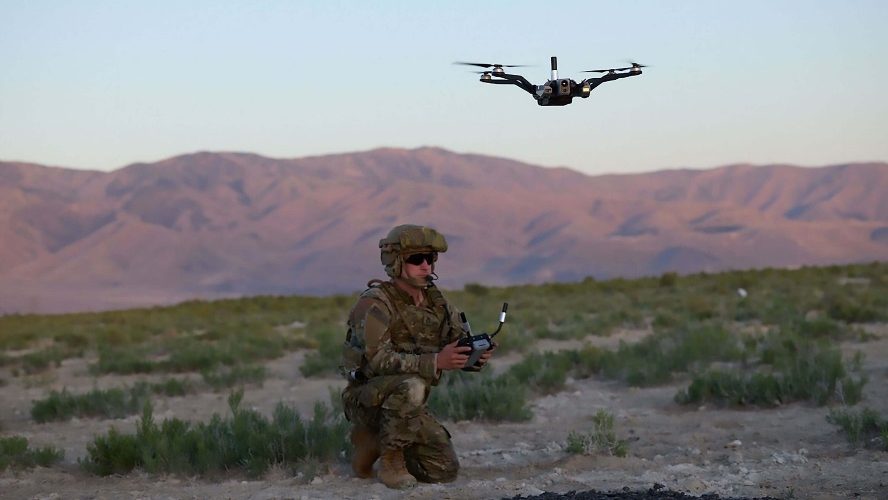
Base commanders will have more authority to approve the drones troops train with, giving them access to a variety of small drones, under recent policy changes.
The changes come after a memo issued by Secretary of Defense Pete Hegseth last week, which focuses on expanding the number and role of small drones across the services. The move seems to be particularly focused on the procurement process, ramping up domestic supply chains, and the rules that cover when and how the military can fly drones, unmanned aerial systems, or UAS.
“Modern battlefield innovation demands a new procurement strategy that fuses manufacturers with our frontline troops,” the memo said. “To simulate the modern battlefield, senior officers must overcome the bureaucracy’s instinctive risk-aversion on everything from budgeting to weaponizing and training. Next year I expect to see this capability integrated into all relevant combat training, including force-on-force drone wars.”
The services have long flown larger drones like the MQ-9 Reaper and MQ-1 Predator, both built as traditional large-scale weapons programs by General Atomics. But as the Pentagon has rushed to accelerate drone acquisitions, the Pentagon’s Defense Innovation Unit has established the Blue UAS Cleared List of a dozen-or-so smaller commercial drones approved for federal use.
Alex Miller, chief tech officer for Army Chief of Staff Gen. Randy George, said the Pentagon guidance gives commanders who are colonels and above the authority to buy, test and train with small drones.
In order to use other drones, commanders had to run the paperwork up the chain of command, a process that was “overly bureaucratic” and required approval from the highest levels of the Office of the Secretary of Defense, said Alex Lovett, a retired Navy captain and deputy assistant secretary of defense for prototyping and experimentation in the Pentagon’s under secretary of defense for research and engineering office.
Previously, to fly a drone not on the approved Blue list, “you had to get an exception to policy that required you writing a memorandum up your chain. If you’re at Indiana, you’d have to go up through the Army, and then submit that to [acquisition & sustainment] and they would approve it case by case,” Lovett said. “I would have to go get this letter to get out of jail. That’s all going away.”
The Blue UAS list was created to fast-track the approval process for commercial drones that the services could fly. Before getting approved for the list, officials would assess security risks like reviewing the internal parts, like chips and batteries, to make sure they didn’t originate from adversarial countries or that their computing systems complied with U.S. cybersecurity standards.
Lovett said the Pentagon has pushed approval for drone use down to base commanders to make their own calls and do a risk assessment on the types of drones they allow on base.
“General guidelines have been put out like, make sure they don’t phone home to a foreign country,” Lovett said.
Miller said more specific policies are being developed. Forthcoming guidance will tell commanders to ensure that the drones do not have a “dial home” device and do not store data like take off and landing spots, and also don’t contain critical components from Chinese, North Korean, Russian, or Iranian suppliers.
“SECDEF’s memo pushes it down to the services to sort of own our destiny a little bit,” Miller said. “It says, ‘Hey, commanders are going to understand the risk better and be able to act in good faith faster.’”
The Army is working to amend its own policies for test and evaluation requirements that can take up to a year for technology to be officially approved, Miller said.
The Blue UAS list is not completely going away, but instead is being folded into a larger database that will be managed by the Pentagon’s acquisitions and sustainment office.
“If you’re a base commander and you say, ‘is this risky? I don’t know.’ You can look on the database,” Lovett said.
In a statement to Task & Purpose, Army Secretary Dan Driscoll said the changes are a “critical step” for the Army to expand the number of drones inside its formations for training and eventual use on the battlefield.
The memo will “remove calcified bureaucracy so warfighters can do their job,” Driscoll said. “Drones are essential for modern and future warfare.”
Soldiers building their own drones
In addition to Pentagon efforts to amass more small drones, Army units have been experimenting with building their own. Earlier this year, the Army’s 173rd Airborne Brigade launched its own drone lab at Caserma Del Din, Italy, to build first-person viewer or FPV drones. Fort Stewart’s Marne Innovation Center in Georgia has begun hosting drone-building classes to teach 3rd Infantry Division soldiers how to build their own.
Those troop-made innovations are meant to be used by the unit that built them, which is in line with the military’s move to let troops decide which type of drones are most useful for their missions.
“The other way is where you buy one drone for everybody and that hasn’t worked out,” Lovett said.
It also falls in line with the Pentagon’s emphasis on small drones that are consumable and disposable.
“It’s like a Diet Coke,” Lovett said. “You use a Diet Coke, when you’re finished with a Coke, you get another one.”
The latest on Task & Purpose
- Air Force updates uniform standards including new rules for boots
- The Army and Navy want the ‘right to repair’ their own equipment
- Here is every rifle Marines have used in the last 250 years
- The Army has realized that horses are no longer good for ‘warfighting’
- Army will look for false accusations, consider ‘credibility’ in misconduct cases
