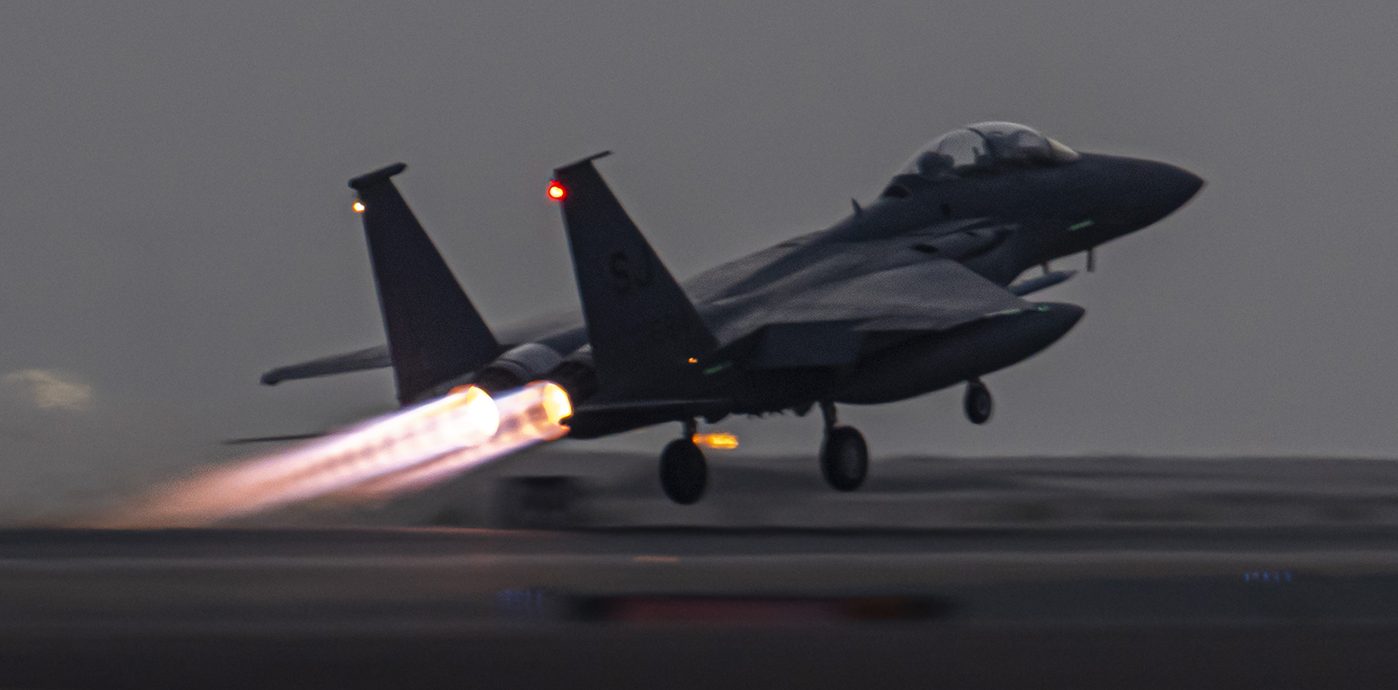
Air Force F-15 crews hunting Iranian drones and missiles last year attacked so many of them that they ran out of missiles and seemed to be out of options for those that remained.
“If they could have rolled down the window and thrown rocks at it, they probably would have,” said Lt. Gen. Derek France, head of Air Forces Central, this week.
So the crews tried an almost unheard of tactic: drop bombs on the targets as they flew.
France discussed the innovative, if low-accuracy, air-to-air tactic at a media roundtable on Wednesday during the Air & Space Forces Association’s annual conference in National Harbor, Maryland.
The engagement took place in April 2024, when U.S. forces helped shoot down drones launched by Iran and Houthi rebels in Yemen against Israel. The Iranian attack involved a total of 170 drones, more than 120 ballistic missiles, and more than 30 cruise missiles.
Top Stories This Week
During the fight, Lt. Col. Curtis “Voodoo” Culver and Lt. Col. Timothy “Diesel” Causey, both of the 494th Fighter Squadron at Royal Air Force base Lakenheath, England, attempted to use a laser-guided precision munition to destroy an Iranian drone. The engagement was first reported by The War Zone and Air & Space Forces Magazine.
“That airplane was out of missiles,” France said. “All it had left was a GBU-54, so a laser-guided JDAM [Joint Direct Attack Munition], which isn’t really designed against an aerial target. But the crew was on the way back. They were going to get gas and reload, and they went: ‘We found one, let’s see if this will work.’”
“The GBU-54 is not so much a TTP [tactic, techniques, and procedures] intentionally,” he added. “It’s: ‘That’s all we got.’”
At first, the F-15 crews thought they had hit their target. But the drone survived. Two other F-15s that tried to bomb Iranian drones also missed.
Both Causey and Culver were awarded the Distinguished Flying Cross in November 2024 for their actions during the Iranian drone attack. On Wednesday, France explained the thinking behind their decision to use a bomb against a drone.
“That airplane was out of missiles,” France said. “So, it had shot its entire missiles [and] had killed a bunch of drones. All it had left was a GBU-54, so a laser-guided JDAM [Joint Direct Attack Munition], which isn’t really designed against an aerial target. But the crew was on the way back. They were going to get gas and reload, and they went: ‘We found one, let’s see if this will work.’”
“The GBU-54 is not so much a TTP [tactic, techniques, and procedures] intentionally,” he added. “It’s: ‘That’s all we got.’”
In the end, the first F-15’s bomb “just barely missed” the Iranian drone, said France, who explained that air-to-ground weapons must hit their targets directly.
“Whereas an air-to-air weapon has what we call a proximity fuze, so if it comes close enough, it will fuze and detonate and take out a drone,” France said.
“So, it didn’t work, but that’s like innovation on the fly,” he added.
Since Iran’s April 2024 drone and missile attack on Israel, the Air Force has started using the Advanced Precision Kill Weapon System, or APKWS, which uses relatively low-cost laser-guided rockets to shoot down drones.
The system allows pilots to kill enemy drones at less than 10% of the cost of firing an AIM-9X Sidewinder missile, Air Force Chief of Staff Gen. David Allvin said on Monday at the Air & Space Forces Association conference. Each F-15E can carry up to 42 rockets, he said.
Had the F-15s flying against Iranian drones in 2024 been armed with the rockets, they “would have had the magazine depth to just shoot one of those at it,” France said on Wednesday.
“That is another laser-guided weapon, but it is smaller, and it does have a proximity fuze,” France said. “So, if it passes close enough, it will take out the target.”
While using bombs against aerial targets is extremely rare, this is one example of the practice working. On Feb.14, 1991, an F-15 crew successfully dropped a laser-guided bomb on an Iraqi Mi-24 helicopter while it was flying.
“You could see it hit the helicopter,” retired Lt. Col. Tim “Rhino” Bennett, the F-15 pilot at the time, told Task & Purpose for a 2022 story. “We had delayed fuzes on those things, so that when we hit a Scud or a Scud site, it would penetrate and then blow up. I think we had a 0.25-second delay on the bombs. So, really the bomb blew up right below the helicopter as it went through it. There weren’t even little pieces of it. It was a great hit.”