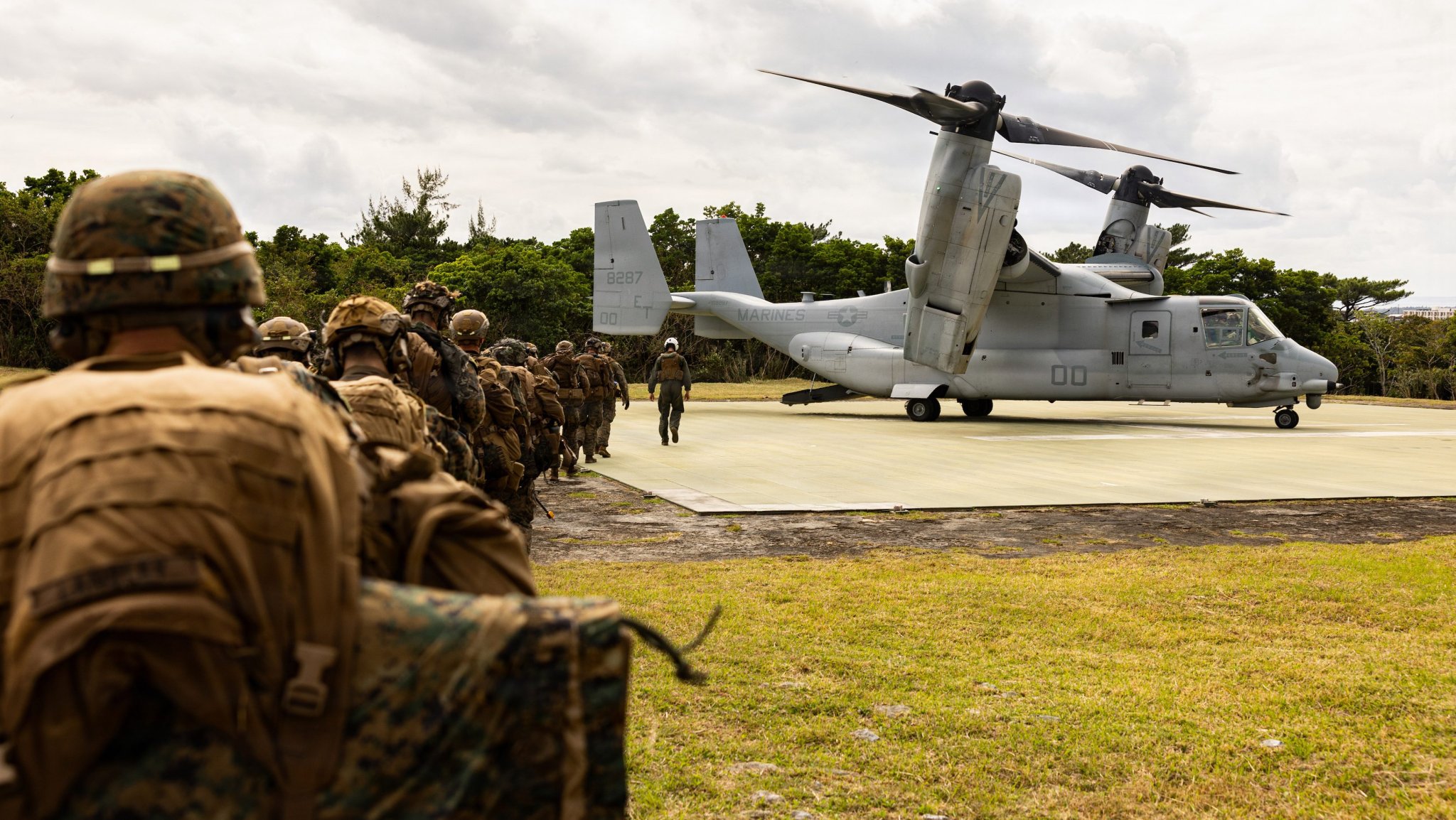
Marine Corps officials said they are implementing five major changes across its fleet of MV-22 Osprey aircraft, including major overhauls of its transmissions, after nearly 20 accidents across the services in a roughly two-year span. A federal watchdog that reviewed the aircraft said the service still has yet to show a “systematic” way of addressing risks.
The Tuesday release of the “2026 Marine Aviation Plan” confirmed that the service is continuing to replace older gearbox components across the fleet with new ones made of harder steel. The service will also make major changes to the rotating engine compartments known as the nacelle, along with a new suite of computers and sensors for the plane.
“As the backbone of Marine Corps combat assault transport capability, MV-22B squadrons have conducted a total of 111 operational deployments and flown over 600,000 flight hours since 2007,” the report said. “The MV-22B flies approximately twice as many flight hours per year as any other Marine Corps rotary-wing aircraft and remains a safe and reliable aircraft.”
Marine and Air Force Ospreys have been in at least 20 mishaps in the last decade, some occurring days apart. Families of Marines killed in a 2022 crash are suing Boeing, the aircraft’s manufacturer, and other subcontractors, alleging the fault lies in poor designs and poor manufacturing by contractors, including improperly tempered steel.
Groundings and mishaps
All three services that fly the Osprey have grounded their fleets multiple times, including a late 2023 standdown that lasted more than three months.
At the heart of most of the accidents — including two that killed a total of 13 flyers — were failures in the plane’s deeply complicated gearbox, which meshes numerous gears and driveshafts. Most of the failures occurred during takeoffs, allowing crews to abort flights or quickly land. But two gearbox failures in mid-flight — one Air Force, one Marine — caused the planes to crash, killing a combined 13 crew members.
The causes of the Osprey accidents have varied, but “most often” they were the result of “material failures and human error tied to supervision, training, and risk management,” Diana Moldafsky, the GAO’s director of the office’s defense portfolio, said Tuesday at a House Armed Services subcommittee hearing.
In fiscal years 2023 and 2024, the Marine Corps and Air Force saw higher serious accident rates with the Osprey compared to the previous eight years — a total of 18 non-combat accidents. Four of those accidents were fatal, killing a total of 20 service members, the Government Accountability Office found in its December 2025 report.
In the aviation plan, the service noted that the Osprey’s rate for Class A mishaps — which are categorized by an accident with a fatality, permanent disability, or property damage of at least $2 million — over the last decade was 2.37 per 100,000 flight hours, which was “lower” than the service’s entire average of 3.3 mishaps.
But looking at the data more holistically, GAO investigators found that the “Osprey consistently exceeded serious accident rates for most Navy and aircraft types,” Moldafsky said. The Osprey’s serious accident rate “generally exceeded” fixed-wing and rotary-wing aircraft accidents in the Navy and Air Force between fiscal years 2015 through 2024.
Comparison to at-sea collisions
At Tuesday’s hearing, Marine Corps Brig. Gen. David Walsh told Congress that the service is implementing all of the GAO’s recommendations. Walsh, a Naval Air Systems Command program officer, including drive shafts and gear boxes, modernized screens, computers for the cockpit and a system that gives maintainers and air crew more timely information about the aircraft.
“We’ve updated our policy and our governance structure to ensure that I as the airworthiness authority, have visibility on all of the risk as they manifest on this platform,” he said.
Joe Courtney (D-Conn.) said he expects Congress to take the Osprey safety risks as seriously as lawmakers did after two Navy guided-missile destroyers collided in the summer of 2017 and killed 17 sailors.
“The possibility of legislative action to codify elements of these recommendations, like in the aftermath of 2017, would send a powerful message to our service members and the public that real change is happening if undertaken,” he said.