
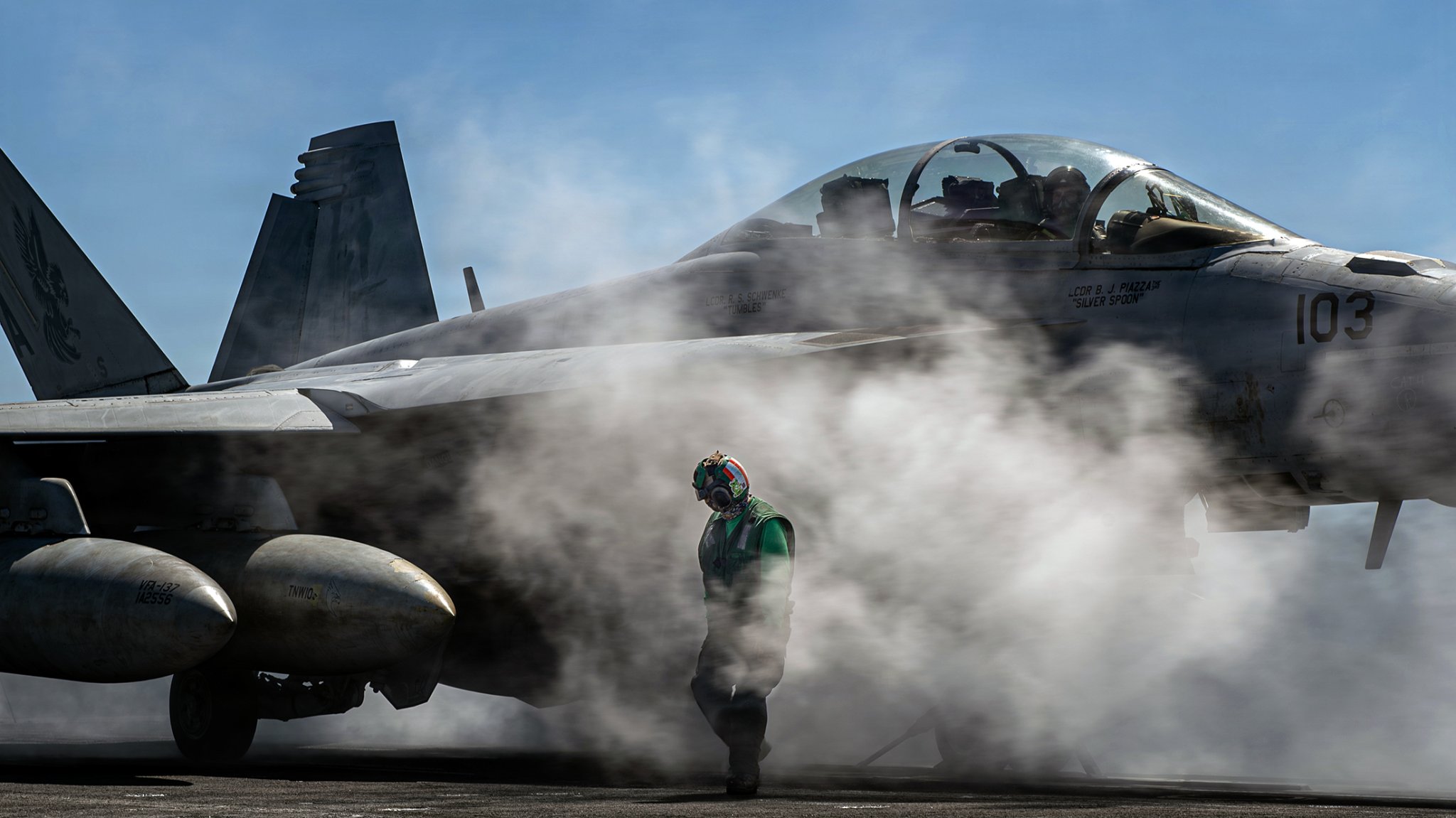
The Navy doesn’t have a handle on how aviation jobs increase risks of brain injuries or head trauma. Because of the knowledge gap, the service cannot protect or treat aviators dealing with these issues, a new Congressional report found.
The findings, published Tuesday in a report by the House Committee on Oversight and Government Reform’s military subcommittee, found a series of gaps in care, research, and cultural norms that may impact how Navy flight officers, like those in the famous TOPGUN program, get treatment for traumatic brain injuries and related mental health issues.
The investigation was prompted by mounting whistleblower concerns and New York Times reporting on a series of suicides among F/A-18 pilots, which suggested that naval aviators may be at risk for brain injuries due to the extreme forces that they take on physically during takeoff and combat maneuvers, according to the committee.
“The Navy is confronting a risk it has not fully chosen to understand,” reads the report. “Despite credible warnings, external reporting, and internal awareness, the Navy has yet to determine whether the very conditions that define naval aviation may also be causing long-term harm to the pilots who endure them.”

In 2024, Lt. Cmdr. Dr. Richard W. Lang from the Department of Orthopedic Surgery at the Naval Medical Center in San Diego, California, acknowledged a series of “high-profile” suicides involving high-ranking, combat-experienced F-18 pilots. In his own independent study, Lang found common, widespread stressors like relationship challenges and substance abuse, and that aviators’ compounding mental health issues also went untreated. The study was circulated among Navy aviation leaders, including Capt. Mike Burks, the program manager for the F/A-18 and EA-18G programs, who advocated for the aeromedical community to “take ownership of the issue.”
The House committee report found that while most agreed, there was no “consensus” on how to address the issue.
The other underlying problem, which the committee called a “strategic oversight,” is that the Navy has not dedicated resources to look at what brain health risks aviators face. Among the Navy’s 127 medical research projects on aviators, all looked at isolated conditions or performance issues like hypoxia, spatial disorientation, cognitive fatigue, and none considered “cumulative brain injury risk over time.”
“The absence of evidence is therefore more indicative of a lack of targeted study rather than a credible conclusion of an absence of risk,” the report said.
Top Stories This Week
While the Navy does have Project Odin’s Eye, which looks at brain health risks for aviators, the committee found that it is narrowly scoped and used to identify performance issues among a small number of special operators. It does not do all-encompassing, long-term assessments across naval aviation.
Beyond the institutional failures, the committee also described the “self-reinforcing system” that aviators face when it comes to seeking mental health care because of cultural stigmas and the potential career impacts. An April 2026 naval aviator cohort study found that nearly 72% of pilots reported avoiding medical care, and 42% said they withheld information due to fears that they would lose their flight status. Similar worries have also been reported among Army pilots and even civilian commercial pilots.
The committee also found that the Navy’s fundamental understanding of aviator mental health is “incomplete” — focused on managing work stress by offering bonuses and leave incentives, instead of studying the physical factors that cause brain injuries.
“This is not an either-or issue. Operational stress is clearly a concern,” the report said. “However, the Navy’s own documents show that it has not seriously examined whether cumulative exposure to high G-forces and other physiological stressors could also be contributing to long-term mental health outcomes.”
To address all of the gaps, subcommittee leaders recommended that Congress mandate a longitudinal study and reforms of medical policies that reduce disqualification criteria and improve transparency over medical waivers.
Loading comments…
Comments couldn’t be loaded. Please refresh the page.