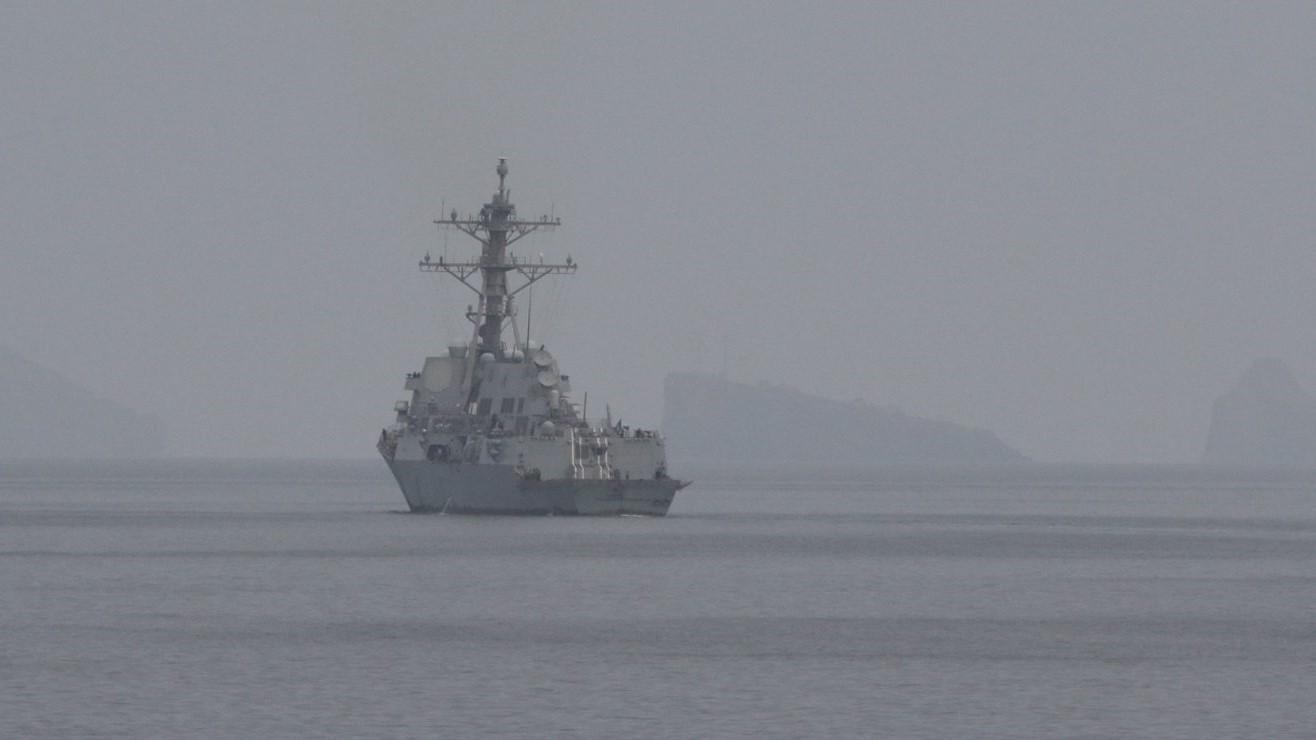
Two U.S. Navy destroyers are now in the Persian Gulf after crossing the Strait of Hormuz on Saturday, U.S. Central Command announced. The warships are now working on “ setting conditions for clearing mines” in the important waterway.
Two Arleigh Burke-class guided-missile destroyers, the USS Frank E. Peterson. and the USS Michael Murphy crossed the strait earlier today and are now sailing in the Persian Gulf, also known as the Arabian Gulf. Axios reported that the move was not coordinated with Tehran, en as negotiations began earlier today. It’s the first major move by U.S. forces in the area since a two-week ceasefire in the war was announced on Tuesday, April 7.
“Today, we began the process of establishing a new passage and we will share this safe pathway with the maritime industry soon to encourage the free flow of commerce,” CENTCOM head Adm. Brad Cooper said in the release. President Donald Trump also confirmed the start of the mission in a post on social media.
It’s not clear how long the mission will last or how many mines have been laid in the waterway.
Top Stories This Week
On Friday, the New York Times, citing American officials, reported that Iran has lost track of some of the mines it laid in the strait. Iran left a narrow path in the already narrow waterway open, but American officials said some mines were laid in a way that let them drift. The United States retired its minesweepers and has turned to its littoral combat ships to fill the mine clearance role. However two of the three littoral combat ships that had been operating in the CENTCOM area of responsibility were moved out of the region in March and sent to Singapore.
CENTCOM said that additional U.S. forces, including underwater drones, will join the mission in the near future. It’s not clear what other surface ships might participate. The U.S. Navy still has several ships positioned around the Middle East that had been participating in the war. Seven other guided-missile destroyers are operating in the Arabian Sea, according to USNI News’ fleet tracker. One, the USS Spruance, is traveling as part of the USS Abraham Lincoln’s carrier strike group. Additionally, the Tripoli Amphibious Ready Group, carrying a Marine Expeditionary Unit, is also in the area. Two more destroyers are sailing in the Red Sea.
The Strait of Hormuz is a critical shipping lane for oil as well as important chemicals relied upon by nations around the world. The weeks-long war has disrupted shipping through it even prior to the laying of mines, causing energy prices to spike.
Mines pose an extreme risk not just to commercial ships in the waterway but military ones as well. During Operation Desert Storm in 1991, the cruiser the USS Princeton hit two mines while sailing through the Persian Gulf. Three crewmembers were injured and the ship was moved out of the war for repairs.
The crossing of the strait comes as American and Iranian negotiators met in Islamabad, Pakistan for continued ceasefire talks. Pakistan, which is serving as the main mediator between the two nations and help set up Tuesday’s ceasefire, said on its state TV that the top negotiators — American Vice President JD Vance, and Iranian Foreign Minister Abbas Araghchi — met face to face, with Pakistani army chief Asim Munir in the room with them. Talks prior to the start of the war had mediators ferrying messages between the parties in different rooms. The status of the Strait of Hormuz remains a major point of contention in the talks, as well as the continued bombing of Lebanon. At least two rounds of talks have taken place so far, according to Iranian media reports.