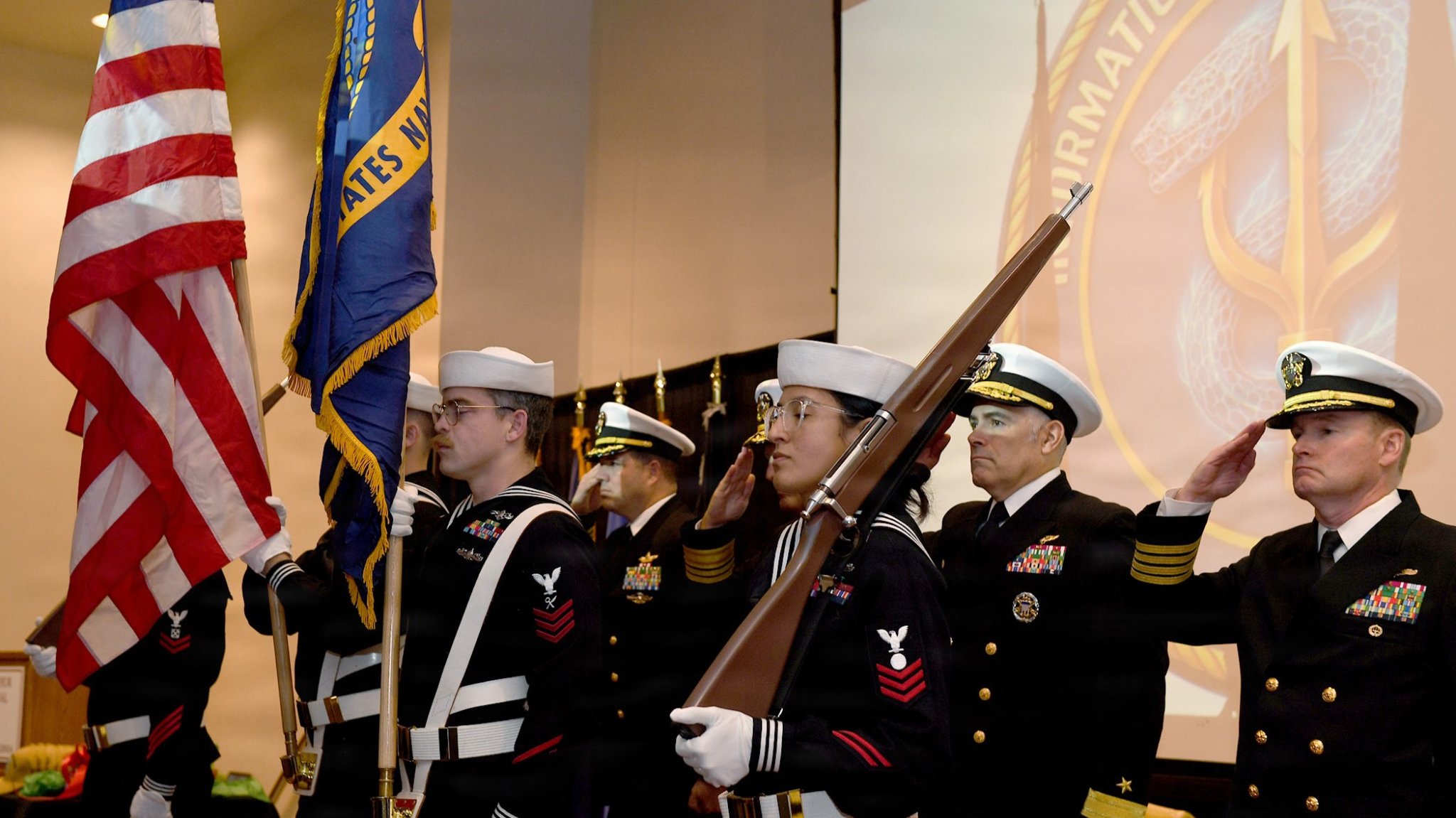
The Navy is the latest service to get into the information warfare fight. On Friday, Naval Information Forces stood up the Information Warfare Squadron Two, the first of a new kind of naval intelligence unit meant to support carrier strike groups.
The new unit, to be based on the East Coast, was officially activated in a ceremony on Dec. 5 in Norfolk, Virginia, according to a release shared by the Navy on the Defense Visual Information Distribution Service, or DVIDS.
Plans for the new type of squadron were approved in June by the Fleet Commanders’ Readiness Council. Vice Adm. Mike Vernazza, head of Naval Information Forces, said that the Navy’s information warfare elements have often been “disparate,” despite their importance. The new squadron structure is meant to create a “unified force” that can support carrier strike groups. As it is a pilot program, the 48-month testing period will see how the unit and subsequent ones can best consolidate and refine information warfare doctrine for a deployed carrier strike group.
According to Naval Information Forces, the new squadron creates a new chain of command bringing in elements from regular carrier strike group staff, as well as Navy Cyber Defense Operations Command, Navy Information Operations Command, the Strike Group Oceanography Team and others. Capt. Jon O’Connor, the commander of the new unit, described its mission as being “about warfighting, pure and simple.”
“IWRON-2 will not only meet, but exceed the standards of excellence because we must. Our mission demands it. We are here to strengthen the readiness, lethality, and survivability of our Carrier Strike Groups by integrating our advanced IW capabilities,” he said, per the Navy.
Top Stories This Week
The new squadron is the first of its kind; the number matches up with the carrier strike group it is a part of.
Task & Purpose contacted Naval Information Forces about the exact make up and size of the new information warfare squadrons, and what the pilot program aims to measure. As of press time Task & Purpose has not heard back. However, according to the Naval Intelligence Professionals, a nonprofit organization made of active-duty sailors and veterans who served in naval intelligence roles, said that each squadron will have approximately 70 sailors assigned to it.
A second squadron is expected to be set up on the West Coast next year.
The activation of the new unit is the latest in several moves by the different military branches this year to reorganize and prioritize information and electronic warfare. Earlier this year the Army shuttered 1st Information Operations Command, which was part of U.S. Army Cyber Command, after more than two decades. It has instead started to activate new Theater Information Advantage Detachments, new units meant to wage war in the battlefields of public affairs and information operations, with a specific focus on tackling disinformation. It also started new electromagnetic warfare companies, with the first of its kind being stood up in the Georgia National Guard.