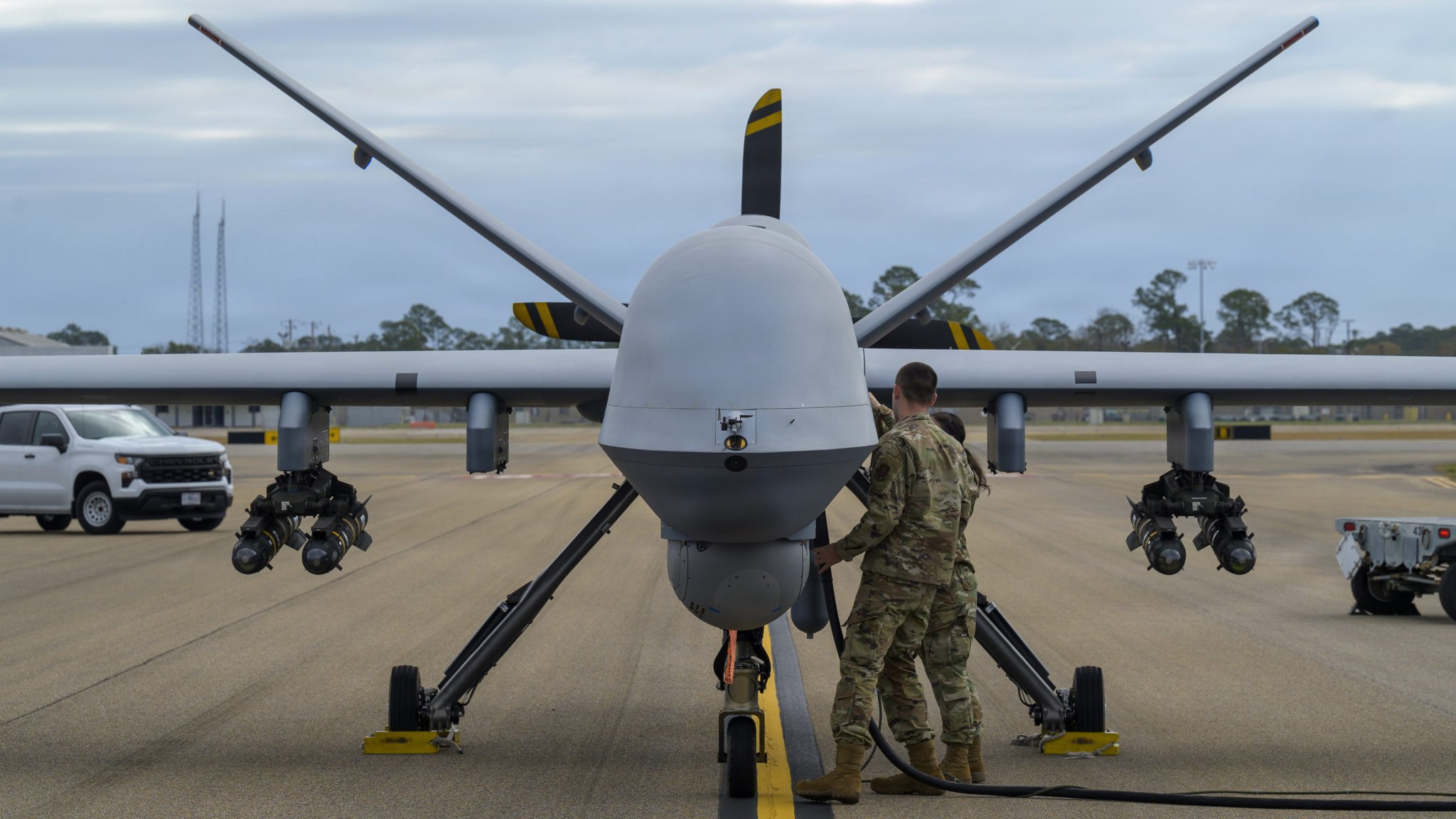
The Air Force has reactivated a squadron in Nevada that flies the MQ-9 Reaper, the unmanned, heavily armed drone that is entering its third decade of flying.
The 42nd Attack Squadron at Creech Air Force Base, Nevada, was the first unit in the Air Force to fly the Reaper, beginning in 2006, clocking over 180,000 combat hours over Afghanistan across 13 years before going “dormant” in 2020.
But with its reactivation, the 42nd ‘s drones will have a capability they previously did not.
Previous Reapers used in Afghanistan needed a set of pilots to be in “line-of-sight” control of the plane during take-off and landing, while the actual missions were handed off to crews based in the U.S. or elsewhere. But new technology automates take-offs and landings, which can now be controlled by satellite. As a result, fewer airmen are needed for those missions, and dedicated Reaper units can focus on reconnaissance and strike missions.
“They would go around the world, and they would deploy and just take off and land. They wouldn’t do any of the missions that we see on television,” said Retired Air Force Brig. Gen. Houston Cantwell, who commanded Reaper units during his career. “A normal pilot and sensor operator from any location in the world [will] use satellite communications and do take-offs and landings, because the aircraft is much more automated than it was before.”
The 4,900-pound drone is operated by pilots at remote bases. Reapers are built to fly for as long as a full day, and have a 66-foot wingspan and 36-foot fuselage, making them useful for both intelligence gathering and strike weapons. Reapers can carry up to eight Hellfire missiles and precision-guided bombs.
The reactivation is part of a larger Air Force reorganization of its MQ-9 Reaper units, Cantwell said. In January, the 11th Attack Squadron also joined the 25th Attack Wing.

The MQ-9 Reaper Keeps Getting Shot Down – And Still Gets Used
A staple of the Afghanistan War
Reapers were part of the U.S. military’s earliest combat drones, often circling the skies over Afghanistan and parts of the Middle East through two decades of war. But conflicts in Ukraine and in the Middle East have reshaped modern war and the need for smaller drones that also handle recon and strike missions.
But the Reaper is still relevant because no other single aircraft can do everything it can over a target, according to David Deptula, the Air Force’s former first chief of intelligence, surveillance, and reconnaissance.
“That matters operationally because the same platform that detects a target can continue tracking it, verify changes in real time, and either strike directly or pass precise targeting data to another asset without the delays that come from handing the mission across multiple platforms,” Deptula told Task & Purpose.
Top Stories This Week
Cantwell said the MQ-9 can fly for up to 24 hours and continuously gather intelligence, which is limited when using manned fighter jets.
“F-35s are amazing, but they can only stay on station for an hour,” Cantwell said. “The MQ-9 also has the ability — because the pilot and sensor operator on the ground — they have unlimited bandwidth when it comes to intelligence feeds, when it comes to putting all the pieces together of what’s going on around the battle space.”
Ongoing Iran operations
U.S. Central Command has released several videos that appear to show operations from the drone’s camera feed, including U.S. weapons destroying Iranian aircraft.
Cantwell said that the war with Iran has shown the importance of space-based intelligence, and history has shown that using fighter jets is a relatively expensive way to find targets.
“But the MQ-9s have been tremendously successful, finding dozens, if not hundreds, of mobile targets,” Cantwell said. “These have been mobile missile launchers, these have been drone launchers. These have reduced the threat to both the U.S. forces and our allies.”
However, the MQ-9 is not as invincible in the skies as it once was over a mostly-defanged Afghanistan and Iraq.
In the war’s early weeks, Iran has shot down at least 10 of them, according to reports from Air & Space Magazine and CBS News. The Reaper’s survivability was also tested last year when the Houthis shot down 7 US Reaper drones worth a total of $200 million over Yemen in March and April 2025 during the group’s assault on commercial vessels transiting the Red Sea.