
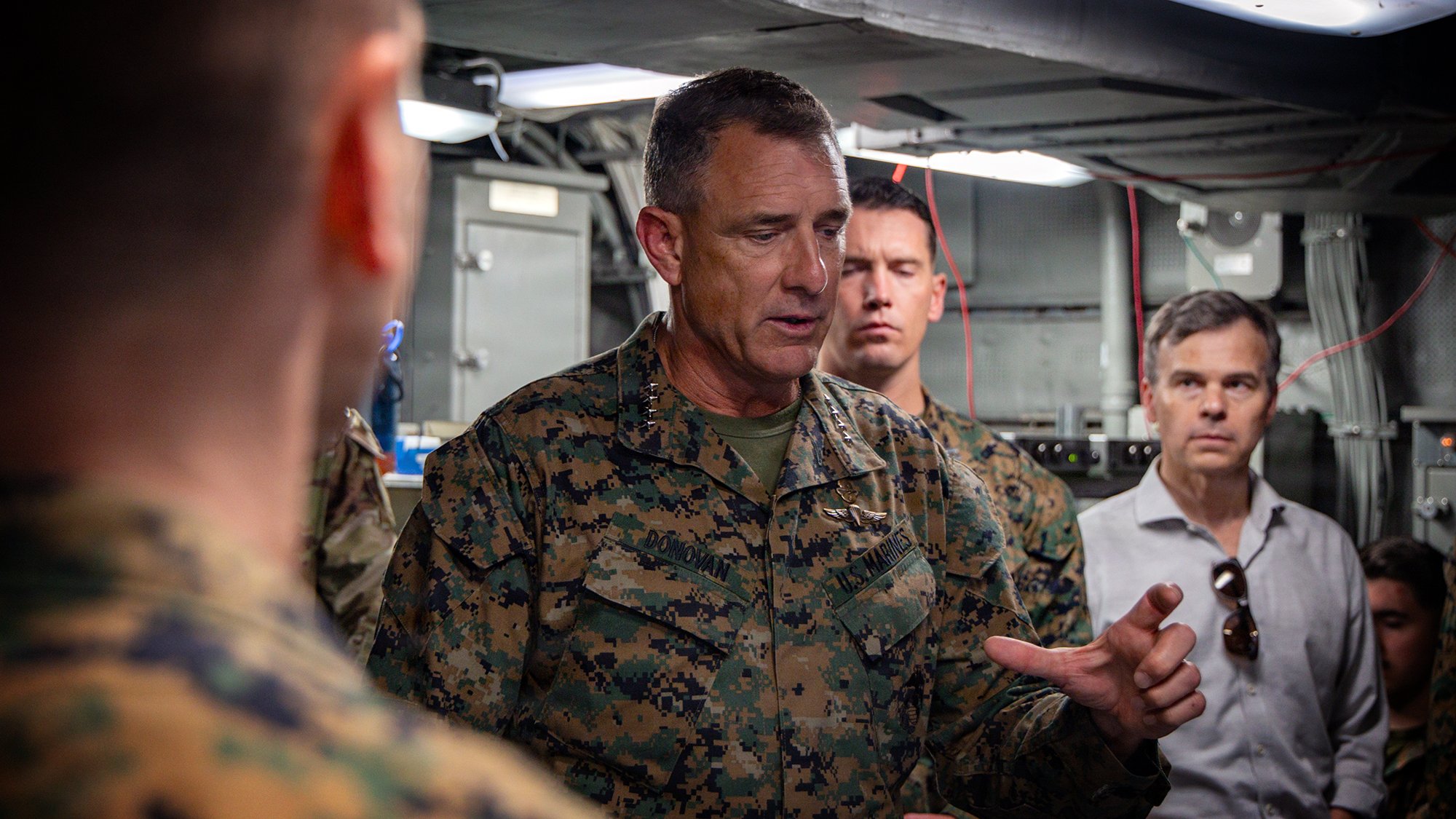
U.S. Southern Command’s top general publicly urged Cubans to take action to change their country’s future over the weekend, amplifying a Central Intelligence Agency appeal for intelligence cooperation that Secretary of State Marco Rubio had endorsed days earlier.
Gen. Francis Donovan wrote that the “now is the time” for Cubans to “seize the moment,” in a statement on X, sharing a post by the CIA that called for them to work together. Donovan’s message comes as several U.S. government officials and senior military leaders appeared to set their sights on Cuba in a series of statements calling for “change.”
On Monday, the U.S. Embassy in Havana announced that its chief of mission, Mike Hammer, had met with Donovan. The embassy offered few details about the discussion, writing on X that the two had “plenty to talk about regarding Cuba.” Southern Command reposted the announcement.
“Cuba’s future belongs to those who act. Seize the moment and build the change you want to see,” Donovan, the commander of U.S. Southern Command, said in a statement on X. “No more broken promises, rampant corruption, or tolerating an elite class living in luxury while the citizens are ignored. Now is the time.”
Secretary of State Marco Rubio last week also urged Cubans dissatisfied with their government to pursue political change through a covert relationship with the U.S. intelligence agency.
“To those who seek to create positive change in Cuba – now is the time,” Rubio wrote on X. “The disappointment of failed promises, corruption, and the privileged lives of only a few; seize this opportunity to create the change you desire through a discreet partnership with the CIA.”
Since returning to office in 2025, President Donald Trump has repeatedly talked about possible military operations against Cuba, as part of a wider push to buy or seize several countries and territories in the Western Hemisphere. It enacted an oil blockade on the country, and several naval deployments to the Caribbean, such as the USS Nimitz this May, have been characterized as shows of force. The blockade has caused an energy crisis on the island in recent months, causing widespread blackouts that have impacted hospitals and other infrastructure, as reported by the New York Times.
According to the United Nations, approximately 3.5 million people have faced water shortages, while more than 100,000 patients, including 11,000 children, were awaiting surgeries delayed by power outages and supply shortages earlier this year.
This summer, CBS News reported that the Pentagon was looking at options for strikes on Cuba, including air assaults by the 101st Airborne Division. In September, CBS News reported that the Army Reserve was reviewing its capability to provide support units for a military mission in Cuba. A document reviewed by CBS News noted SOUTHCOM would oversee the troops, which would “possibly [be] needed in 90-120 days.”
Also on Friday, President Trump floated the possibility of military action against Cuba. Speaking at a rally in Florida, Trump said that ships returning from the war with Iran could travel to Cuba.
“Those beautiful [U.S. Navy] ships will pass Cuba. We’ll have one of them stop about 50 yards off the coast,” he said. “They’ll raise up their hands. And then we’re going to send Marco Rubio in to finish up the deal.”
It is unclear whether the government’s statements indicate pending military action toward Cuba, or if Southern Command is preparing for imminent operations.
SOUTHCOM did not respond to Task & Purpose’s questions about the statements by publication time.
After building up a large force in the Caribbean last fall, the U.S. military carried out a raid into Venezuela in January, capturing President Nicolas Maduro following an indictment of him by the Justice Department. In May, the Justice Department issued indictments for multiple Cuban officials, including former President Raul Castro.
Although the large naval force that had been in the region at the start of the year has shrunk, the Pentagon has several elements still in the Caribbean that could be used in the event of a future strike on Cuba. Those include drones and aircraft deployed to bases in Puerto Rico, as well as Marines with Littoral Combat Force-24, which is operating out of the island when not in the Eastern Pacific as part of Joint Task Force-Western Hemisphere.
Loading comments…
Comments couldn’t be loaded. Please refresh the page.