
Four months after American special operations forces infiltrated Venezuelan airspace to raid its capital city, U.S. troops were once again flying over Caracas. This time, as part of an elaborate training exercise around the U.S. embassy.
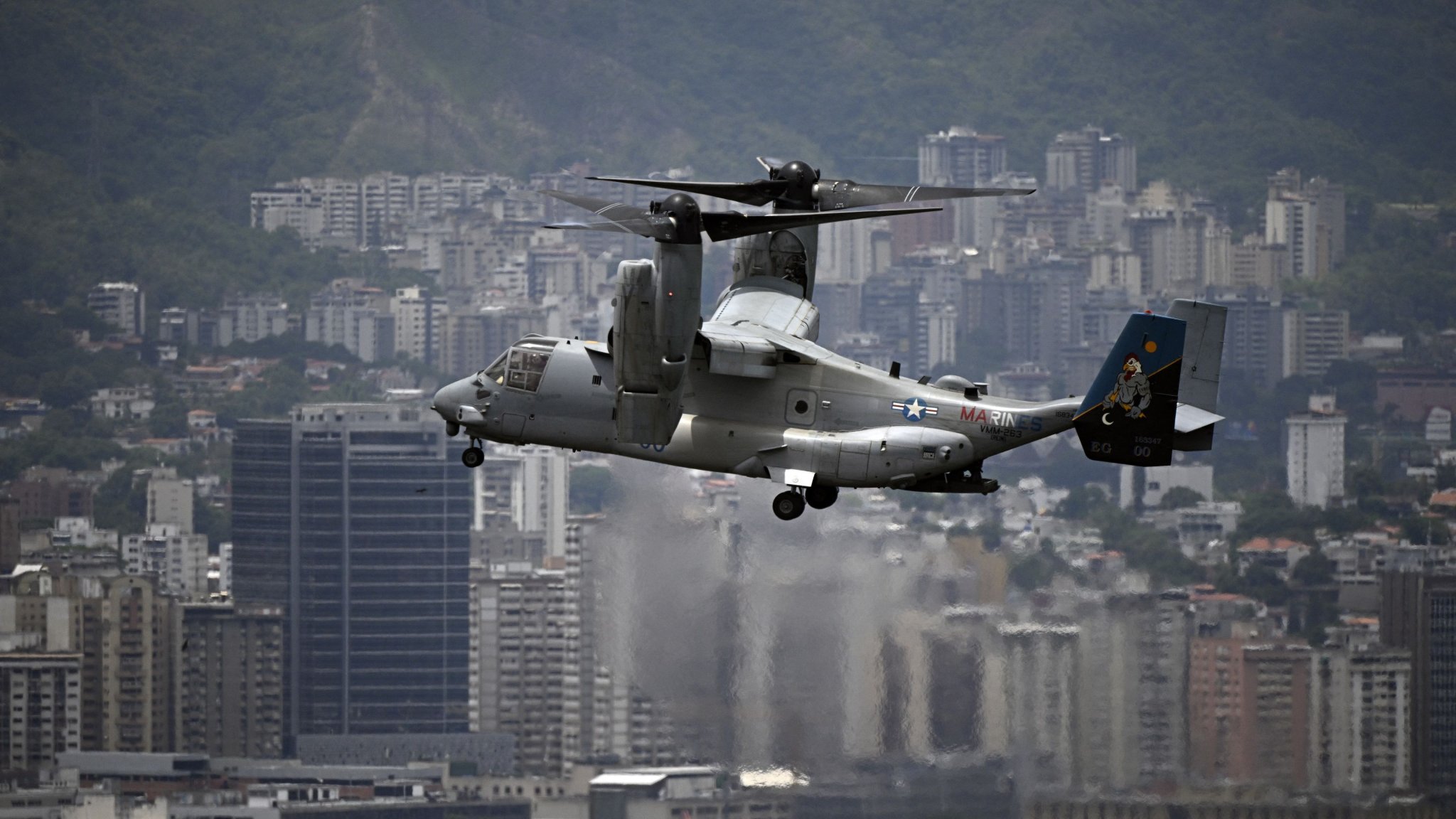
Two Marine Corps MV-22 Ospreys flew over the capital of Venezuela on Saturday and landed outside the U.S. embassy as part of a “rapid response” drill, the U.S. embassy for Venezuela said in a social media post.
“A US military response exercise is currently underway at the Embassy of the United States in Caracas,” the embassy wrote in its Instagram post. “Ensuring the Army’s rapid response capability is a key component of mission readiness, both here in Venezuela and around the world.”
In the video, the two Ospreys can be seen landing in the embassy parking lot, maneuvering to a landing spot surrounded by trees, before Marines exited the two aircraft. Photos from Agence France Presse of the drill show the Ospreys flying low over the city during the day, with dozens of city residents watching the aircraft pass overhead.
Top Stories This Week
Notably, the exercise was also attended by Marine Corps Gen. Francis Donovan, the commander of U.S. Southern Command, who arrived via Osprey. He, as well as embassy’s Chargé d’Affaires John Barrett, took part in the evacuation drill.
The aerial evacuation drill is the largest display by the American military in the city since Operation Absolute Resolve, the nighttime attack on Venezuela on Jan. 3. A joint force carried out several airstrikes, mainly in Caracas but in other parts of Venezuela as well, hitting several targets while special operations units entered Caracas. Flying low into the city, they reached a military compound and, following a gunfight at the base, seized and escaped with Venezuelan President Nicolás Maduro and his wife Celia Flores. Maduro was extradited to New York. Since then some U.S. forces have remained in the Caribbean.
The Associated Press noted that markings on the Ospreys show the aircraft belong to Marine Tiltrotor Squadron 263. That squadron is part of the 22nd Marine Expeditionary Unit, currently embarked with the Iwo Jima Amphibious Ready Group, which played a major role in Operation Absolute Resolve. The Marines and the Navy ships were moved into the Caribbean in the fall of 2025 as part of a wider U.S. military build up. Since the capture of Maduro several U.S. ships have left, with some heading to the Middle East, but the Iwo Jima Amphibious Ready Group has remained. The Marines onboard have continued to train, and have participated in raids to seize sanctioned oil tankers. This past week, the USS Nimitz and its carrier strike group entered the Caribbean, bolstering the naval presence there.
The American embassy in Caracas reopened in March, seven years after it was closed following diplomatic ruptures between the United States and Venezuela.
Loading comments…
Comments couldn’t be loaded. Please refresh the page.