For its annual fitness competition, the Space Force has “Guardian Arena,” which tests both brains and brawn to measure the service’s unique requirements. It’s essentially the Army’s Best Squad competition, but for the most cerebral military branch.
And they are unique, with the Space Force being one of the few branches where one might need to triangulate the position of a satellite while in the middle of the combat zone in the Middle East or the Pacific under austere conditions.
“Ultimately, physical fitness in the Space Force is about more than brute strength- it provides the cognitive advantages that enhance decision-making and operational effectiveness,” said Space Force Maj. Alyson Gleason.
The event began on Monday at Patrick Space Force Base, Florida, and it is scheduled to conclude on Tuesday. It comes as the Department of the Air Force has recently announced changes to its fitness tests for both airmen and guardians and is working to make sure gyms are open 24 hours a day, seven days a week.
Top Stories This Week
The events for this year’s Guardian Arena competition include a physical challenge event called Guardian Strike; a full-day competition of physical, tactical, and cognitive challenges over eight hours; and a final physical challenge to determine the winner of the best Space Force Unit, Gleason told Task & Purpose.
Fitness trainers and coaches embedded throughout the Space Force worked to model some of the events after another competition: the CrossFit Games, said Gleason. Those games measure fitness by testing an athlete’s strength and endurance through events that include weightlifting and light-weight sprints.
For their competition, the Space Force pit 35 teams against each other in both physical tests, such as a timed weightlifting event, and tactical challenges in subjects including space domain awareness, space launch operations, and position, navigation and timing, Gleason said.
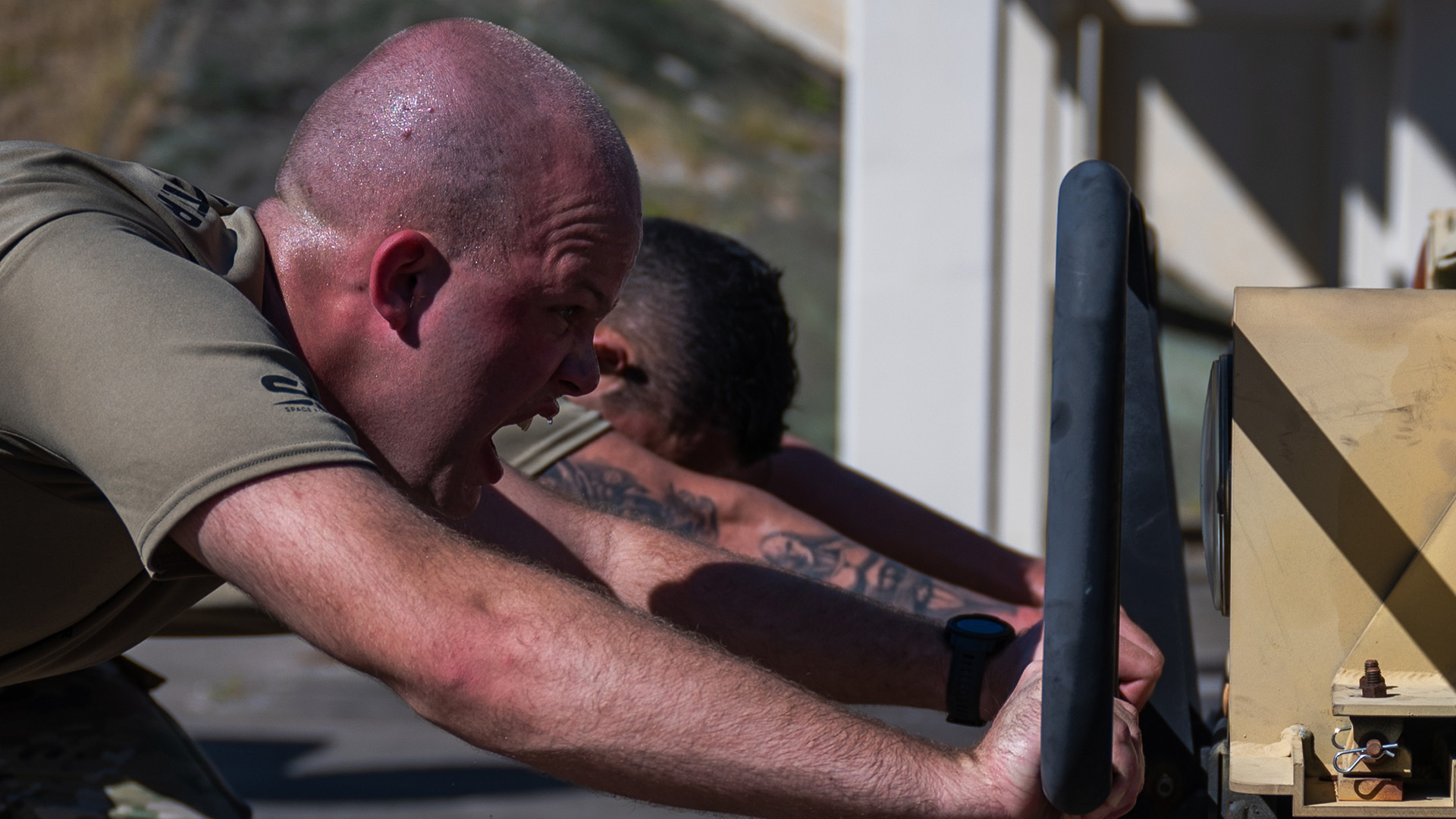
“While the physical events have undoubtedly grown in difficulty, pairing them with advanced academic challenges forces competitors to maximize their physical abilities while solving complex problems in a timed environment,” Gleason said in a statement. “There is no competition like it — one that requires lifting a 150-pound sandbag while your teammate calculates orbital flight patterns. It is a true test of both wit and physical prowess.”
Many Space Force jobs require more technical knowledge than physical strength. But physical fitness is also a “foundational” to being a service member, said retired Space Force Col. Kyle Pumroy.
“Being physically fit also helps you establish, maintain, and mentally relate to warfighting and being a warrior,” said Pumroy, a senior resident fellow for Space Studies at the Mitchell Institute’s Spacepower Advantage Center of Excellence. “It’s a deeper rationale than ‘you might get winded on your shift.’”
The Guardian Arena competition also stresses the need for teamwork, which is a major part of being in the Space Force, he said. Guardians need to work together to protect U.S. satellites from adversaries, Pumroy said.
That requires a different service culture from the Air Force, which places greater emphasis on how individuals should perform in combat, such as fighter pilots, he said.
“None of these activities in the Space Force is going to be done by one person who focuses on a console, taking in all the stimuli, making the decision themselves, and then sending commands,” Pumroy said. “The architectures are too complex for one individual to do that. It takes a team to make all that happen.”
Additionally, roughly 10 to 15% of guardians are tasked with electronic warfare missions that can involve deploying to war zones, said Pumroy, who conducted space operations while in Afghanistan. That means they must be in shape for ground combat.
“All bets are off then,” Pumroy said. “When I was in Afghanistan, we were expected to be fit because we got rocket attacks. What if there was a security breach? We’re armed the whole time, so if we have to run with our weapons and ammunition and then battle gear, we can’t be out of shape.”