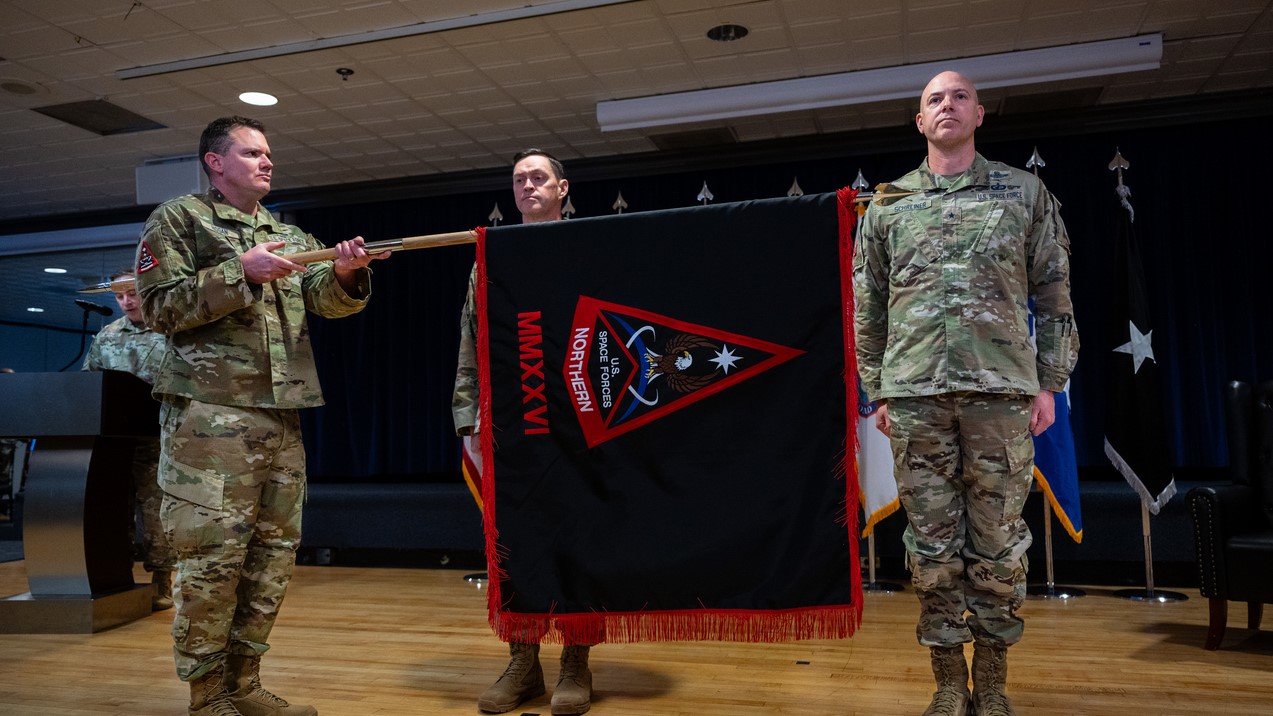
Six years after Space Force was established, the service officially activated its first component field command over North America.
U.S. Space Forces Northern was officially stood up on Jan. 30 at Peterson Space Force Base in Colorado. It serves as Space Force’s main contingent under U.S. Northern Command. As with previous regional-specific elements, the new service component focuses on providing Space Force’s capabilities to support regionally specific missions. Although it is far from the first service component to be activated, the new element is unique as its area of focus directly covers and includes the United States.
The move comes days after Space Force formally activated its contingent under U.S. Southern Command, although the military admitted that element had been active since December 2025, ahead of the attack on Venezuela to capture Nicolas Maduro. Both activations come as the Department of Defense prioritizes the Western Hemisphere.
“As technological and numeric threats to the Nation intensify, Space Forces Northern will bring crucial capabilities to the Homeland Defense mission, including enhanced domain awareness; missile warning and tracking; positioning, navigation, and timing; SATCOM; and the capacity for orbital and electromagnetic warfare,” Gen. Gregory Guillot, the head of U.S. Northern Command and the North American Aerospace Defense Command (or NORAD) said at the ceremony.
Top Stories This Week
According to Space Force, the specific duties include providing space-specific capabilities to defend the United States, including early warning capabilities, and defensive and offensive electromagnetic elements. Brig. Gen. Robert Schreiner, SPACEFOR-NORTH’s inaugural commander, noted that it will provide NORTHCOM with capabilities to “preserve freedom of action” in and from space. As with other parts of Space Force, it will also work on “orbital warfare,” a field the service is greatly working to expand, that includes both non-kinetic offensive elements and direct-action tools. The latter is a field that is largely theoretical or in development, as Space Force launches into orbit have focused on communications and jamming satellites.
NORTHCOM, headquartered at Peterson Space Force Base, encompasses not just the United States but the Northern Hemisphere including Canada, Mexico, portions of the Caribbean and, as of last year, Greenland. The command shares a headquarters with and overlaps in roles with NORAD, a bi-national defense structure between the United States and Canada.
The activation also comes a week after the Department of Defense released its 2026 National Defense Strategy, a policy document released every four years. This one outlines the Trump administration and Pentagon’s priorities with regards to the military. The strategy covers a range of topics but centers its focus around a reorientation towards the Western Hemisphere, calling on allies to take more action abroad.