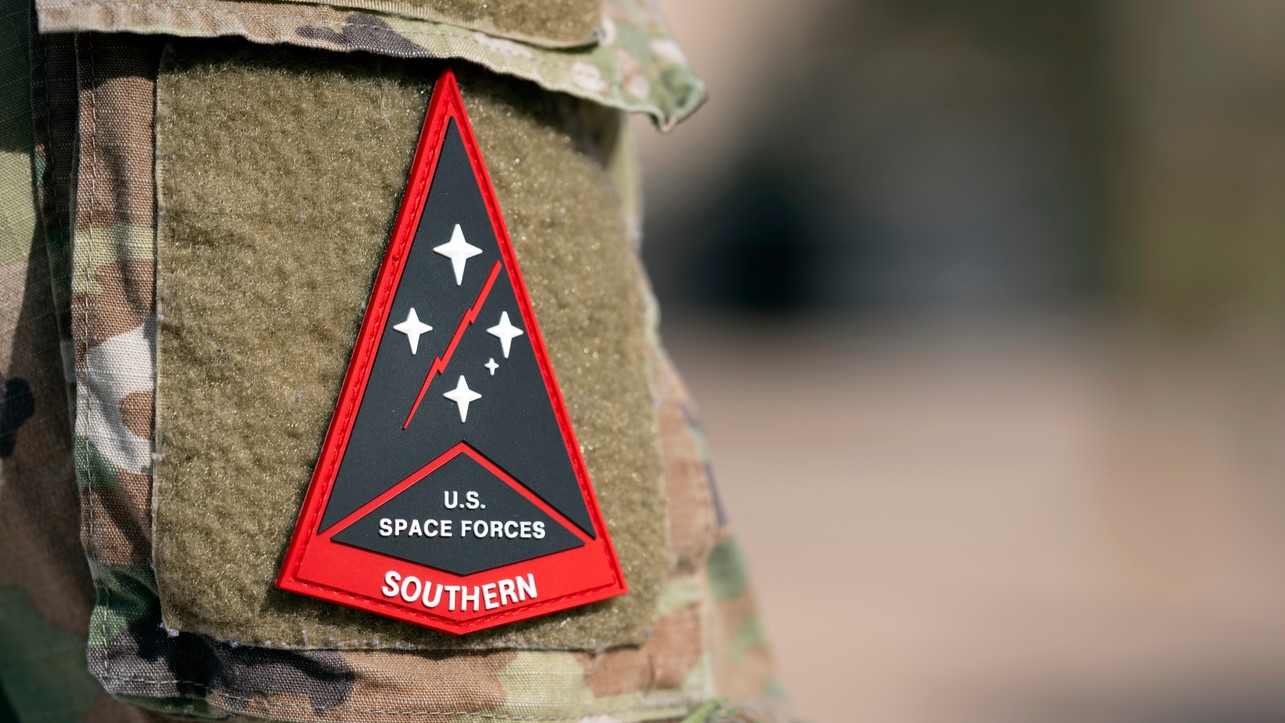
The U.S. Space Force officially stood up a new element focused on Latin America this past week, nearly three weeks after Guardians were taking part in a major combat operation in South America.
On Jan. 21 Space Force Force Southern was formally activated. The new component, operating under U.S. Southern Command, is based out of Davis-Monthan Air Force Base in Arizona. Under this new purview, it will coordinate space-related matters dealing with Central and South America, as well as the Caribbean, where U.S. forces have been massed for months.
“This new organization reaffirms our commitment to address local threats of all shapes and sizes, ranging from malign state actors to violent extremist organizations and to transnational criminal organizations,” Chief of Space Operations Gen. Chance Saltzman said at the activation ceremony. “Space Forces Southern will continue to be a force for good in the region, using space to maintain peace and stability, and defend the homeland.”
Top Stories This Week
Although the new element was formally activated on Wednesday, Space Force officially revealed it had been operating since Dec. 1 2025. Saltzman and the service did not specify exactly what the Guardians working as part of it have been doing, but comments from him as well as other top military officials alluded to an important role in the attack on Venezuela that led to the capture of Venezuelan President Nicolás Maduro.
“As we clearly saw in recent operations in the SOUTHCOM [area of responsibility],” he said, “without space, kill chains don’t close, our strategic advantage evaporates, and we can’t complete our joint missions.”
Shortly after the raid on Jan. 3, Chairman of the Joint Chiefs of Staff Gen. Dan Caine first revealed Space Force’s involvement in the operation. During a press conference with President Donald Trump and Defense Secretary Pete Hegseth, he noted Guardians’ participation in the joint force, which he said allowed members of U.S. Space Command and Cyber Command to layer effects on the Venezuelan defense that were able to “create a pathway” for advancing American aircraft.
Space Force operates early warning tracking systems, satellites and other communication assets both in actual space and on terra firma. It has been actively working to expand systems in the Pacific theater and the Department of Defense recently put out a request for bids to improve the infrastructure at Pituffik Space Base in Greenland, which the service oversees.
Space Force has largely focused on communications and observation technology and systems but over the last year has looked to expand its offensive capabilities. That includes expanding what it calls “orbital warfare,” which it notes as distinct from electromagnetic warfare. Space Force recently unveiled plans for future weapons and their naming conventions.