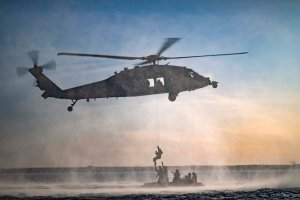
In January, the Pentagon announced that it was sending 1,500 soldiers and Marines to the U.S.-Mexico border to augment 2,500 service members already deployed there in support of ongoing U.S. Customs and Border Protection operations.
Nearly 8,500 troops are currently assigned to the border mission, according to officials with Joint Task Force-Southern Border, the name of the command running the military’s mission there.
The additional troops were sent following President Donald Trump’s Jan. 20 executive order, which declared a national emergency on the southern border, calling for the Defense Department to assist the Department of Homeland Security with border security. The Trump administration has also established multiple “national defense areas” across parts of California, Arizona, New Mexico and Texas, in which U.S. troops can temporarily detain trespassers before handing them off to federal law enforcement.
But in reality, the border mission has faced setbacks, not unlike its stateside equivalent, Operation Lone Star, launched by Texas Gov. Greg Abbott in 2021. The governor’s plan to use thousands of Texas National Guard troops for border security has faced challenges and criticisms over its cost and effectiveness.
And the federal mission has faced its own challenges.
In July, Task & Purpose reported that the Pentagon shifted $200 million from an array of service programs, which included barracks for enlisted personnel, to replace a mesh barrier with a permanent protective barrier at the Barry M. Goldwater Range in Arizona. In May, Military.com reported that $1 billion in barracks management funds were also diverted to the border.
That money is separate from the $178 billion set aside for the Department of Homeland Security to use for border security and immigration enforcement, an amount that the Congressional Research Service found is “the largest single package of DHS supplemental appropriations ever put before Congress.”
The border mission has also become an unofficial testbed for new technology. In August, Task & Purpose reported that soldiers were testing wearable headsets, unmanned aerial systems, UAS, and radars retrofitted to take down cartel drones.
Around the same time, soldiers with the 2nd Stryker Brigade Combat Team were assigned to barracks with broken air conditioning and bathrooms that leaked raw sewage and were infested with insects, according to the Department of Defense Inspector General. That watchdog report looked at housing at the Doña Ana Range Complex in New Mexico and at soldiers’ barracks at Fort Bliss, Texas.
U.S. Northern Command officials reported to the Inspector General that housing arrangements for soldiers assigned to the mission changed, but the investigators wrote in their report that the southern border task force still uses three of the barracks identified for “health and safety concerns.”
We’re looking for more insight from the thousands of troops who were previously part of the U.S.-Mexico border mission or are there now. Without your voice, we can’t tell your stories or bring attention to the challenges you may be facing.
If you’ve served on that mission and want to fill us in on your experiences, please leave us a note using the form below and we’ll reach out. Please be sure to include T&P Border Story at the top of your submission, so we can make sure we don’t lose track of your tip.