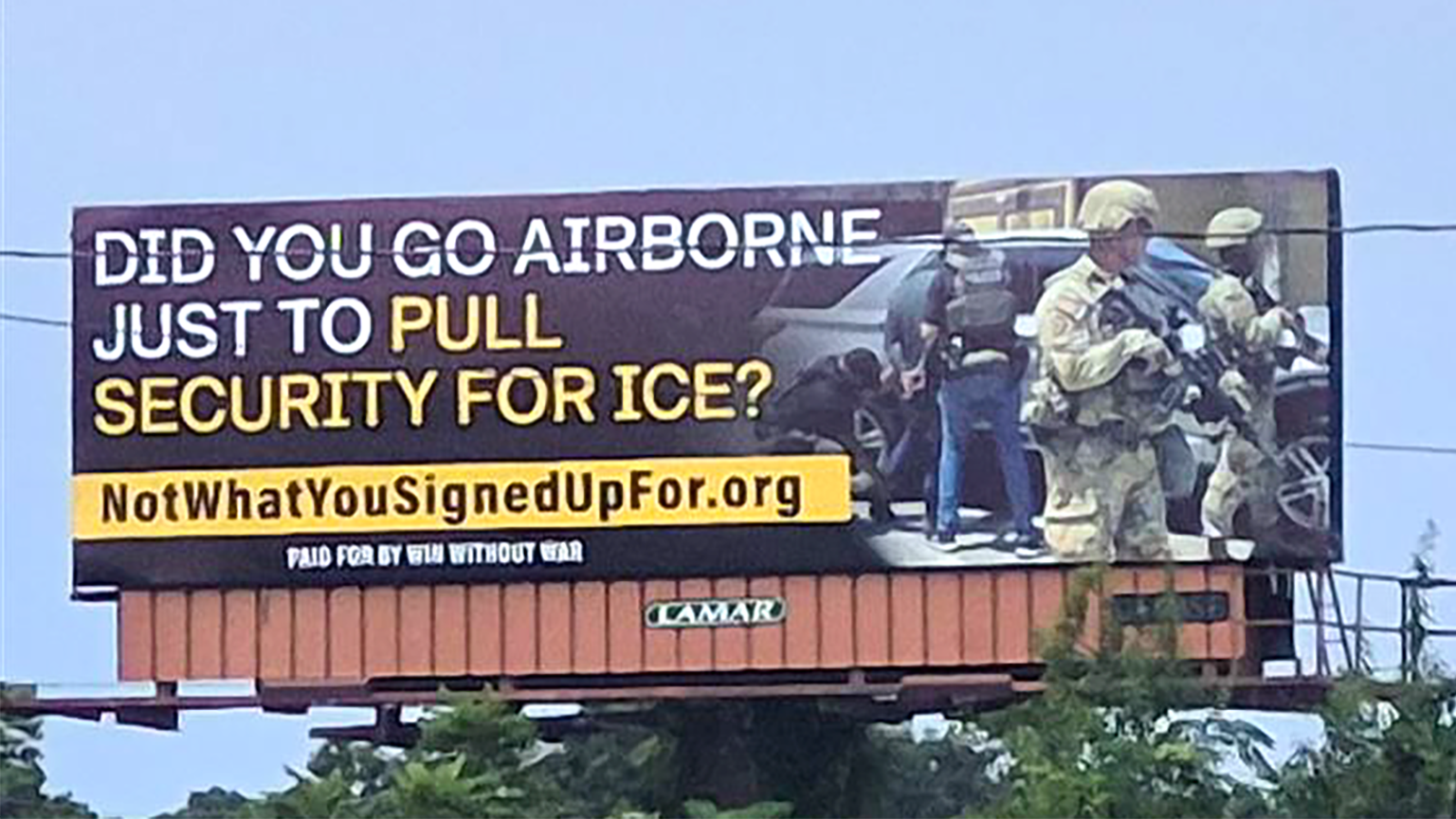
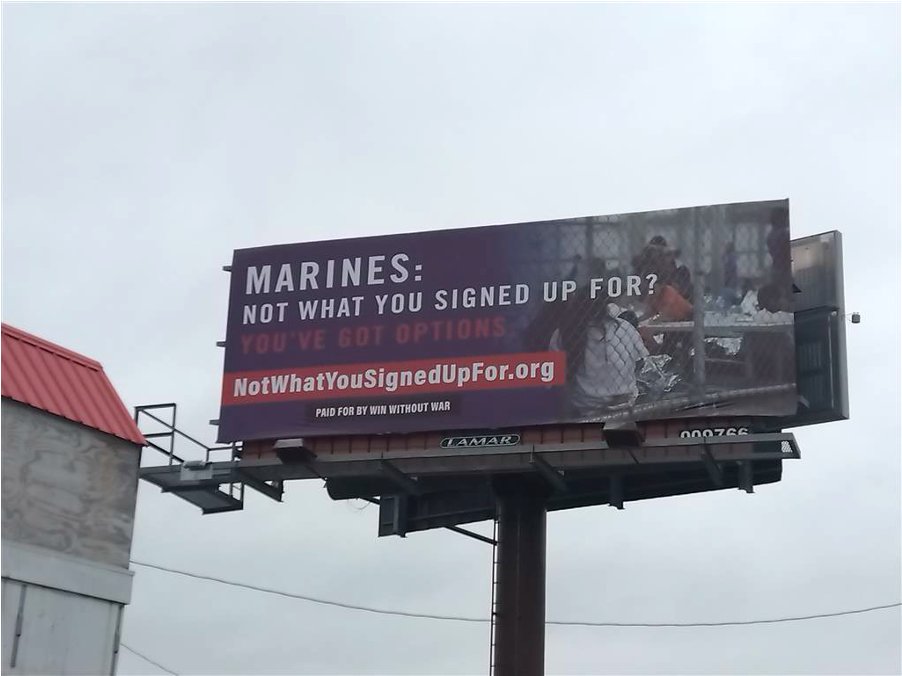
“Did you go to Airborne just to pull security for ICE?” a billboard asks in Fayetteville, North Carolina. The billboard is one of two put up last week in North Carolina outside of two of the largest military bases, the Army’s Fort Bragg and the Marine Corps’ Camp Lejeune.
The signs are part of a campaign led by veterans, About Face: Veterans Against The War and Win Without War, that wants to reach troops who may have questions on the legality of current or future orders as the Trump administration increasingly uses the military for domestic duties that include immigration and law enforcement.
The billboards direct viewers to a website titled: “Not What You Signed Up For” with encrypted email and messaging platforms where service members can access resources and experts with link to the GI Rights Hotline and the National Lawyers Guild’s task force focused on military law.
“We have several cities that the administration has threatened or announced to send the National Guard into, or to have those governors send the National Guard into,” said Harrison Mann, the associate director for policy and campaigns for Win Without War. Mann was an Army major when he resigned from the Defense Intelligence Agency in 2024 over the Biden administration’s use of American military hardware to support Israel’s military in its war with Hamas.
“We want to make sure those troops also can know their rights and understand their options,” he said.
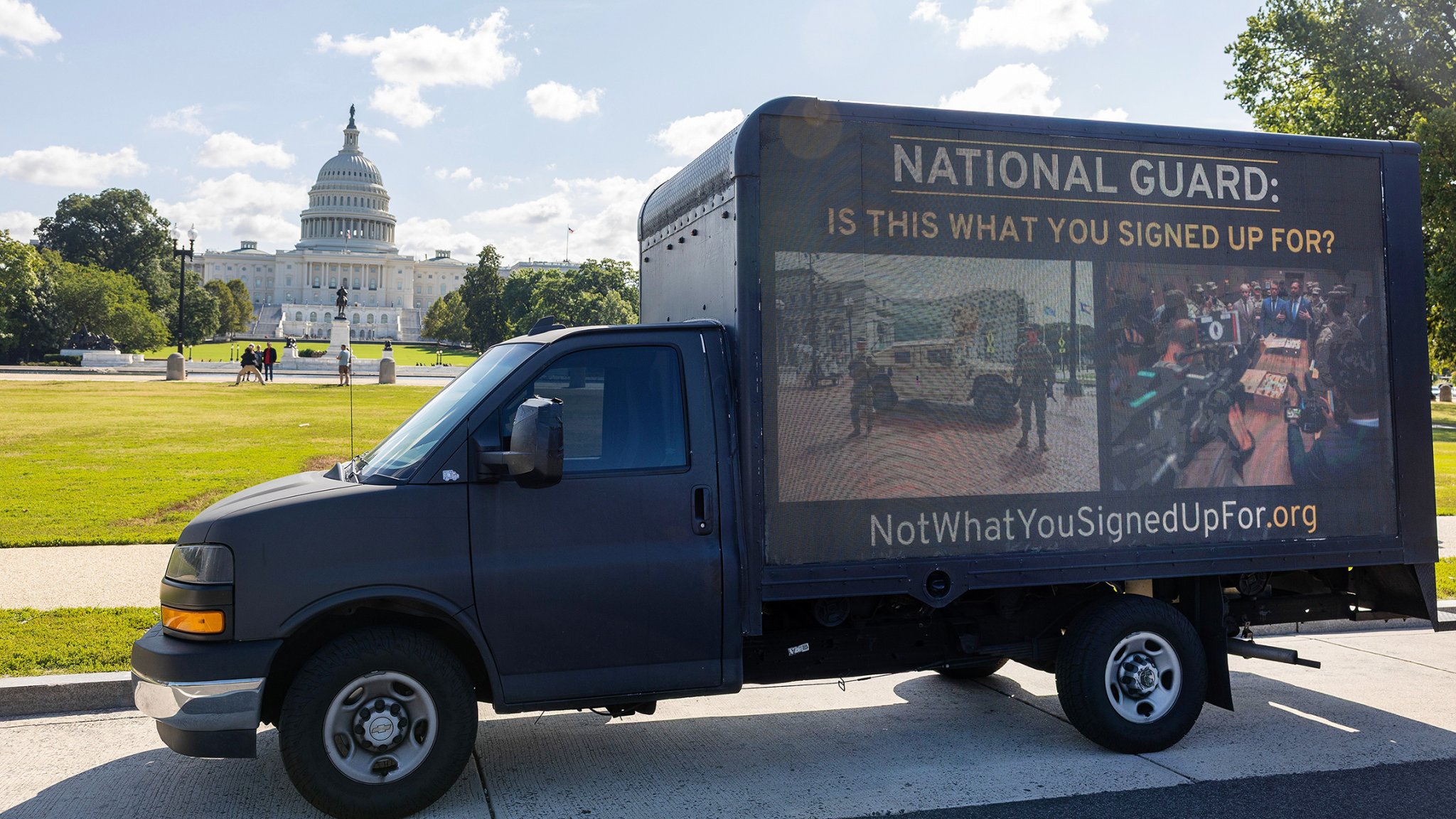
The groups behind the signs have so far sponsored three billboards. The Fort Bragg sign sits between two central streets leading to the base, Bragg Boulevard and the All-American Freeway, where a large percentage of troops assigned to the base pass as they enter through the main gate. At Camp Lejeune, the group’s sign sits on Lejeune Blvd, just off a bridge that leads to the base’s main gate. The group has also sponsored a third mobile billboard on a truck to drive around Washington D.C. where National Guard members have been deployed since August.
Beginning last summer, the Trump administration has widely deployed troops in law enforcement roles. Unlike typical disaster and emergency deployments for guard troops, local leaders and significant portions of local residents have widely rejected the Trump-backed deployments, including 700 Marines and 4000 National Guardsmen sent to Los Angeles in June and more than 2,000 National Guard troops from seven states currently in Washington D.C.
In addition, nearly 1,700 National Guard troops from 19 states have been authorized to support Immigration and Customs Enforcement, or ICE, according to the National Guard Bureau. As of Wednesday, 1,500 troops were on duty assisting with administrative and logistics, including units with the Virginia National Guard that are collecting and entering biometric data, scheduling appointments, and tracking fleet expenses.
The billboard campaign comes amid a growing concern from progressive veteran groups and military legal experts that troops could be faced with orders that go against their conscience or are deemed unlawful in future courts martial under different political administrations.
One of the lawyers that troops can be connected to is James M. Branum. He said many younger troops are telling him, “This is not what they signed up for.” More senior troops, he said, are “just biding their time” and want to “keep [their] head down.”
Though Branum said he expected to field more calls from Guardsmen who are unhappy with their deployment, he’s found himself counseling more active duty troops who are “reading the writing on the wall,” and “concerned about what’s coming.”
Brittany Ramos DeBarros, organizing director for About Face: Veterans Against The War, said her personal military experience shaped the work she’s doing now, including the campaign.
“I was really swayed by this kind of military culture that makes you feel like if you disagree with what’s happening, you’re the only one and there’s something wrong with you, and you don’t have any choices,” she said. “You’re not alone. There are people out here who will support you.”
Top Stories This Week
DeBarros joined the Army on a Reserve Officers’ Training Corps scholarship and deployed to Afghanistan in 2012. During her time there, DeBarros grew disillusioned with the gap between the military’s stated mission in Afghanistan and the reality on the ground. In the Reserves, she began speaking out about the war and civilian casualties as a captain. She was threatened with a court-martial and was eventually discharged.
DeBarros said she sees the operations on U.S. soil reflecting a lesson she came to terms with in Afghanistan — that the military’s purpose is “to carry out violence as effectively and efficiently as possible” and that its use for peace-keeping or diplomacy are “not realistic.”
“That carries forward to today when I see the National Guard being deployed in U.S. cities to carry out these policing operations, to support domestic issues around immigration,” she said. “Anyone who has really spent a lot of time in the military understands that sending the Marines to LA to supposedly keep the peace is one of the most kind of antithetical things you can do.”
For Mann’s 13-year Army career, he said he never thought about whether the orders he was given were lawful. But with the growing political nature of the domestic deployments, he said that veterans like himself want to ensure troops know their rights and can ask questions.
“I don’t want the first time that a soldier or Marine thinks about how they’re going to respond to an unlawful order to be when it’s getting shouted at them in Baltimore or Memphis or wherever,” Mann said. “People need to start thinking about that now. So the overarching goal is just to start that conversation, both within the military, and make everybody besides the military aware of that risk.”
The law of ‘Lawful Orders’
The military’s Manual for Courts-Martial states that a service member can defend against obeying an order if they knew it to be unlawful or “a person of ordinary sense and understanding would have known the orders to be unlawful.”
However, they would choose to violate it “at their own peril,” Branum said, adding that “all the pressure is on the service member to make the right call.” If a military member refuses an order, the lawfulness of that order would be determined by a military judge, according to the manual.
Earlier this month, a federal court in California ruled that the deployment of troops to LA was illegal and went against a federal law known as the Posse Comitatus Act, which prohibits the use of federal troops to enforce domestic laws.
In a statement to Task & Purpose about the billboards, Pentagon Press Secretary Kingsley Wilson said Win Without War was “not a veteran’s group” and that it uses Democratic money “to solicit donations for poorly designed graphics.
“The Department of War is proud to work alongside our interagency partners to keep America’s borders secure and its communities safe,” Wilson said.
First amendment
But is it legal to use a billboard to encourage military members to question orders?
A 2014 Supreme Court case on a protester outside of a military base ended with the court ruling against the protester.
For 17 years, Dennis Apel protested outside of Vandenberg Air Force Base in California. He was sentenced to two months in prison after squirting his own blood out of a syringe at the base sign days before the U.S. declared war on Iraq. He continued protesting but stood in a designated “protest zone.” Apel was barred from the base and then convicted of violating that bar. His case was heard by the Supreme Court, where arguments centered around whether the land was controlled by the military.
“A public road outside of a closed military base, especially in a designated protest zone, is a place where all should be able to peacefully protest,” Apel’s lawyer, Erwin Chemerinsky, wrote in an online blog post about the case.
The Supreme Court’s 2014 ruling did not address the Constitutionality of the case but did determine that even though the protest area was outside of the Vandenberg fences and not technically used for military activity, it “does not diminish the base commander’s control over the entirety of the jurisdiction,” a Lawfare blog summarized.