
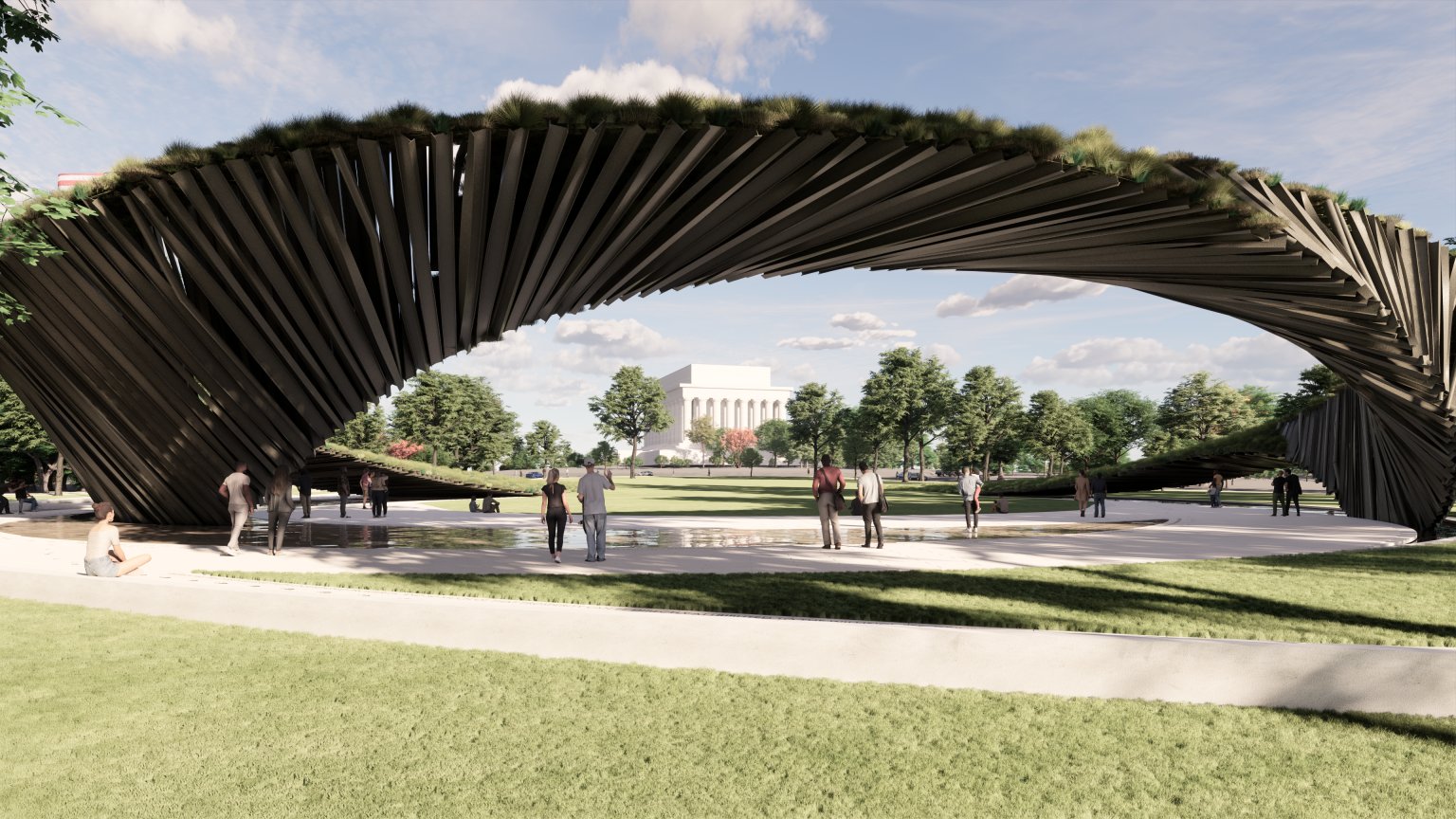
The initial reaction to Kengo Kuma’s design for the Global War on Terrorism (GWOT) Memorial has not been kind. Criticism seems to fall into three buckets: its abstract design, the absence of a clear heroic tribute, and a lack of a “roll call” or list of names of the fallen. Rep. Derrick Van Orden, a retired Navy SEAL now in Congress, called it a “jazz hands monument to our fallen brothers and sisters.” Sen. Jim Banks, another Navy veteran-turned-lawmaker who served in Afghanistan, referred to it as “disconnected abstract art.” Online, many veterans questioned why there isn’t a display of names or images of the more than 7,000 killed in these conflicts.
Some of the criticism aimed at Kuma and the 23-person advisory council behind the design is fair, but it should not stop us from taking a closer look at what the design actually proposes.
My deployed experience in the GWOT was with a Stryker brigade during the 2007 surge in Iraq. I’m now research and teach as a college professor on the experience of American military veterans and as they have come back to the nation they served. Each time I teach a class, and each time I meet a veteran on campus, I hear a new answer to what the GWOT “meant.” If the 20 years of GWOT, have a central story, it is still evolving.
I believe the most interesting aspect of the proposed memorial is not what it includes, but what it leaves out. Kuma’s design does not glorify a war whose mission shifted for two decades and whose outcomes remain genuinely contested. It avoids flattening twenty years of varied conflict into the heroic narratives of special operations and infantry troops that pervade current cultural storytelling. And it chooses open space over architectural closure.
That restraint matters because the alternative is well established. Many memorials resolve their subject before the visitor arrives. The Marine Corps War Memorial, with its flag raised in bronze certainty, is a beloved national emblem, but there is no mystery in its message. Similarly, the massive National World War II Memorial, with its arches and gold stars, reflects the size of the war and America’s mobilization to meet it. Memorials like these do not invite interpretation. They deliver a conclusion.
A design that refuses easy resolution is making a bet that visitors can sit with ambiguity. I think this is a smart bet because the legacy of GWOT is still being written.
One of the foundation’s renderings shows people gathered informally on a lawn, something closer to a meeting than a monument. If that becomes the memorial’s actual function, a place where people convene, talk, and exchange accounts of a war that impacted American society in countless ways, then the design has succeeded at something harder than commemoration. It has made room for conversation.
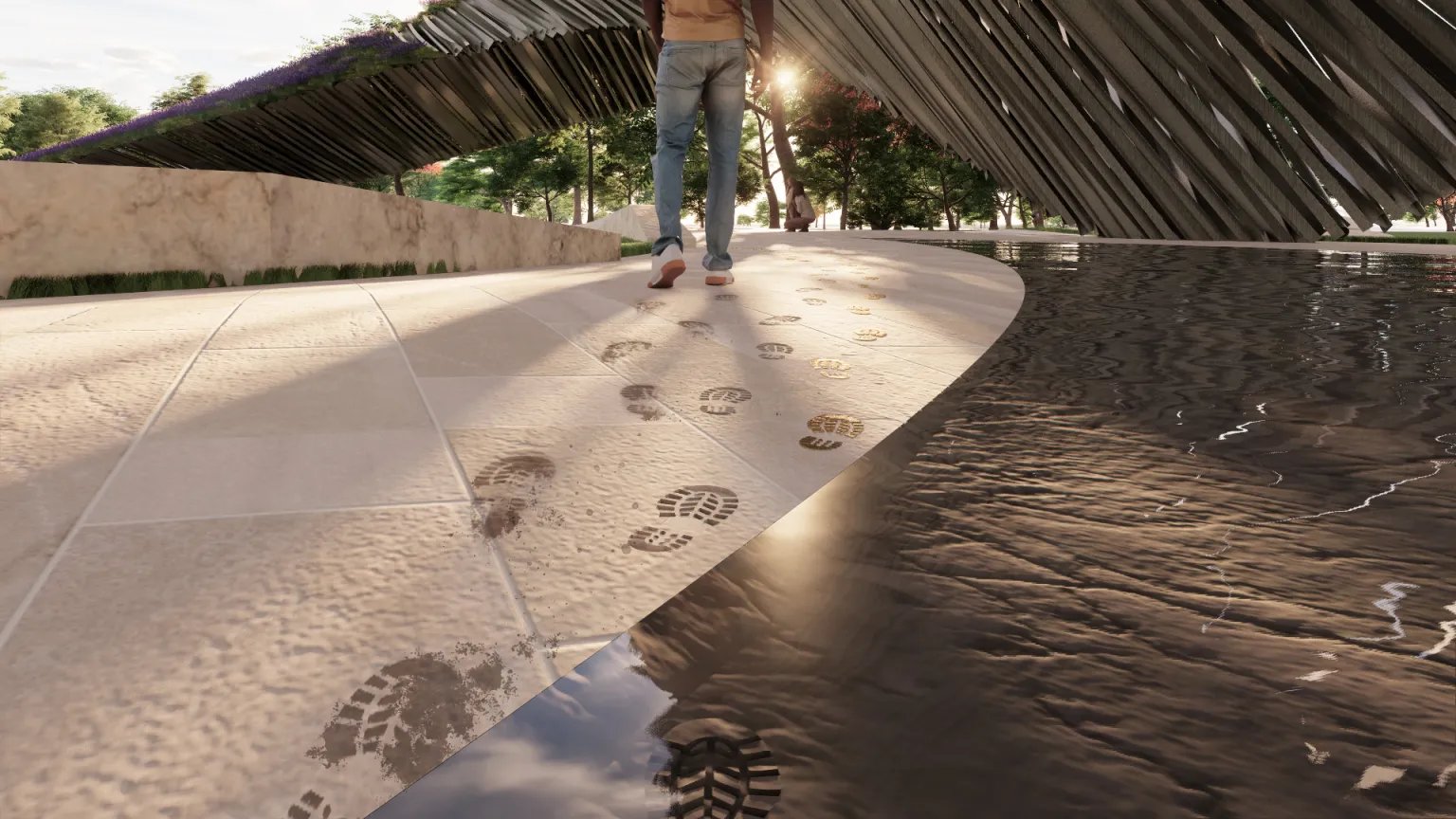
But these important choices do not excuse the design’s weaker elements. The footprint pathways, cast in varied boot, shoe, stiletto (and paw) combinations, cannot bear the weight that the memorial assigns them. The orientation of the arch toward Section 60 at Arlington is similarly strained. It gestures at meaning without earning it. The symbolism it depends on may not survive long anyway, since the planned United States Triumphal Arch (a.k.a. the Arc de Trump) may eventually interrupt the sight line the GWOT memorial intends to establish.
The long shadow of The Wall
Unfortunately, the memorial’s deepest problem is not its design, but its location. Placing the GWOT Memorial next door to the Vietnam Veterans Memorial, known universally as The Wall, was a mistake. The Wall’s granite panels transmit an enormous symbolic and emotional weight that has evolved over decades into a fixed national narrative about an unpopular war, troubled homecomings, and delayed reckoning.
Adjacency invites comparison, and comparison creates expectations. Imagine the expectations a future visitor will carry as they walk 200 yards from one memorial to the other. Proximity to The Wall will not clarify the GWOT Memorial’s message.
Those expectations were emerging last month with calls for etched names and unambiguous design elements. Already, reviewers are projecting The Wall’s emotional rhetoric onto the unbuilt GWOT Memorial.
But the location is selected, so design questions must give way to a harder one: however it looks, what happens at the site after the ribbon is cut? The daunting task of successfully memorializing the Global War on Terrorism depends almost entirely on this answer.
Stone and steel can establish a space, but they cannot by themselves generate understanding. That requires interpretation, and interpretation requires people. Trained staff, structured programming, and a willingness to host difficult conversations about costs, benefits, politics, and tactics are what can transform this memorial from a backdrop into a forum. Without interpretation, the memorial to America’s longest period of conflict risks becoming an elaborate version of “thank you for your service.”
So, it is reasonable to be skeptical of the current design. Much of that skepticism is earned. But skepticism is not the same as dismissal. The proposed design, flaws and all, is trying to do something genuinely difficult: commemorate a war before the country has agreed on what it means.
Jim Craig is a teaching professor of sociology and veterans studies at the University of Missouri-St. Louis and a veteran of the Global War on Terrorism. He is a founding member of the Veterans Studies Association.
Loading comments…
Comments couldn’t be loaded. Please refresh the page.