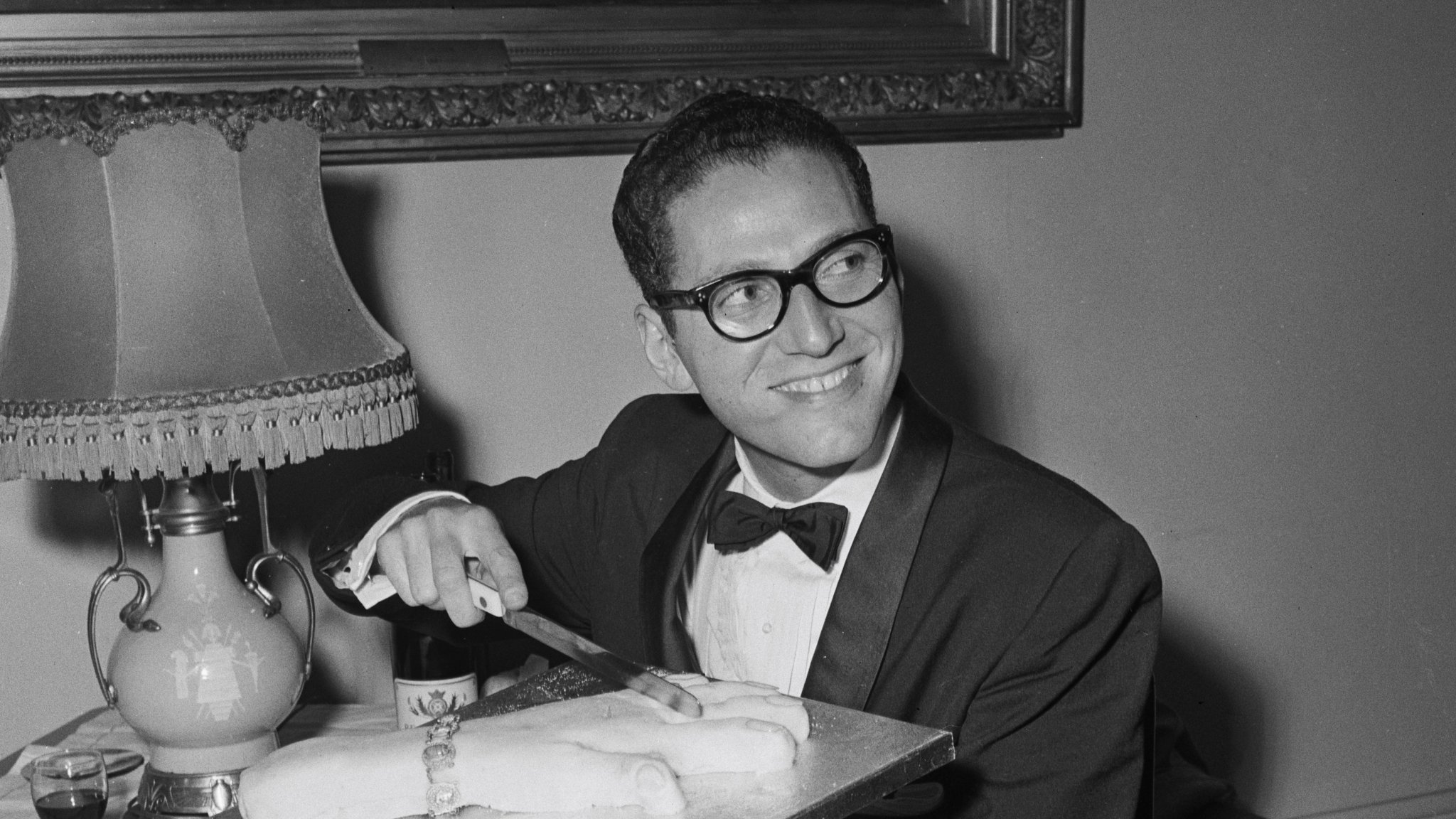
Tom Lehrer, the social satirist and mathematics professor who used music to poke at the world, died this weekend at the age of 97. Known for songs such as “The Vatican Rag,” “Poisoning Pigeons in the Park” and “The Elements,” his music remained comedy staples for decades after he recorded them and influenced performers such as Weird Al Yankovic. He also was a former enlisted soldier, whose time in the U.S. Army influenced much of his musical repertoire.
The mathematician and satirist died on Saturday, July 26 at his home in Cambridge, Massachusetts, according to his friend David Herder.
Thomas Lehrer was born April 9, 1928. He studied piano as a child and, as a prodigy, attended Harvard at the age of 15. He earned a bachelor’s and a master’s degree in mathematics and became a teacher, along with working as a researcher at the Los Alamos Scientific Laboratory. He also began recording music, often comedy songs with a satirical bent, selling copies as word of mouth began to pick up. And then he was drafted. The songwriting mathematician with a master’s degree joined the U.S. Army as an enlisted soldier in 1955. He spent his two years in the Army secretly working for the National Security Administration, which was classified at the time.
He reached the rank of Specialist Third Class — or as he later remarked, “corporal without portfolio” — and left the Army in 1957 to go back to teaching and recording. Lehrer began touring and recorded more albums, featuring some of his most iconic songs, such as “The Masochism Tango,” “Send the Marines” and “We Will All Go Together When We Go.” He also worked as a songwriter and performer for several television shows before stepping back from the music scene in the 1970s to focus on academics.
He wrote comedic songs, but almost all of them had a dark edge. Death and conflict played a common role in his lyrics, with the threat of nuclear war and annihilation in particular hanging over his work. During the Space Race he also took the time to lambast Werhner von Braun, the Nazi rocket scientist brought over by the military in Operation Paperclip and a major leader at NASA. “Once the rockets are up, who cares where they come down?’/‘That’s not my department,’ says Wernher von Braun,” Lehrer sang.
Top Stories This Week
His time in the Army influenced his works. In his 1959 live album ‘An Evening Wasted with Tom Lehrer,’ he joked that, now a civilian again, he is “now, of course, in the radioactive reserve”; it was after all the 1950s and soldiers were regularly involved in rather large nuclear tests.
“And, the usual jokes about the Army aside, one of the many fine things one has to admit is the way that the Army has carried the American democratic ideal to its logical conclusion, in the sense that not only do they prohibit discrimination on the grounds of race, creed, and color, but also on the grounds of ability,” Lehrer said as an introduction to his song “It Makes a Fellow Proud to Be a Soldier,” which he said he wrote during his service and claimed to have submitted it as a contender for the Army’s official song. The track poked fun at all walks of soldiers, from intellectuals to school dropouts to career-minded officers and bad mess cooks.

It Makes a Fellow Proud to Be a Soldier
Lehrer’s worlds also mixed. While in the Army and at the NSA, he co-authored the 1957 paper “The Gambler’s Run with Soft Hearted Adversary.” The paper, a math heavy work, had five sources in its content, but the bibliography listed six. The extra one was Lobachevsky, the same Russian mathematician who Lehrer had already written a well-known song about in 1953. Bluesky user Opalescentopol claimed to have asked the NSA about the paper and the joke in it while working there, and the NSA said that no one at the organization had noticed the hidden prank before. The paper was eventually declassified in 2020.
His military career also had another notable distinction. While in the Army and assigned to a naval base in Washington, D.C., Lehrer claims to have helped invent the modern version of the Jell-O shot. Versions had existed for years, but according to Lehrer, he combined alcohol with pre-flavored Jell-O mix. It was Christmas and he helped through a party.
“The rules said no alcoholic beverages were allowed. And we wanted to have a little party, so this friend and I spent an evening experimenting with Jell-O. It wasn’t a beverage,” he told SF Weekly in 2000.
“We finally decided that orange Jell-O and vodka was the best,” he continued.
Lehrer retired from teaching in 2001. He viewed his musical career as brief, noting he only wrote and recorded 37 songs in two decades. However his songs inspired several comedians and musicians, including Weird Al Yankovic. On Instagram, Yankovic wrote “My last living musical hero is still my hero but unfortunately no longer living. RIP to the great, great Mr. Tom Lehrer.”
Update: 7/27/2025; This article has been updated with additional information involving Tom Lehrer’s time in the military and in the NSA.