
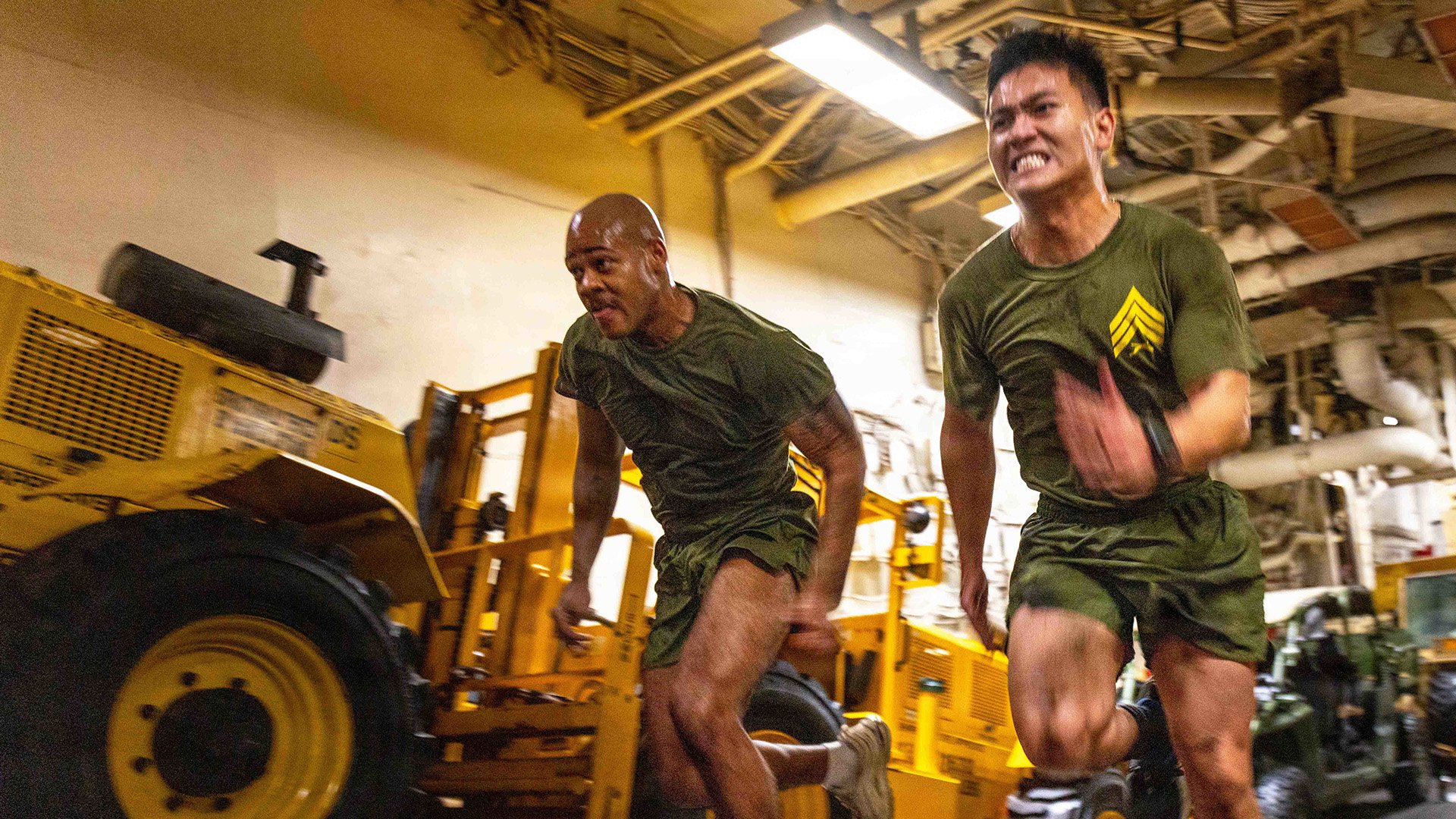
Military members in jobs deemed to be closest to combat will have to keep up higher scores on their annual fitness tests under new Pentagon rules, though each service will decide on its own what those standards will be.
A memo released Aug. 31 by the Department of Defense will require all “combat arms” troops — jobs whose duties and training are primarily aimed at direct combat — will need to maintain fitness scores of at least 70% in their service-specific fitness tests.
Notably, the requirement applies to the regular service fitness tests. Combat arms troops in all services, which covers more than 80 military occupations, must also take a separate combat field test each year, meeting separate requirements also set by their service.
What “70%” means, however, is less clear. Officials with the Army, Navy and Marine Corps each said each service is determining its own rules for the 70% cutoff.
For the Army, the requirement will largely mirror standards already in place. Soldiers in designated combat occupations — which include close to two dozen jobs like infantry, armor, and Special Forces — must score at least 350 of 500 possible points on the five-event Army Fitness Test and earn a minimum of 60 points on each individual event. The test consists of a three-repetition maximum deadlift, hand-release push-ups, sprint-drag-carry plank, and two-mile run.
Top Stories This Week
That means a soldier does not necessarily need to score 70 points on every event. A soldier could score below 70 on one event and make up those points elsewhere, provided they score at least 60 on each event and reach the 350-point overall minimum.
The Marine Corps said the new Pentagon requirement does not change its existing standards for combat-arms Marines. Those standards took effect Jan. 1 under a policy issued last year, Maj. Hector Infante, a Marine Corps spokesperson, told Task & Purpose.
Marines in combat arms roles will have to score at least 210 of 300 possible points on the Physical Fitness Test, equivalent to 70%, using the male scoring table. They must also earn the minimum required score on each individual event. The three-event Marine PFT consists of pull-ups or push-ups, a plank, and a three-mile run.
For the Navy, 70% works differently for sailors in combat arms, which is a smaller community than in the Marines or Army. Those sailors, who primarily serve in Naval Special Warfare roles, must score at least 70 out of 100 on each event of the service’s Physical Readiness Test, a Navy spokesperson told Task & Purpose. Unlike the Army, where a score below 70 on one event can be offset by higher scores elsewhere, sailors must reach 70 on every PRT event for which they are medically cleared.
The Navy said the new Pentagon instruction reiterates guidance issued in December 2025. Combat-arms sailors must also complete a separate Combat Fitness Test consisting of an 800-meter swim with fins, weighted push-ups, weighted pull-ups and a weighted one-mile run. Sailors carry an additional 20 pounds during each weighted event.
Air Force officials did not clarify its 70% requirement, or how it will fit under the overhaul of the service’s Physical Fitness Readiness Assessment. That test uses a 100-point scoring system measuring cardiovascular fitness, muscular strength, core endurance and body composition. The service also maintains separate scoring charts for Air Force Special Warfare and explosive ordnance disposal personnel.
Body composition is now included in an airman’s overall score using waist-to-height ratio, calculated by dividing waist measurement by height, an Air Force official told Task & Purpose. Airmen with a ratio of .55 or higher who also receive an unsatisfactory overall score must undergo a second body fat assessment.
The Air Force said in 2020 that it was permanently removing waist measurements as a scoring component of its fitness test after years of criticism. Waist-to-height measurements returned in 2023 under a separate body composition program but did not count toward fitness scores. Under the new program, body composition is once again part of an airman’s overall score. The Air Force is working to provide bases with InBody770 bioimpedance scales for secondary assessments, while bases without them use tape measurements
Loading comments…
Comments couldn’t be loaded. Please refresh the page.