
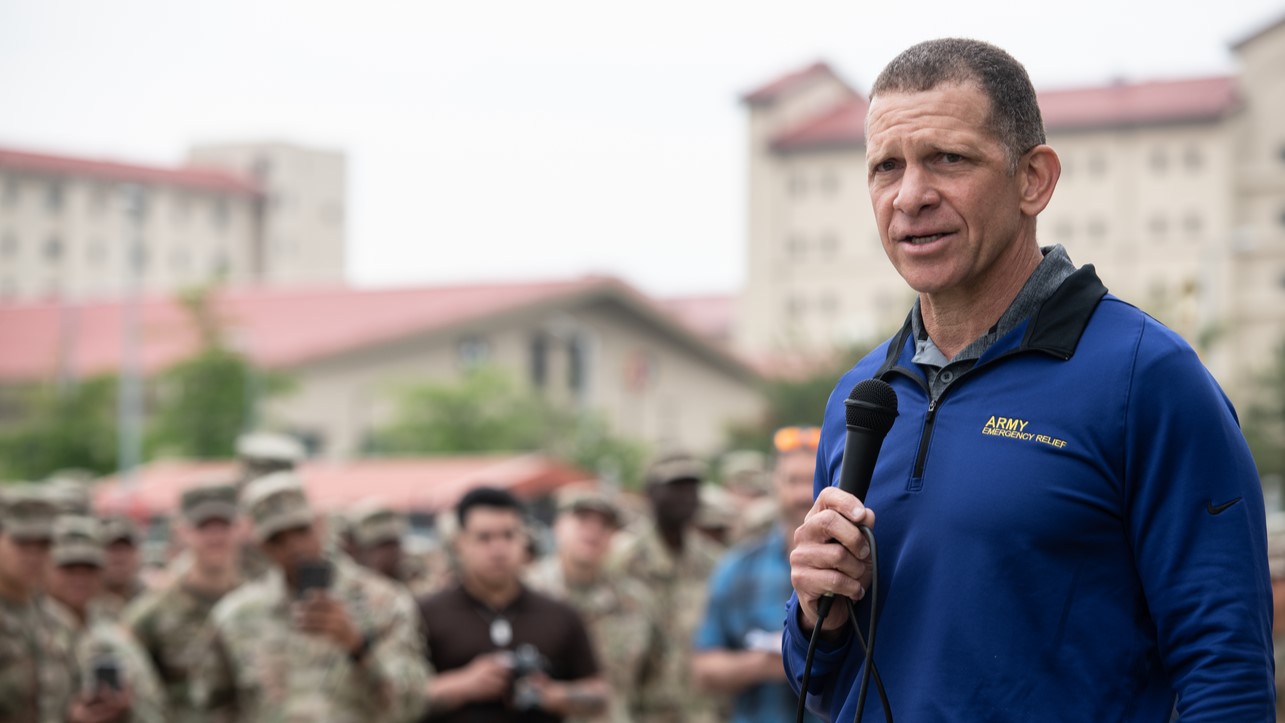
After federal food assistance money did not go out at the start of the month, the Army’s official nonprofit announced it would step in and offer grants to help soldiers and their families afford food during the government shutdown.
Retired Sgt. Maj. of the Army Tony Grinston, who serves as the CEO of Army Emergency Relief, said Monday morning that the charity would cover Supplemental Nutrition Assistance Program (SNAP) and Special Supplemental Nutrition Program for Women, Infants, and Children (WIC) payments for soldiers and their families. In a video posted to his LinkedIn page, and subsequently shared to the Army Reddit page, Grinston announced that the nonprofit will offer grants to help support soldiers in need.
“We got you,” Grinston said.
He directed soldiers to go to the Army Emergency Relief website to apply for assistance. Soldiers will need to write what they missed in terms of SNAP and WIC, but since these are grants, they do not need to be repaid. The grants apply solely to soldiers and their families already enrolled in those programs.
“We’re going to provide that assistance as a grant for the same amount that you would have received because you already applied for that benefit,” Grinston said.
Top Stories This Week
SNAP benefits expired at the start of the month, with a notice on the United States Department of Agriculture’s website saying that “[…] the well has run dry. At this time, there will be no benefits issued November 01.” The expiration was set to impact more than 42 million Americans who rely on the assistance. Federal funds for both WIC and SNAP go to individual states, which administer food assistance.
The exact number of service members and military families who rely on SNAP is unclear, with data over the last 15 years putting it in the range of a few thousand across the armed forces, without specific numbers for individual services, like the Army. The number of people receiving SNAP can vary based on factors such as the cost of living.
Eileen Huck, the deputy director of government relations for the National Military Family Association, told Task & Purpose last week that military families who rely on federal food assistance are “predominantly younger families, junior enlisted troops, they’re families who are already struggling financially.”
Military charities and nonprofits such as Army Emergency Relief have been offering troops and their families assistance over the last month during the government shutdown.
Grinston’s video, posted Monday morning, came shortly before President Donald Trump’s administration announced it would partially pay SNAP benefits. On Oct. 31, two different federal judges ruled that the administration is legally required to tap into the $5 billion SNAP contingency fund to help Americans avoid going hungry. The Department of Agriculture sends roughly $8 billion a month to states, averaging $356 a month per household, according to federal data.
In response to the court order, the Department of Agriculture announced on Monday that it would “fulfill its obligation to expend the full amount of SNAP contingency funds today,” and would “cover 50% of eligible households’ current allotments.” However, the department said that there would be delays in restarting payments as it adjusts to using the contingency funds, saying in a court filing that new payments “will take anywhere from a few weeks to up to several months,” according to NPR.
Loading comments…
Comments couldn’t be loaded. Please refresh the page.