
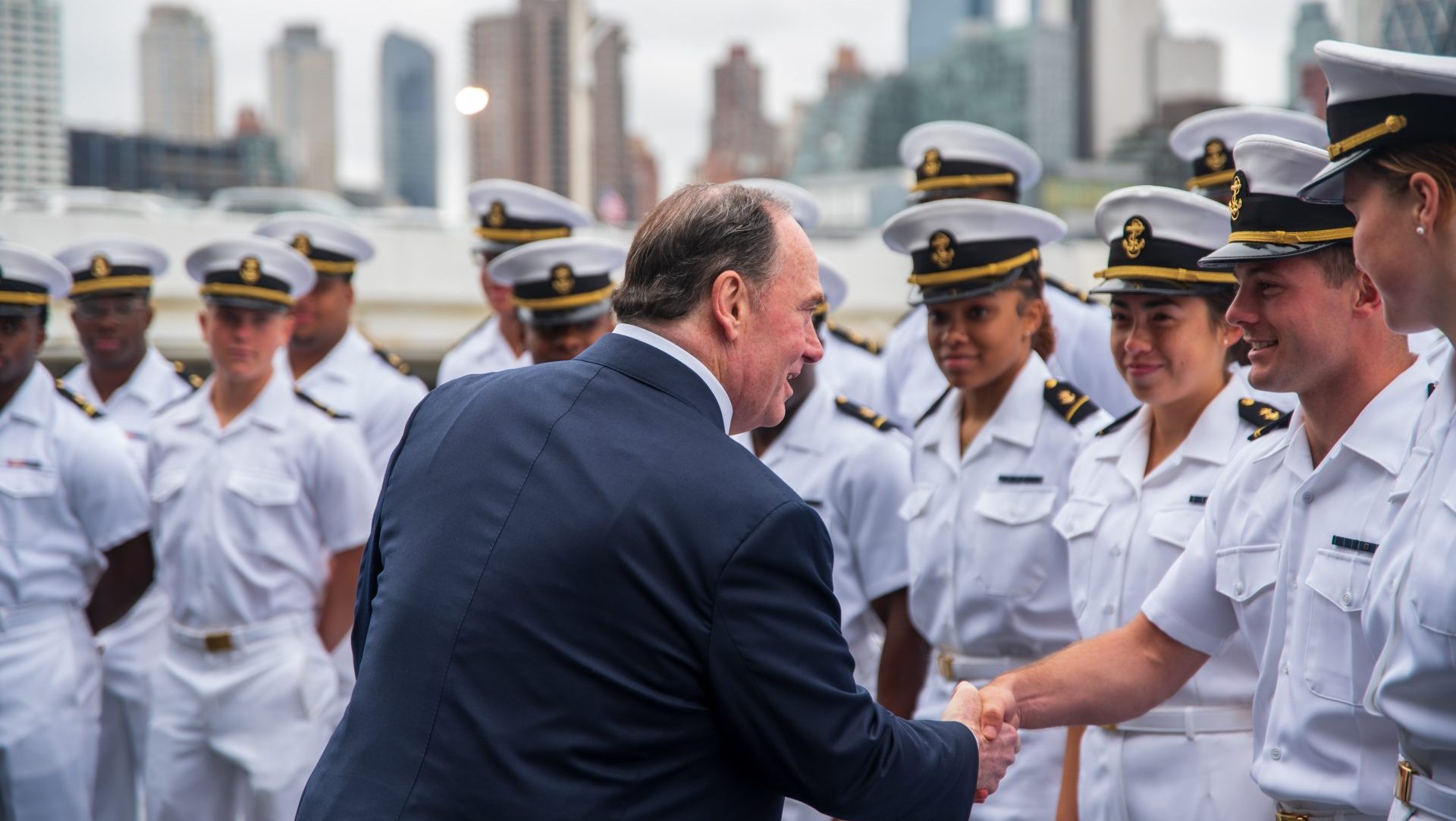
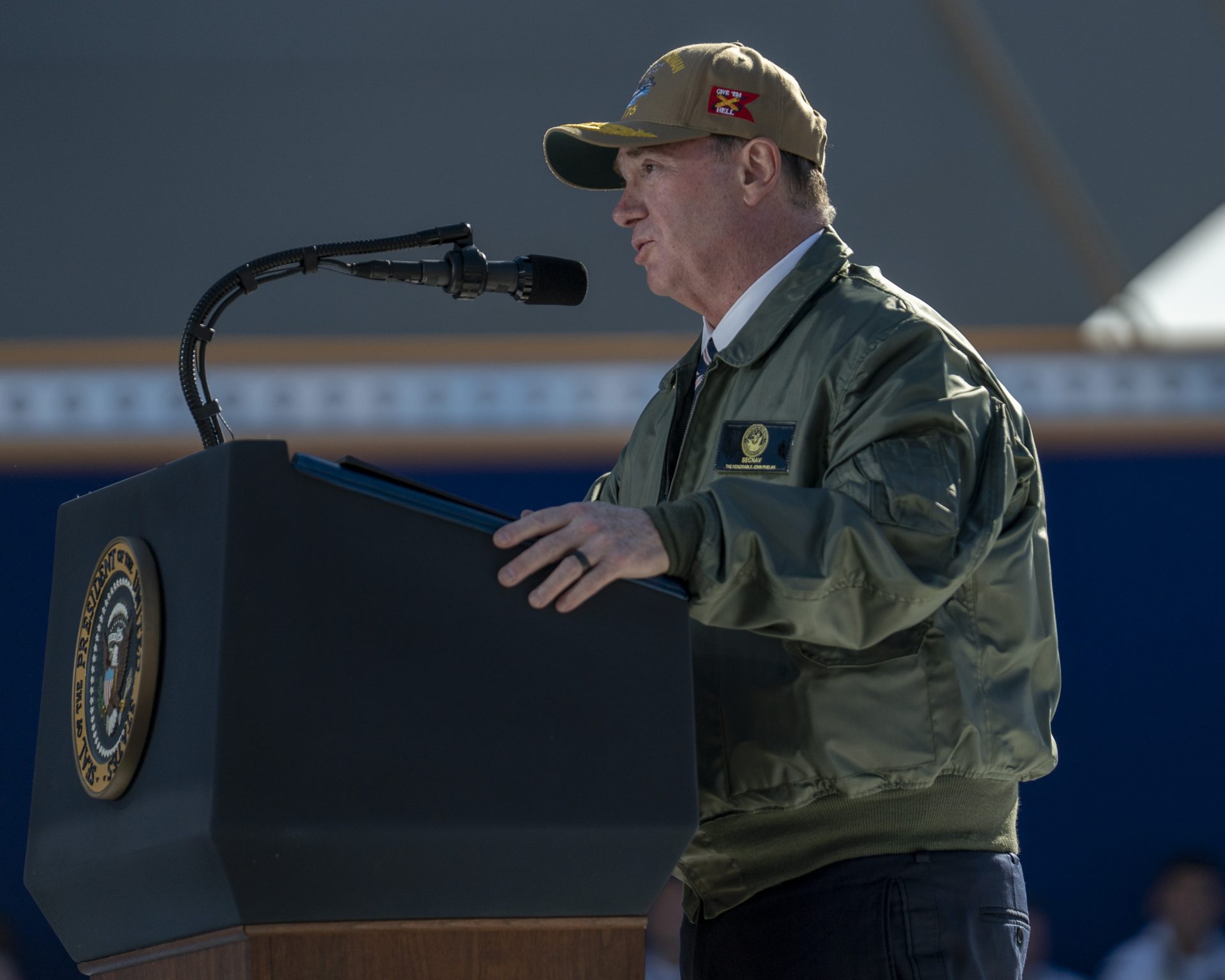
The Department of the Navy is looking into whether sailors’ and Marines’ social media posts have violated the department’s social media guidance, according to a recent message from Navy Secretary John Phelan.
“At the direction of the Secretary of the Navy, the DON [Department of the Navy] is actively reviewing reports related to Service Members social media activity that is misaligned with the DON’s current social media guidance,” according to the Oct. 24 “All Navy” message. “The guidance remains in full effect, and we are committed to upholding the highest standards of conduct. Service members are expected to uphold Navy and Marine Corps core values on duty, off duty, and online.”
The message does not specify what exactly prompted the review, or how sailors’ and Marines’ social media posts may have been “misaligned” with official guidance.
Navy officials did not provide a statement for this story due to the ongoing federal government shutdown.
Phelan’s message comes after Terence Emmert, then serving as acting Navy secretary, issued an advisory in March about the Department of the Navy’s social media policies.
For the most part, Emmert’s message was similar to Phelan’s, but Emmert did not indicate that sailors or Marines had violated official social media guidance.
Both messages remind Marines and sailors that the Uniform Code of Military Justice restricts what they can say on- and off-duty, and they could potentially be charged with a variety of offenses for violating those limitations on their speech, including showing contempt toward officials, failing to obey an order or regulation, and prejudicing good order and discipline or bringing discredit upon the armed forces.
Top Stories This Week
The two messages also encourage troops to include disclaimers to make clear that their posts reflect their personal views, and are not necessarily the official positions of the Department of the Navy, the Defense Department, or the United States.
Phelan’s message comes as elections are scheduled throughout the country for next week. Both Phelan and Emmert reminded Marines and sailors that they are prohibited from engaging in “partisan political activity” while on duty, and they should avoid implying that their personal political activities are approved or endorsed by the military.
In recent months, troops’ public comments have also come under scrutiny following the Sept. 10 death of Charlie Kirk, founder of the conservative activist group Turning Point USA, who was shot at Utah Valley University in Orem, Utah.
The following day, Defense Secretary Pete Hegseth cautioned service members and Defense Department civilians that the Pentagon would monitor their social media posts for any comments that mocked Kirk’s death.
“We are tracking all these very closely — and will address, immediately,” Hegseth posted on X. Completely unacceptable.”
Phelan also posted on X that the Department of the Navy would not tolerate any social media comments from sailors, Marines, or civilians that disparaged Kirk’s death.
“I am aware of posts displaying contempt toward a fellow American who was assassinated,” Phelan wrote. “I want to be very clear: any uniformed or civilian employee of the Department of the Navy who acts in a manner that brings discredit upon the Department, the @USNavy or the @USMC will be dealt with swiftly and decisively.”
The Navy would not say whether the social posts that Phelan mentioned on X were connected to the review announced in the Oct. 24 message.
However, in the wake of Kirk’s death Chief of Naval Operations Adm. Daryl Caudle issued guidance on Sept. 15 about how reports of “unprofessional personal social media use” should be tracked.
As of Sept. 30, a total of 128 service members and 158 non-uniformed Defense Department personnel had been investigated for their comments online about Kirk, according to the Washington Post.
The military services have long struggled to regulate what troops say on social media. In 2017, the Marine Corps was rocked by the Marines United Facebook group scandal. Members of the group, which included troops and veterans, shared nude or sexual photos of women without their consent. The following year, the Marines announced that about 130 people had been investigated for online misconduct ranging from sexual harassment to revenge porn, of which roughly 60 were punished.
More recently, a Reserve soldier also lost his full-time position with Civil Affairs for his social media and public comments criticizing U.S. support for Israel and linking to apps that track ICE agents. In 2021, the Army announced it was separating another soldier for joking about the Holocaust on his TikTok channel.
Do you have a tip for us about the military’s recent social media review, or about another story? If so, please reach out to us here.
Loading comments…
Comments couldn’t be loaded. Please refresh the page.