
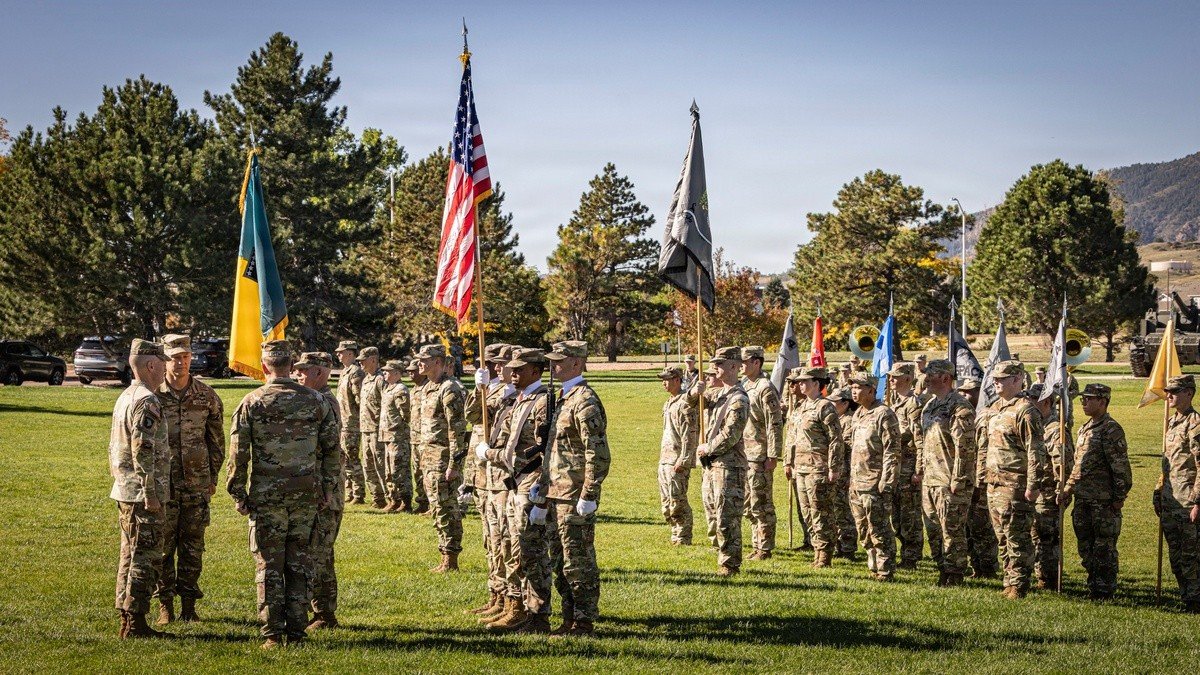
The Army activated its fourth multi-domain task force this week, as part of the wider restructuring the force.
The new 4th Multi-Domain Task Force was stood up at Fort Carson, Colorado on Oct. 8. It comprises 2,100 soldiers tasked with coordinating cyber warfare, long-range missiles and other capabilities in support of the wider Army. Like some of the Army’s other similar units, this new task force is focused on the Pacific theater, the Army said.
“While we build this formation to deter aggression and preserve peace, if war comes, we must be prepared to fight and win,” Col. Hugh W. A. Jones, the unit’s commander, said at the ceremony. “We owe those in harm’s way every advantage we can give them, while leaving our enemy nowhere to run and nowhere to hide.”
The new formation, based out of Fort Carson, is expected to be organized into four battalions. Those include a long-range fires battalion armed with High Mobility Artillery Rocket Systems and hypersonic missiles, one focused on cyber warfare and signal intelligence, an air defense battalion and a sustainment battalion.
The Army began establishing these task forces in 2017, as a pilot to bring together cyber and electronic warfare capabilities, long-range precision missiles and targeting abilities across land, air, space and sea. The concept called for organizing around these tactics to disrupt near-peer or peer-level adversaries’ targeting and surveillance abilities. In the decade since the 1st Multi-Domain Task Force was established, the Army has also worked to better integrate drones and other uncrewed systems into the formation.
This July, the Army merged the 1st Multi-Domain Task Force with the 7th Infantry Division, creating a first of its kind formation. The 7th Infantry Division Multi-Domain Command – Pacific is meant as a “covering force” in the Pacific, adding long-range artillery as well as electromagnetic warfare capabilities to support the infantry. The new 4th Multi-Domain Task Force will report to the 7th Infantry Division Multi-Domain Command – Pacific, which the Army calls its “multi-domain operational headquarters.”
According to the Army, plans call for creating a fifth multi-domain task force, to be set up by 2028.
Loading comments…
Comments couldn’t be loaded. Please refresh the page.