
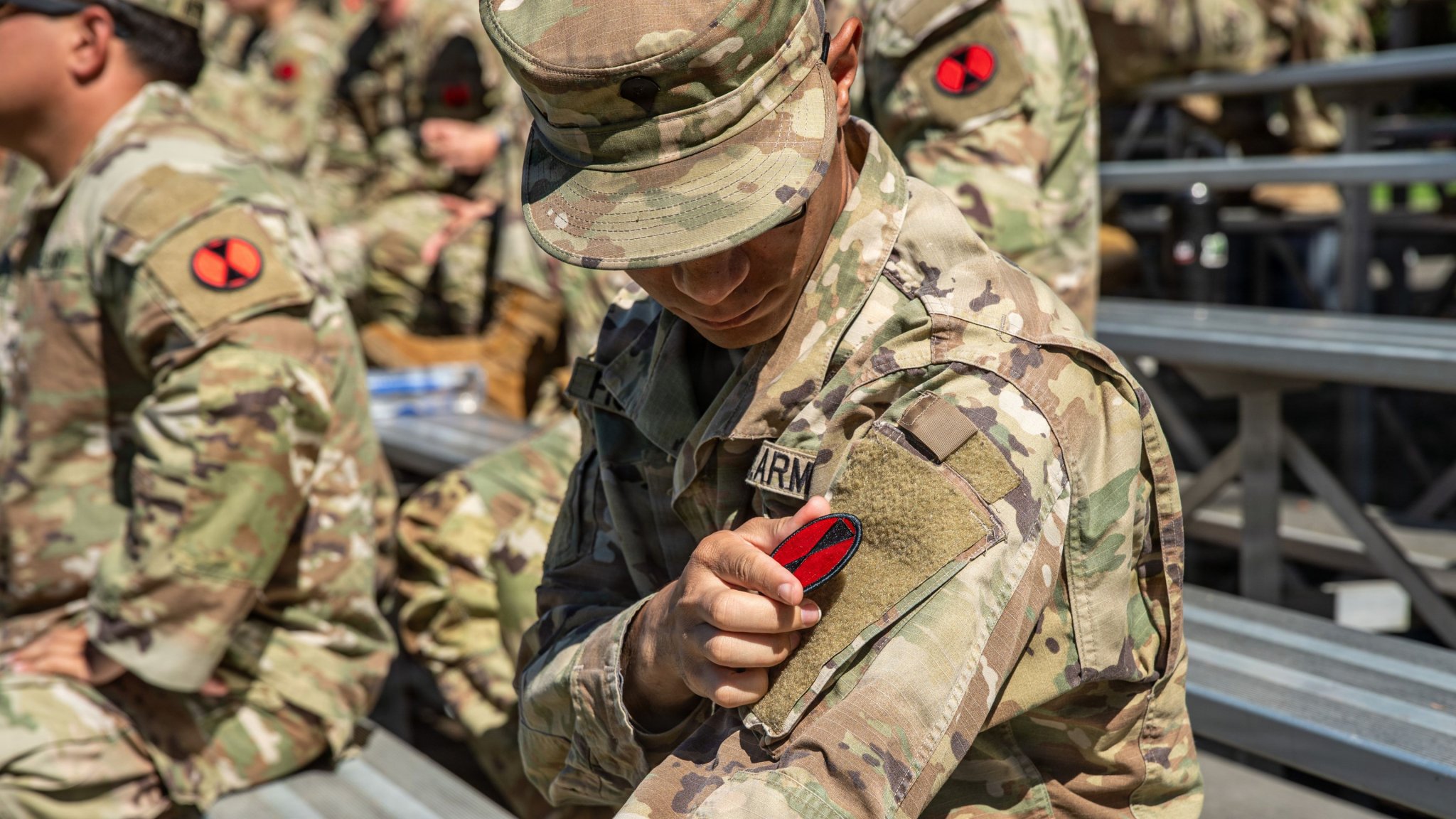
The Army officially created a new kind of formation this past week, moving thousands of soldiers into a “multi-domain command.”
On Thursday, the Army formally created the 7th Infantry Division Multi-Domain Command – Pacific, merging the 1st Multi-Domain Task Force with the 7th Infantry Division. The new command is the first of its kind, taking a long-standing ground force and combining it with a relatively new formation focused on modern warfare tactics involving cyber and electronic warfare and the use of drones at scale.
The move, part of the wider Army’s transformation initiative, puts roughly 12,000 soldiers under the new command, headquartered at Joint Base Lewis-McChord.
Top Stories This Week
Last month, the deputy commander Col. Todd Burroughs described the new command as a “self-contained” one, operating similarly to a covering force. In practice, it would combine reconnaissance and counter-reconnaissance missions and target enemy positions with electronic and cyber attacks, as well as artillery, to provide a path for the main joint force.
In practice it will combine the 7th Infantry Division’s two Stryker brigade combat teams with the long-range artillery and cyber warfare capabilities of the task force. Part of that is the idea of what the Army calls “Cross-Domain Contact Layer,” essentially rapidly tracking and identifying threats and then taking them out.
“Through our emerging cross domain contact layer concept, our division will employ capabilities such as unmanned surface vessels; long-range, one-way attack drones; and launched effects to penetrate the adversary’s anti-access/area-denial network,” Maj. Gen. Bernard J. Harrington, the command’s leader, said. “Every radar that emits, every node that transmits, every headquarters that commands, we aim to hold continuously at risk alongside our joint partners and allies.”
As TWZ reported, that also involves drones. Lots of drones. Harrington told reporters the command’s strategy involves being able to “overwhelm potential adversarial systems by a volume” of several types of remote systems.
The 1st Multi-Domain Task Force was originally stood up in 2017. A second was established in Europe in 2021 and a third. That was one force impacted by several canceled deployments in May. After diplomatic disputes with Germany, the Pentagon stopped the long-planned deployment of a field artillery regiment meant to join the 2nd Multi-Domain Task Force in the country.
At the ceremony on Thursday, Army Pacific chief Gen. Ronald Clark pointed to the new formation’s capabilities as being able to support forces throughout the Pacific region. The reorganization comes as the military as a whole reshapes its Pacific presence, moving some units, reinforcing Guam and fielding new technology to support forward-deployed units.
Loading comments…
Comments couldn’t be loaded. Please refresh the page.