
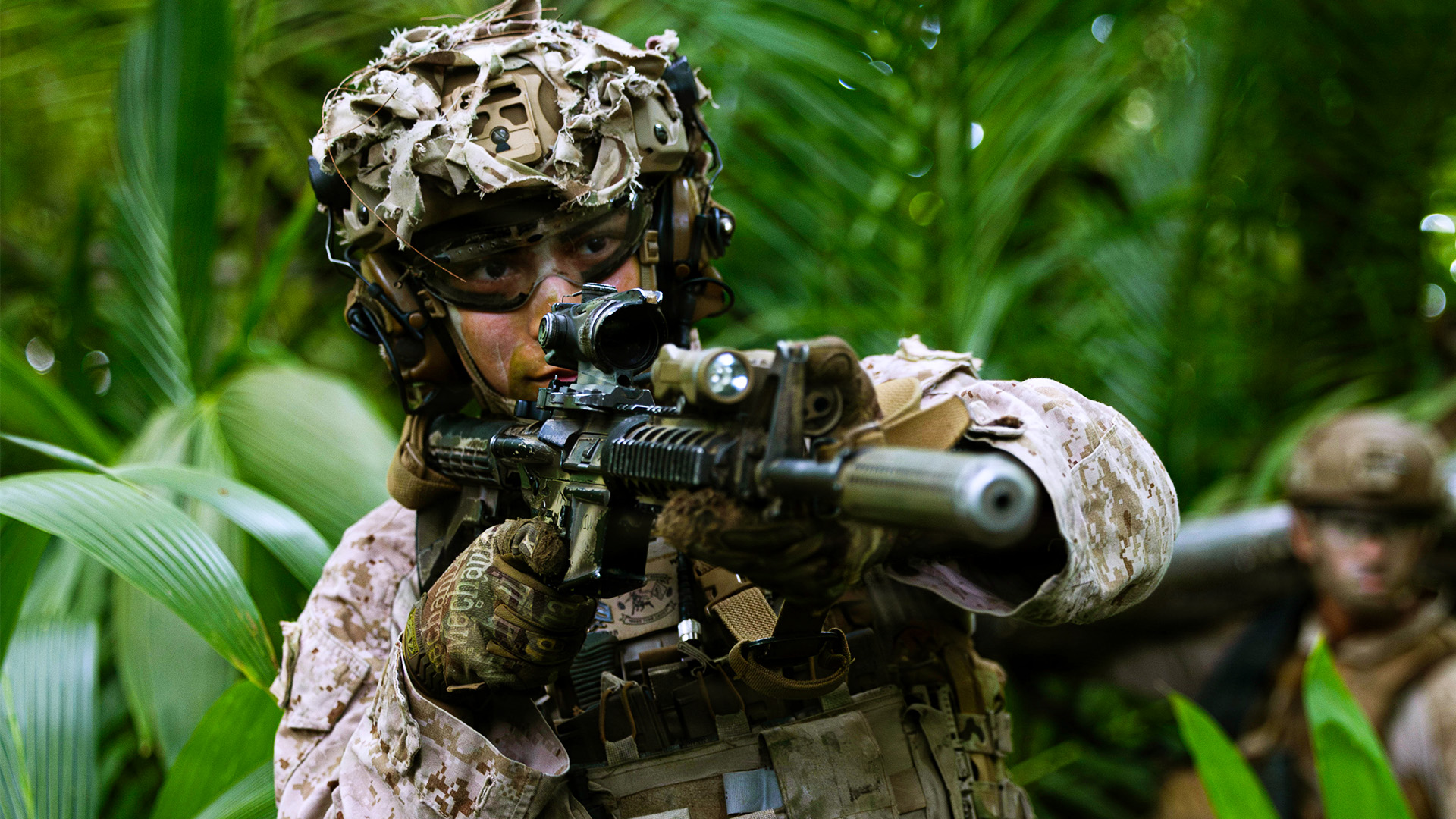
Marine Corps leaders are considering making Scouts a Primary Military Occupational Specialty, similar to Machine Gunners and Mortarmen, said a senior Marine commander in charge of training.
Currently, Scout platoons are designated within infantry and light armor reconnaissance units and manned by Marines trained in traditional PMOS.
Marine Maj. Gen. Michael A. Brooks, who leads Training Command, laid out the concept for a Scout PMOS on Monday.
“There is interest in turning our scout MOS, which is 0315, into a Primary MOS,” Brooks said on Monday. “So, it would be like, you know, Machine Gunner, or 0331; or Mortarman, 0341. You’d have an 0315 Scout as a primary MOS. We don’t do that right now. It’s an additional MOS.”
Though for now just a concept, the potential reshuffling of infantry PMOSs comes as the Marines announced an overhaul to their training pipeline for Reconnaissance Marines. The new PMOS, should it come to pass, would be a further evolution of the role of Scouts in infantry units.
Top Stories This Week
In 2023, the Marine Corps announced that it was creating 26-member Scout Platoons to replace Scout Sniper units.
“The Scout Platoon’s role is to provide all-weather, timely information to the battalion commander,” said Capt. Steven J. Keenan, a Marine Corps spokesman. “Their primary function is to serve as surveillance and reconnaissance for the battalion commander, and aggressively hunt, investigate, and evaluate enemy activity in the battlespace.”
So far, Scouts have not had a Primary Military Occupational Specialty, or PMOS, which is a job that Marines are expected to do for most of the time, like mortars or, on the modern battlefield, drones. But that could change, Brooks said.
“We know what an Infantry Scout does: They do the sensing and battlefield shaping for the infantry battalion commander,” Brooks said, “But the function they perform is reconnaissance. So we started looking at perhaps some training efficiencies between the skills that infantry scouts needed and the skills, or at least a subset of the skills, that the Recon Marines needed, and perhaps use that to build a more efficient and common start in the training pipeline.”
Brooks spoke with reporters during a media roundtable on recent changes to training for Reconnaissance Marines, which include replacing the 12-week Basic Recon Course. Marines wanting to join a Recon unit will need to complete two new courses: the Ground Reconnaissance Course and the Amphibious Reconnaissance Course.
Training for new Scout PMOS, Brooks said, would likely overlap with some of the changes in the Recon pipeline with Scouts attending the Ground Recon Course to receive their PMOS.
“If you think about the roles and functions that they’re going to perform, there’s a big crossover between what a Scout would be doing for a Recon battalion in terms of reconnaissance, and what a Recon Marine would be doing for a division or the [Marine Air-Ground Task Force],” Brooks said. “And so there’s an opportunity there to bring similar training to both cohorts in one place and build efficiencies out of that.”
Lt. Col. Worth Parker, a retired ground reconnaissance and special operations officer, said that while both Scouts and Reconnaissance Marines provide commanders with information about what’s in front of them, a major difference in the two roles is the distance ahead they cover. Scouts typically operate at lesser distances beyond the forward edge of the battle area than Reconnaissance Marines, he said.
“Let’s say a rifle company is going to assault an objective,” Parker told Task & Purpose. “You might use the Scouts to find a route to the objective and then bring them back to link up with the company commander to take that company on to where they have to go.”
Granting Scouts a Primary MOS could help their professional development, Parker said. But it would require the Marine Corps to establish a career roadmap for Scouts who advance beyond the rank of sergeant, he said.
“For proficiency’s sake, having any formalized training and a formalized career path is a benefit to the Marines within it,” Parker said.
On Monday, Brooks did not provide a timeline for when the Marine Corps could decide whether to grant Scouts a Permanent MOS.
“I can tell you that it is, it is in the decision-making apparatus,” Brooks said. “But I feel like we’re getting closer to that decision.”
Loading comments…
Comments couldn’t be loaded. Please refresh the page.