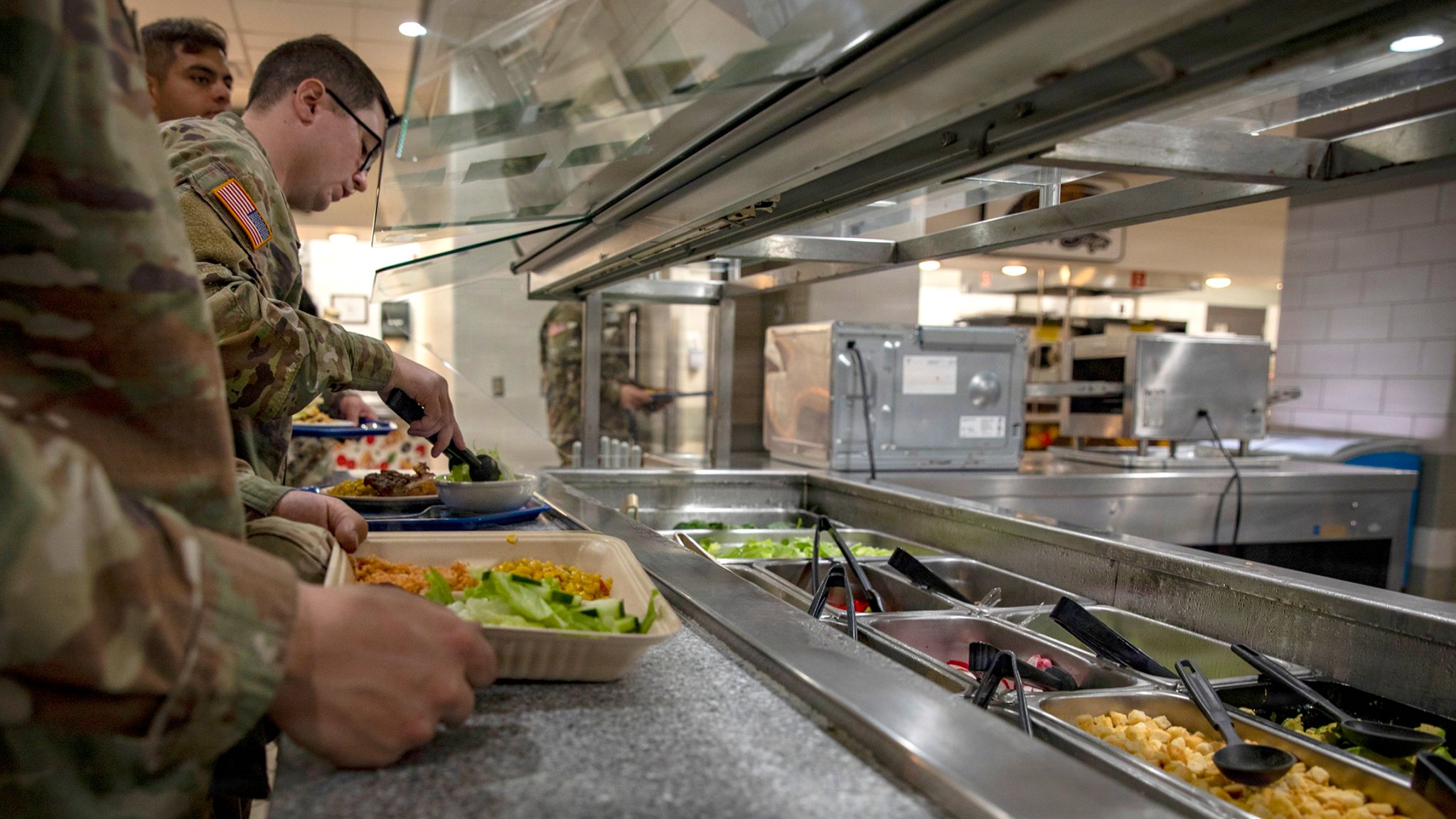
The Army will open a new dining hall at one of its largest bases later this month, which the service has closely modeled off cafeterias on college campuses. Soldiers will be given $39 worth of what the Army is calling “freedom dollars.”
Freedom dollars is the term the Army is using to refer to the funds that are taken out of soldiers’ paychecks to go toward meals at dining facilities. Typically, soldiers can only get a set number of food items per meal card swipe. Now, individual items are assigned a value, and soldiers can spend up to their allotted daily amount. This system will be implemented at the new dining halls, which the Army has taken to calling campus-style dining venues.
“The ability to go get three meals that are high-quality breakfast, lunch, and dinner is baked into that monetary allowance,” Lt. Gen. Chris Mohan, commanding general of Army Materiel Command, said Monday. Mohan spoke with reporters on a call as the service offered details for its overhaul of base dining facilities. The move is part of an ongoing plan by the Army to redesign its dining facilities so they more closely resemble those at college campuses.
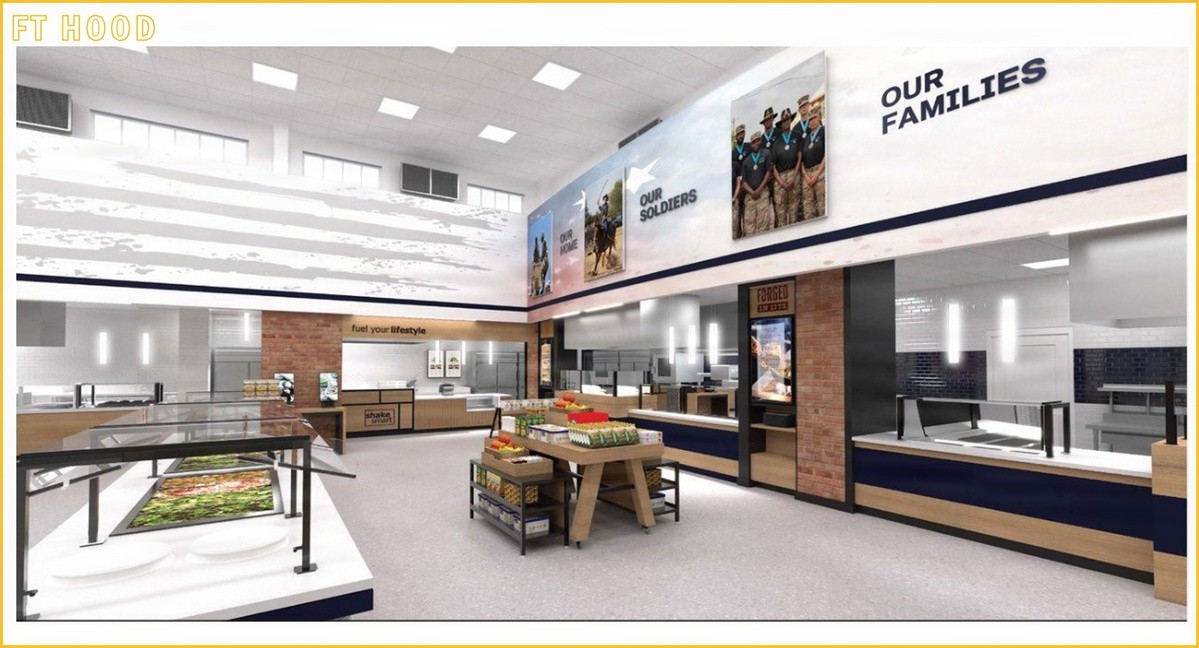
Army officials also gave reporters a look at a planned “campus-style dining venue” set to open Feb. 18 at Fort Hood, Texas. The dining halls are run by Compass Group USA, Inc., which the Army has contracted with to run its new facilities based on the company’s history of running airport lounges and handling the meal-planning for college sports teams, Mohan said.
The company served a free sample lunch last Saturday to 75 enlisted soldiers and spouses at Fort Hood’s “Bistro 42,” which draws its name from the year the base was established — 1942.
Bistro 42 has expanded hours and is open from 6:30 am to 8 p.m., without closing in between meal times — a move that Army officials say will accommodate soldiers with hectic schedules. Fort Hood’s facility has a mobile food truck and seven food stations with options ranging from smoothies, acai bowls, Italian food, specialty burgers and salads.
In addition to eating in the dining hall, soldiers will be able to place online orders through a mobile phone app and pick up their meals at a designated drop zone or have them delivered.
Mohan gave an example of what an enlisted soldier’s daily meal plan for $39 could look like:
- 7:30 a.m. overnight oats ($2)
- 8:35 a.m. online app order for an omelet with veggies ($5) and fresh fruit ($2)
- 11:45 a.m. dining hall meal of grilled chicken breast sandwich, home fries, side salad, drink and dessert ($10.50)
- 3:45 p.m. food truck snack of two brisket tacos and slaw ($9)
- 6:30 p.m. 42 Bistro meal for Peri Peri chicken, balsamic bean salad, drink and dessert ($8)
- 9 p.m. snack of hummus and carrots ($2.50)
“That is a lot of food,” Mohan said, adding that soldiers might try to supersede that amount but their chain of command “has to really educate them on how this is going to work.”
The Army has budgeted a certain amount for each meal, but any leftover dollars that soldiers don’t use for one meal will be rolled over to use later that day. If soldiers do want more food than the $39 will cover, they “can choose to pay out of pocket for what they go over,” Kim Hanson, an Army Materiel Command spokesperson, told Task & Purpose.
The first set of campus-style dining halls are planned for Fort Bragg, North Carolina; Fort Stewart, Georgia; Fort Hood, Texas; Fort Drum, New York; and Fort Carson, Colorado, and the Army has announced plans to expand it to nearly 10 other bases. The next campus-style dining venue is planned to open in March at Fort Carson.
Each facility is run by a professional chef and a registered dietitian who can make “on the spot” changes to the menu based on ingredient availability from local vendors and “to account for fresh fruits and vegetables” that are available in a particular season, according to Mohan.
Top Stories This Week
As a way to convince soldiers to spend more time at the new dining halls, the Army has installed WiFi and plans to host community events like cooking classes or officer professional development courses. The Army is also leaving it up to senior base commanders to decide whether their specific dining hall will sell beer and wine.
“We tell our soldiers, ‘hey, look, go carry a rifle, but on Friday night, you can’t have a beer in a restaurant,’” Mohan said. “I think that we have to take a step back and trust our soldiers.”
The “vast majority” of soldiers will probably eat breakfast at the dining hall and many will go to the food truck for lunch, but dinner is where they expect to see more variance since “soldiers tend to do other things,” Mohan said. “But we want to give them the option.” By having the dining halls stay open until 8:30 p.m. or 9 p.m., Army planners hope it will give soldiers a “long window for them to use that entitlement,” he added.
The overhaul is also part of an effort to get more customers, like military families or civilians who work on post, into the Army’s dining hall by offering a la carte options that are equivalent or even more cost-effective than local restaurants.
“After church on Sundays, we go to our favorite restaurant. I get a three-egg omelet, and it cost me $12. A three-egg omelet at Bistro 42 with three eggs, a protein, three vegetables, cheese or whatever is going to be $5.75 and so it’s going to be very, very competitive,” he said. “We hope that it will draw in not only the soldier population, but also families, particularly those that are younger and have less financial resources.”
The Army is still trying to decide on its second set of facilities to be revamped, which will include dining halls at bases in Alaska, Hawaii and Europe. The Army is also planning upgrades to dining halls run by the Army Transformation and Training Command, where soldiers attend Basic Combat Training and Advanced Individual Training.