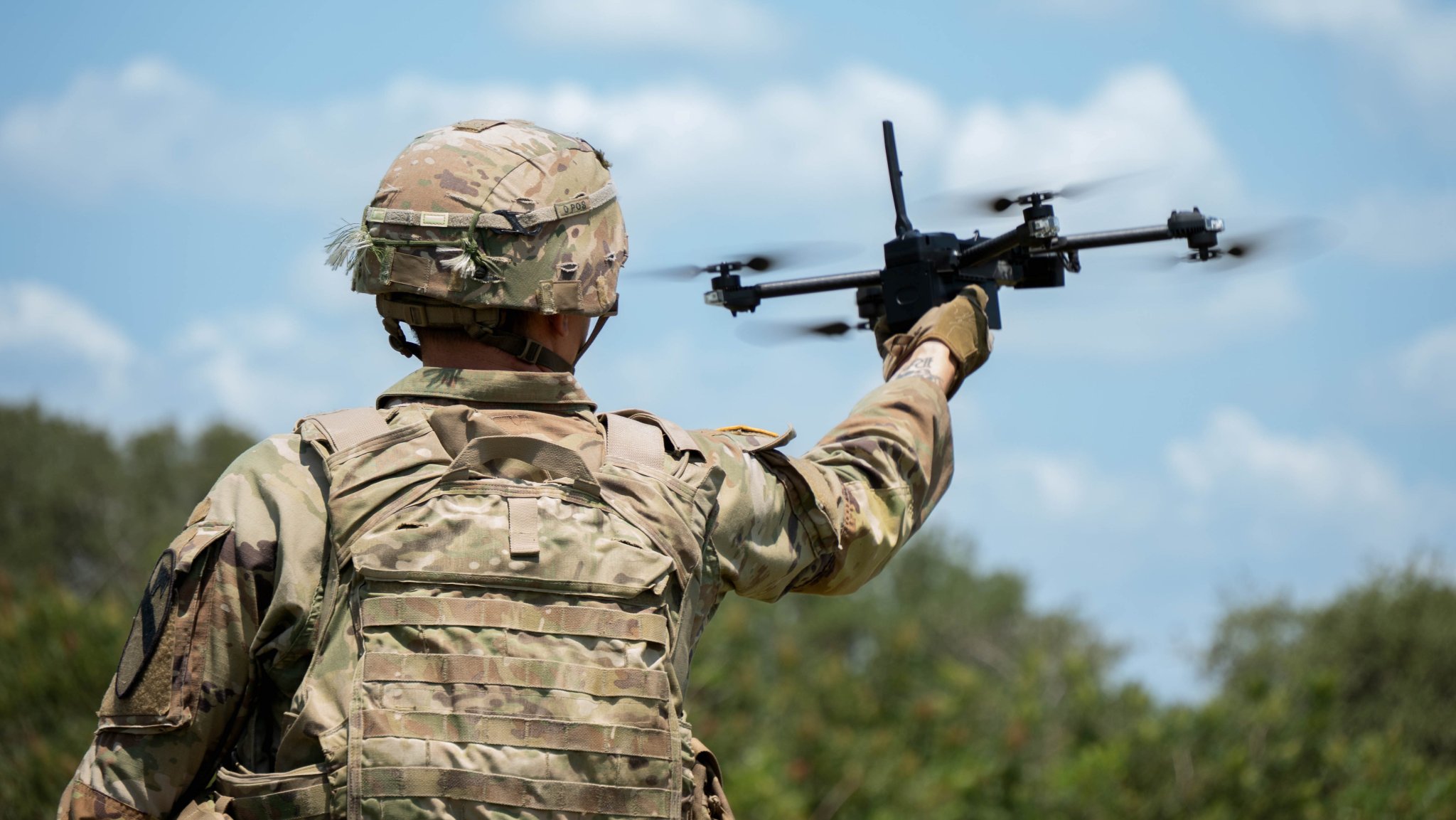
Soldiers will have the chance to attend the Army’s first official drone course to become experts in flying, building, and repairing them in combat.
Officials at the U.S. Army Aviation Center of Excellence at Fort Rucker, Alabama, announced the launch of its Unmanned Advanced Lethality Course this week. The training is just one part of the U.S. military’s recent efforts to catch up on unmanned systems, which have seen wide use on battlefields across the globe for the past decade.
For the Army’s course, soldiers first attend three weeks of classroom instruction on a variety of commercial drones and complete 20 to 25 hours of simulated flying. The course uses commercially available simulators — “essentially, video games” — to build foundational flying skills, said Leslie Herlick, a spokesperson for the Army Aviation Center of Excellence and Fort Rucker.
“Research indicates that dedicating 25 or more hours to simulators like Liftoff, VelociDrone, or the Drone Racing League can demonstrably improve real-world flight performance,” Herlick said.
Top Stories This Week
After playing drone video games, soldiers head out to the field and practice flying in urban warfare settings. One scenario that soldiers face includes receiving specific enemy target locations and having to employ a reconnaissance or surveillance drone.
After positively identifying a target, soldiers practice taking them out with First Person Viewer, FPV, or one-way attack drones, Herlick said, noting that the course is currently using balloons to “simulate the effects of drone strikes,” to minimize destroying “valuable” drone systems during the training — basically to save money.
Students also learn how to manufacture and repair drone parts with computer-aided design software and 3D printers that use resin, filament, and carbon fiber materials.
There are currently 28 soldiers from across the Army completing the course and they hail from a variety of backgrounds like infantry, cavalry and aviation. Many of the students are drone hobbyists, while others were previously certified as drone master trainers and are part of the Army’s Transform in Contact Units. Herlick said the course was designed to be broadly applicable and not tied to soldiers from a specific Military Occupational Specialty or unit.
Officials said in an Aug. 18 news release that Fort Rucker will become the advanced drone training site for select soldiers.
The course has soldiers train with five commercially available systems that are on the Department of Defense’s Blue UAS Cleared List — which lays out which commercially available drones are approved for federal use. Army officials declined to name the specific systems.
Officials acknowledged that the military has been slow to institutionalize its drone training across the force.
“This course is a catch-up,” Capt. Rachel Martin, the course director who created the curriculum in three months, said in the release. “We’re behind globally, and this is our aggressive attempt to close that gap.”
In July, the Army was chosen to lead the Pentagon’s interagency task force to coordinate the military’s different drone programs, but the service’s drone expertise has mostly evolved through unit-level efforts, such as the 173rd Airborne Brigade’s drone lab, which teaches soldiers how to build FPV drones.
Maj. Wolf Amacker, chief of the aviation center’s drone directorate, said in the release that it’s the first drone-specific proficiency course developed under U.S. Army Training and Doctrine Command, which is responsible for setting the training standards and requirements that soldiers have to meet to be ready for combat.
“While some units have proactively developed their own internal training programs addressing similar concepts, this course represents a standardized, Army-wide approach to this critical capability,” Herlick said. “This centralized training aims to ensure a consistent and effective baseline of proficiency across the force.”