
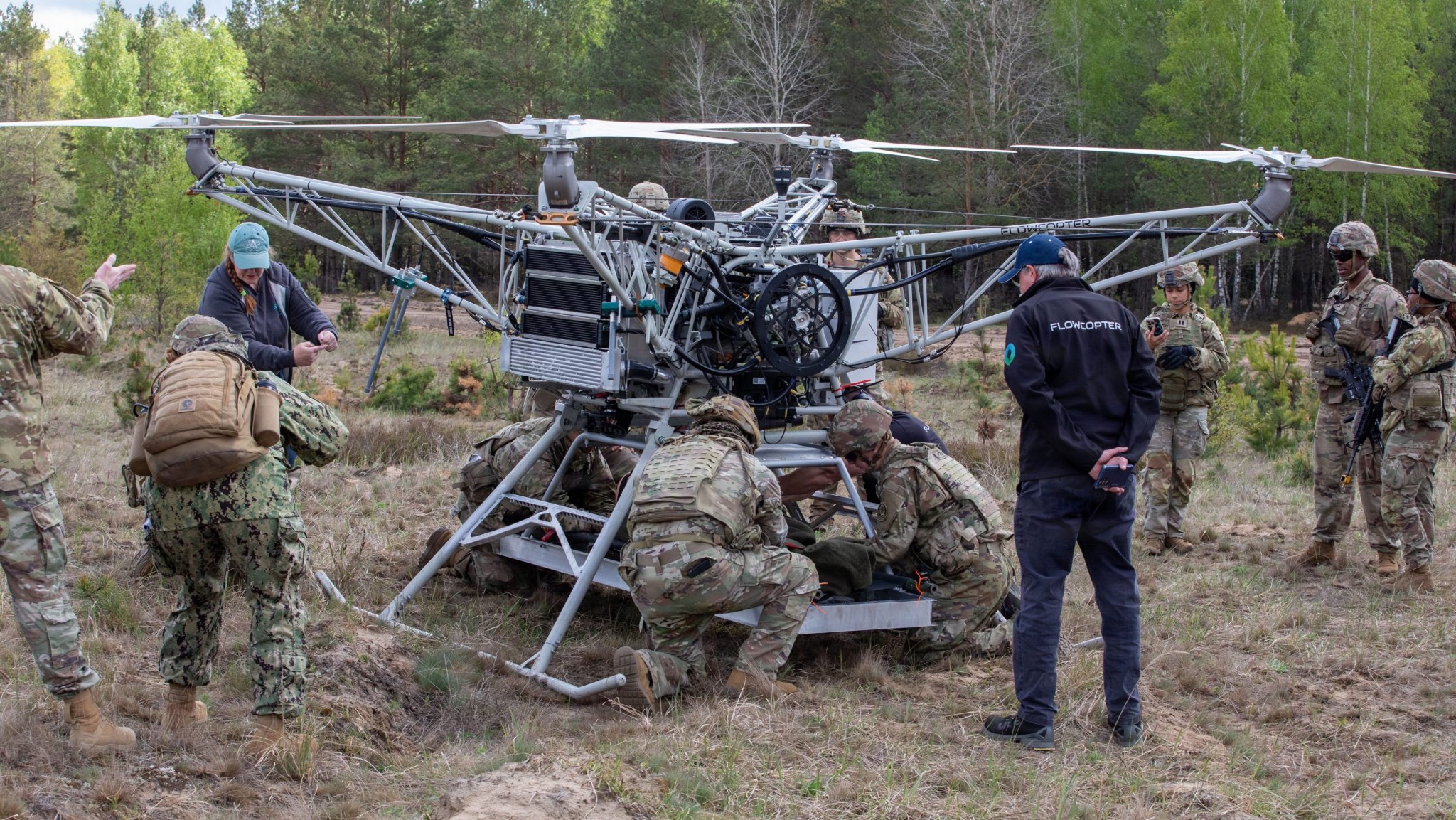
In a combat experiment that oddly resembles the claw game at an arcade, the Army will strap a test dummy under an oversized drone at an exercise in Poland this week, the first step toward eventually evacuating injured soldiers from active combat.
As part of ongoing NATO exercises in Poland, the Army will test whether an oversized quadcopter, known as a Flowcopter, can safely fly a casualty out of combat and to a nearby field hospital, officials confirmed to Task & Purpose.
The Poland exercise follows a 2nd Cavalry Regiment medical evacuation demo with the Flowcopter unmanned aerial vehicle, UAV, in Bemowo Piskie Training Area, Poland. On Sunday, soldiers prepared for the full exercise by loading a test dummy onto the drone during an Autonomous Triage and Treatment Challenge.
The previous drone tests were done for Sabre Strike 2026, a NATO exercise that began in April and runs through the end of May. As part of the exercise, 15,000 troops from eleven countries are training across the High North, Baltic region, and Poland. For Sabre Strike, troops are running through air defense operations, counter-drone tactics, cyber defense scenarios, and the latest medical evacuations without humans in the cockpit.
The exercise will use the Flowcopter FC-100, a UAV capable of taking off and flying with up to 650 kg or just over 1400 pounds. The flight endurance depends on the weight. Carrying 330 pounds, the drone can fly for over 5 hours. But with just 110 pounds, the Flowcopter can last for a little more than 11 hours in the air.
The Flowcopter is powered by a hydraulic-gas engine instead of batteries.
The drone exercise is the latest real world test that the Army is running as the U.S. military pivots to “trade steel for blood” and looks at technologies that take humans out of combat roles and put robots into harm’s way. While the U.S. military has begun thinking about humans and machines will team up in battle in recent years, aerial experts have routinely cautioned that the notion of unmanned flights carrying wounded humans was still more of a concept than reality.
In a 2025 Military Medicine paper by active duty Air Force doctors, the researchers wrote that early casevac exercises “have shown promise,” but aerial evacuations in modern combat pose a number of challenges when it comes to flying patients out of a combat zone and making sure they arrive at a field hospital safely.
“There are numerous operational limitations including payload capacity, lack of onboard medical personnel, and the need for triage protocols tailored to autonomous evacuation. Additionally, adversarial UAS use presents significant risks to medical operations,” they wrote. “Persistent aerial surveillance compromises force protection, while precision strikes and the coordinated use of large numbers of UAS threaten the ability to safely provide point-of-injury care, prolonged field care, CASEVAC, and medical evacuation. These emerging threats challenge long-held assumptions about air superiority and rapid evacuation capabilities.”
However, the latest exercise seems to show that autonomous evacuation is a real consideration for the Army.
Last month, the service issued a federal solicitation looking for a new gound vehicle to transport personnel through the “last tactical mile,” the final aldangerous portion of terrain leading to the front lines of combat. The notice from the Army’s Capability Program Executive for Mission Autonomy, stated that the service is seeking a vehicle that can not only bring supplies to troops in direct combat, but also be able to evacuate at least two wounded soldiers.
The relevance of the casualty evacuation exercise is also compounded by military planner estimates that the U.S. will see massive numbers of injuries and deaths in modern combat. With the anticipation of large-scale casualties, the U.S. is also acknowledging that there may be fewer instances for safe air evacuations and have also turned to drones to move blood supplies faster and closer to soldiers injured in combat.
Loading comments…
Comments couldn’t be loaded. Please refresh the page.