Dozens of soldiers at a Virginia base reported getting food poisoning. At the same time, viral social media posts showed that the base dining facility, where enlisted troops eat most of their meals, had received a failing grade. However, base officials say they are separate issues.
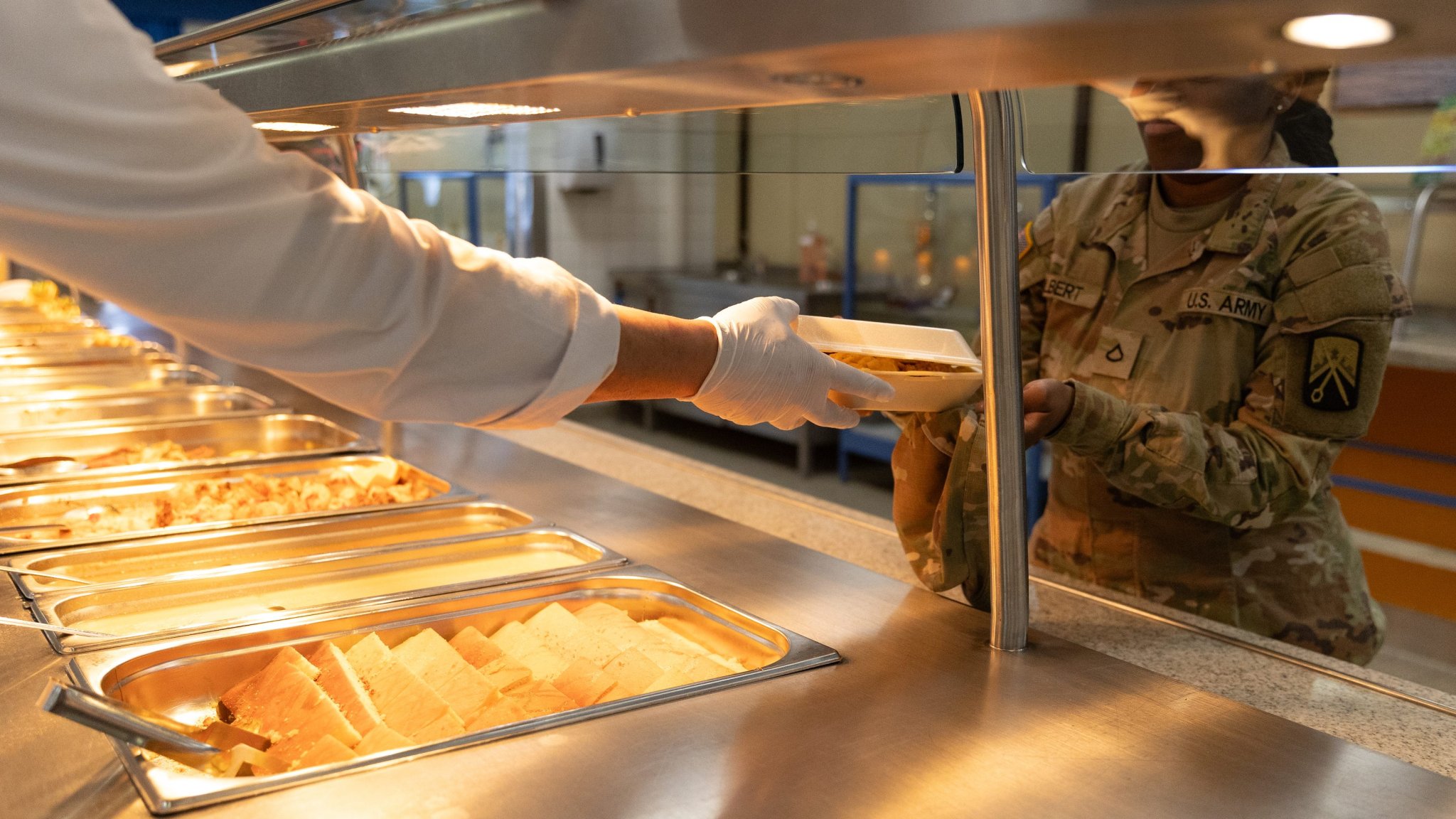
The dining hall in question was at Fort Lee — formerly Fort Gregg Adams — in Virginia, home to the Army Ordnance Corps & Ordnance School. Last week, the Samuel Sharpe Warrior Restaurant received an “F” rating, according to photos obtained by Hots&Cots, an app that junior enlisted troops use to rate barracks and base dining facilities, or DFACs.
Under the military’s food code inspection standards, an “F” rating indicates that the facility is noncompliant and that there is either an “imminent health hazard,” or at least one critical violation that cannot be corrected onsite.
Service members took to the Army Reddit page and other troop-run Instagram pages to discuss the DFAC’s failed rating and alleged that there were outbreaks of E. coli and meningitis on base.
However, Army officials say that the DFAC’s “F” rating was the result of a “damaged pipe, not due to issues with food storage or food preparation.”
DFAC workers reported a pipe leak on Sept. 17 that occurred on the second floor, away from the food preparation areas, Dani Johnson, a Fort Lee spokesperson, told Task & Purpose in a statement. The restaurant was closed for 24 hours to repair the pipe and reopened the next day for dinner. After the repair, the restaurant was reinspected and received a “C” rating. Officials are “[continuing] to improve quality control efforts to verify compliance,” Johnson said.
However, a group of soldiers did fall ill, but the cause is still under investigation at the Kenner Army Health Clinic Public Health, officials said. The soldiers who developed symptoms of food poisoning were students of the Army Quartermaster School who typically use a different DFAC, Johnson said. However, she added that “it has not been determined” where the soldiers ate.
“The trace was inconclusive on where they got ill at because there were no large commonalities,” Johnson said.
Nearly 40 soldiers going through Advanced Individual Training at the Quartermaster School reported symptoms over a week’s time that were “consistent with food-borne illness,” but Johnson said these were not linked to E. Coli. All of the soldiers have been treated, and a contact trace did not find a “specific location or food item” to be “the root cause,” she added.
“There are still pending laboratory results, but everything is negative for agents that cause illness so far,” she said. “We are treating this matter with the utmost seriousness. Currently, there is no risk to base personnel or the community.”
Another soldier attending the Army Ordnance School is currently hospitalized off-post after being diagnosed with Haemophilus influenzae serotype A (HiA). The base conducted contact tracing and gave preventive antibiotics to others who were in close contact with the soldier, officials said.
The bacteria, also referred to as “H. influenzae,” can cause mild infections like ear infections in children and bronchitis in adults, or more serious illnesses like pneumonia or meningitis, according to the Centers for Disease Control.
DFAC issues
As of Wednesday, Google reviews for the DFAC showed a rating of 2.8 out of 5 stars, with many comments complaining about the cleanliness and food quality.
Fort Lee’s dining facility is run by Southern Foodservice Management Inc. In January, officials signed a nearly $47 million contract with the company because of an “emergent need” for dining facility services at Fort Lee (previously Fort Gregg Adams) due to a “disruption” that closed all DFACS on base that month, according to the federal contracting notice.
Company officials were not given authorization to discuss DFAC issues with Task & Purpose.
Rob Evans, founder of Hots&Cots said the handful of DFAC reviews on the app were subpar.
“I’ve heard nothing but negative things about this dining facility from people in my [direct messages],” Evans said, adding that the complaints have been about dirty utensils, bad food, fruit flies and overall cleanliness.
Top Stories This Week
There is no public-facing database for dining facilities or restaurants that fail food safety checks, like in the civilian world. But according to the military’s food code regulation, food managers are supposed to post a sign or placard in the facility “that is conspicuous to customers or by another method acceptable to the regulatory authority.”
The Army’s veterinary food inspection specialists are tasked with inspecting sanitation and health standards at base commissaries, dining facilities, DFACs, exchanges, shoppettes, Child Development Centers, and Family and Morale, Welfare and Recreation clubs.
“An examination of food-borne illness outbreaks among active duty soldiers has found that most cases originate from our food operations and are the result of failure to apply prescribed sanitation standards,” according to an Army presentation on food risk management.
UPDATE: 9/24/2025: This article was updated after publication to clarify that it has not been determined where exactly the soldiers who became ill had eaten.