
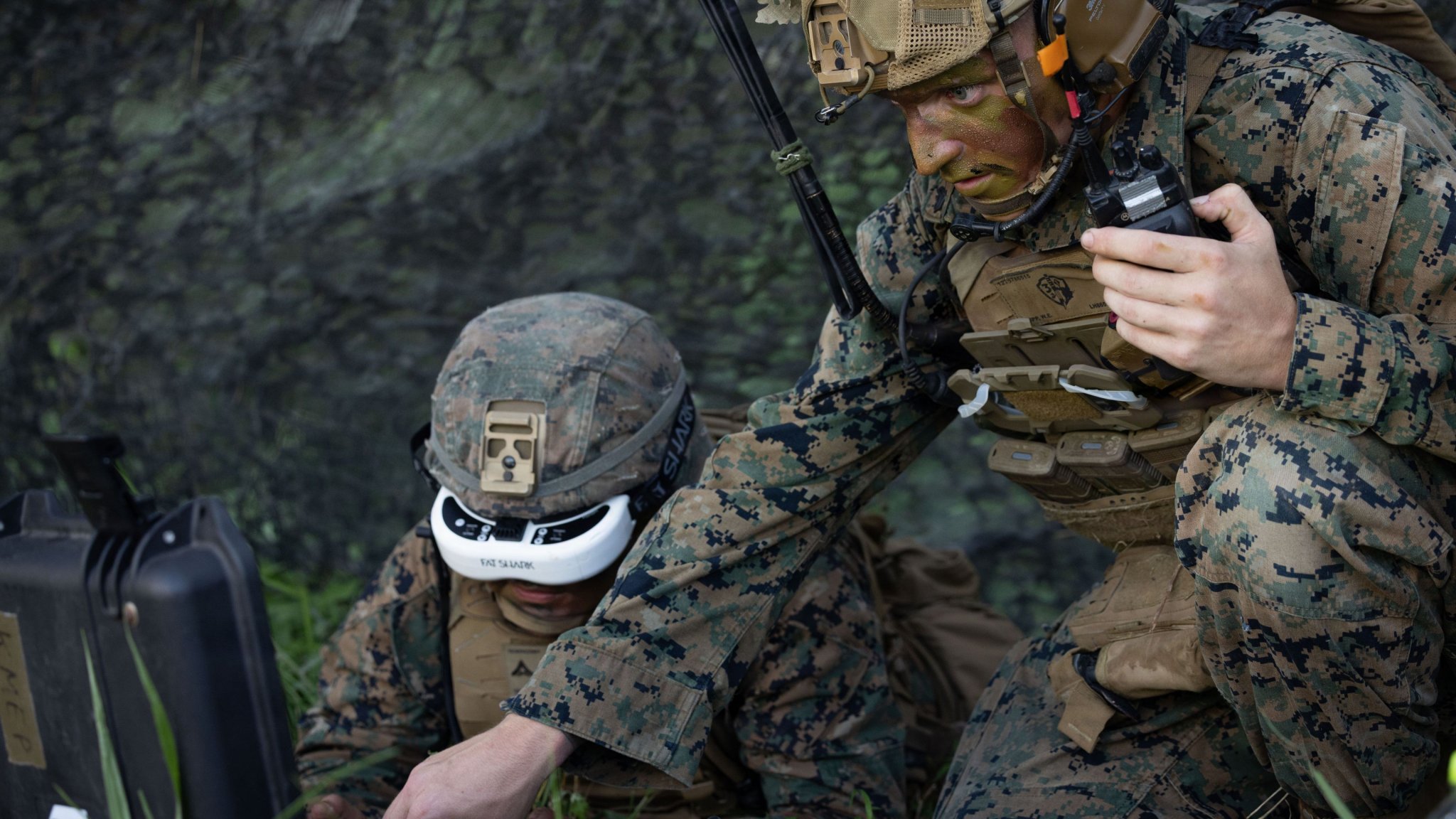
Marines in South Korea carried out their first live-fire tests with new first-person-view one-way attack drones, which give infantry squads the ability to strike enemy positions as far as kilometers away.
On July 30, Marines from the 3rd Light Armored Reconnaissance Battalion conducted one test, while last week on Aug. 5, Marines from 3rd Battalion, 7th Marine Regiment carried out a live-fire test only a few miles south of the demilitarized zone. In both tests, Marines operated Neros Archer drones, a small quadcopter model meant to fly into targets and take them out.
Marines have trained with the Archer drones domestically, but last week’s test on the Korean Peninsula showed how the new technology can play a role in forward-deployed units’ capabilities.
In a release touting the successful live-fire flights, the Marine Corps emphasized how the drones will expand the capabilities of small infantry units. The small drones can let squads of Marines hit a target far away with a small flying explosive. The drone is meant to help Marines take out enemy personnel and armor. Like other FPV drones, the Archer transmits a live video feed to its operator, who watches its path via goggles and controls its flight path.
“Equipping our Marines with FPV attack drones give us a useful tool that provides an additional kinetic option for us to use,” 1st Lt. Evan Brace, a company executive officer with 3rd Light Armored Reconnaissance Battalion, said in the release. “This capability allows units down to the fireteam level to possess organic, precise fires capable of shaping their battlespace.”
Like other branches of the military, the Marine Corps has been working quickly to adapt for drones on the battlefield, both in fielding them and defending them. Last month the Marine Corps said it was setting up two new units to prepare Marines on the ins and outs of drone warfare before deployments.
The successful flights in Korea are also the latest move by Marines in showcasing and expanding their offensive capabilities in the western Pacific. The Marine Corps’ strategy in the Pacific theater has focused on an expected island-hopping campaign, where Marines will have to deal with enemies on land and adversarial ships just off the coast. This summer the Marine Corps moved both the Navy-Marine Expeditionary Ship Interdiction Systems, or NMESIS, and Marine Air Defense Integrated Systems, or MADIS, weapons platforms to Okinawa. The two weapons are meant to target enemy ships and aircraft. FPV drones, meanwhile, are for dealing with smaller ground-based positions.
This month’s FPV drone test is also part of an ongoing push for greater capabilities on the Korean Peninsula. Last fall, the Air Force set up a new drone-based reconnaissance and surveillance force and created a “super squadron” at Osan Air Base, moving nearly three dozen F-16s to the installation.
Loading comments…
Comments couldn’t be loaded. Please refresh the page.